
How a Hydronic Heating System Is Put Together
Straight to it
- A hydronic heating system carries heat in water. Caleffi gives the reason in one line: an equal volume of water carries nearly 3,500 times the heat that air does.
- Seven parts do the work: circulator, expansion tank, air separator and vents, zone valve, aquastat, relief valve and gauges. Every figure below is one manufacturer's own rating.
- Surface area buys low water temperature. Caleffi shows 31 feet of baseboard at 180 degrees F and 111 feet at 120 degrees F each releasing 20,000 Btu/hr.
- Weil-McLain's boiler manual sets the typical cold water fill on a residential system at 12 psi; its user manual tells owners the gauge should not pass 24 psig.
- 2021 IRC M2101.10 tests the piping at one and one-half times design pressure, never below 100 psi, for at least 15 minutes. That is an acceptance test, not a diagnosis.
A hydronic heating system warms water in a boiler, then drives it through a sealed circuit that runs out to radiators, baseboard or floor tubing and returns for another pass. Seven parts do that work. EIA's RECS 2020 counts 9.29 million US homes, 8 percent of the stock, on a steam or hot water boiler. Water carries the heat here, and the charge is never consumed: the same water circulates season after season.
Water, not air
Caleffi's idronics 15 gives the reason a house is piped, not ducted: a given volume of water takes on close to 3500 times the heat that the same volume of air will.
Hydronic means hot water, the water that heats the rooms rather than the tap water a separate appliance serves. Against forced air the trade is quiet steady heat for fast recovery: boiler against furnace.
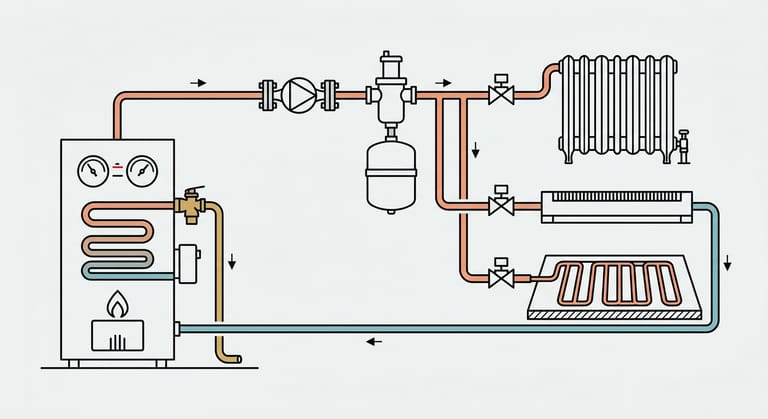
The loop, from the boiler outward
- A thermostat closes its circuit and calls for heat.
- The burner lights, or the elements come alive, and the exchanger passes that heat into the water.
- A circulator pushes it into the supply main.
- Baseboard, radiators or floor tubing release the heat into the rooms.
- Cooled water returns and goes around until the high limit stops the burner.
Expansion tank and relief valve stand off to one side of that current instead of within it. Amtrol gives the tank its job in one line: hold pressure below the point where a safety relief valve would have to open. Inside the boiler itself, the circulator and the aquastat that ends the cycle each get a page of their own.
Seven parts of a hydronic heating system, and the figure each carries
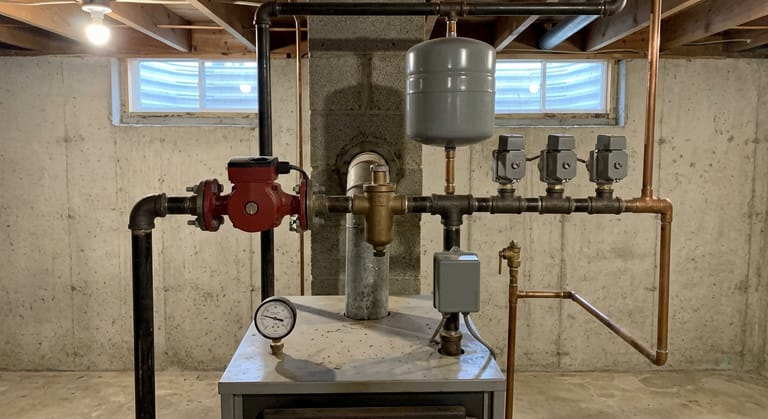
| Part | Job | A published figure |
|---|---|---|
| Circulator | Moves the water | Taco Model 007: 0 to 23 GPM, 0 to 10 ft of head |
| Expansion tank | Absorbs the volume hot water gains | Weil-McLain: charge normally 12 psig on a home system |
| Air separator and vents | Gets air out | Caleffi puts a manual air vent atop each heat emitter |
| Zone valve | Opens one circuit | Resideo V8043: "Open or close in 15 seconds max.", 24 Vac |
| Aquastat, the high limit | Ends the burner cycle | Resideo L8124: high limit adjustable 130 to 240 degrees F, differential 10 degrees F fixed |
| Relief valve | Opens before pressure hurts the vessel | Watts Series 174A: "Standard Pressure Setting: 30psi" |
| Gauges | Show what the system is doing | 2021 IRC M2002.2: pressure and temperature on a hot water boiler |
Those seven are the hydronic heating parts a supply counter means.
One loop or three zones: how the piping is run
Two layouts recur. In a series loop the water runs through every length of baseboard in turn, so the last room gets the coolest water. In a zoned system the piping splits into circuits, each with its own thermostat and a zone valve or circulator. A 3 zone hydronic heating system is three of those on one boiler.
Resideo's submittal calls the common valve two position, normally closed when de-energized. Its manual opener exists for a power failure and reverts to automatic once power returns: a lever left latched over is a familiar reason one zone runs hot for a month.
Pushing one thermostat up and noting which zone warms is owner work, and zone valves, and what a stuck one looks like goes further. Control wiring and the 24 volt transformer are not: (800) 555-0163 reaches a heating contractor who works on boilers, at no charge.
What the water heats, and why surface area sets its temperature
| Emitter | Rating | Conditions it assumes |
|---|---|---|
| Fin tube baseboard | 580 BTU/hr per linear foot | Slant/Fin Fine/Line 30 at 180 degrees F average water, 1 GPM, 65 degrees F entering air, active finned length, 15 percent heating effect factor |
| Cast iron radiator | 340 BTU per section | Governale Gov-Free, 4 by 25 inch section, 180 degrees F water |
| Radiant floor | 10 to 30 Btu/h per square foot | Uponor Table 9-1, residential, 80 to 165 degrees F supply, captioned "not for System Design" |
Caleffi states the principle: "The greater the total surface exchange area of the heat emitters, the lower the required supply water temperature for a given rate of heat transfer." Its own figure: 31 feet of baseboard at 180 degrees F and 111 feet at 120 degrees F each release 20,000 Btu/hr. That is the argument for radiant floor heating, which Caleffi notes runs cooler than fin tube or cast iron.
The emitters are not the boiler: fin tube, cast iron and floor loops are what a room actually feels, and each has a page of its own: hot water baseboard, a baseboard length that stopped heating, cast iron radiators, how radiant tubing is installed and what a baseboard heater replacement involves.
Talk to someone who sees these boilers every week
Call (800) 555-0163Free to dial. Whoever answers works on boilers and holds whatever license or registration your state requires.Partner contractors who work on boilers and hydronic systems- Contractors who work on boilers, not just furnaces
- Answered at 2 a.m. in January
- Dialing costs nothing and books nothing
- The price is the contractor's own, set with you
Hot water or steam in the same basement
A hot water heating boiler is pumped and closed, while a steam boiler makes vapor that climbs to the radiators on its own. Caleffi describes those radiators as sized for low pressure steam at 215 to 220 degrees F, and Governale prints 15 psi steam and 30 psi water as the maximum working pressure of its Victoria radiator. Surging belongs to steam boiler repair.
Air in the loop: why it hurts, and how the system is filled
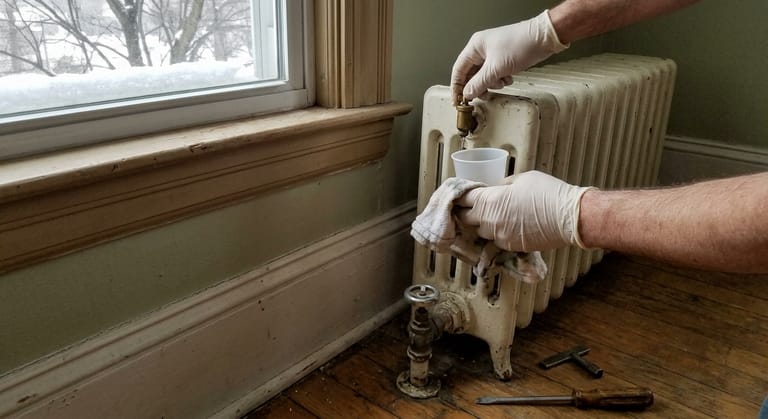
Air inside the loop is a fault, not a nuisance. Caleffi lists seven consequences, among them noise, poor heat transfer where surfaces are not wetted, corrosion from oxygen on ferrous metal, and lost flow behind an air pocket. Its shorthand: "Cool spots on radiators usually indicate entrapped air."
An air separator, an air eliminator in some catalogs, strips air from moving water near the boiler. A manual air vent, which Caleffi describes as worked by screwdriver blade or square key, sits atop each emitter.
Weil-McLain's manual treats 12 psi as the typical cold water fill on a residential system, correct pressure varying with each application, and its user manual tells owners the dial should stay under 24 psig, a higher reading pointing at the tank or at the dial.
Reading that gauge cold and opening a vent on a cold radiator are owner work. Purging the whole system, the fill valve, the relief valve and anything on the gas train or boiler wiring are not: (800) 555-0163 reaches a licensed heating contractor, best called before the heating season starts.
Closed loop, antifreeze and cleaning
The system is sealed, which is the point: Taco sets its balancing valves for flow "through closed-loop hydronic heating & cooling systems", and Raypak warns that automatic make-up water "should be avoided in order to prevent undetected dilution or loss of glycol". An open loop, not sealed from another supply, is a different arrangement.
Antifreeze is manual dependent. Raypak's Tech Corner calls for an inhibited glycol made for heat transfer and keeps automotive antifreeze out, since its silicates tend to gel. Weil-McLain's user manual rules out glycol of any kind for the models it lists, hydronic grades included. Cleaning means a flush, priced by HomeGuide on July 14, 2025 at $150 to $600.
The code behind the pipes
IRC Chapter 21 governs hydronic piping. New or altered work has to pass an acceptance test before it is signed off. M2101.10 in the 2021 edition sets that test hydrostatically: hold the piping at least 15 minutes at one and one-half times the system's maximum design pressure, and never below "100 pounds per square inch". Embedded floor tubing gets longer, M2103.4 in the same edition: 100 psi held 30 minutes.
Is hydronic heating efficient, and what does it cost to keep
Efficiency is measured at the heat source, not along the pipe. DOE's FEMP office defines AFUE as the share of fuel energy a boiler delivers as heat over a year. Federal minimums for boilers made from January 15, 2021 forward are 84 percent AFUE on gas hot water and 86 on oil hot water; ENERGY STAR's Boilers Version 3.0 criteria, Rev. January 2024, ask 90 percent on gas.
HomeGuide's December 31, 2025 page puts a new boiler at $3,200 to $9,000 on average, its July 14, 2025 service page an inspection at $70 to $125. The distribution side rarely goes with it: pipe, baseboard and radiators stay.
What is yours to check, and what is not
Weil-McLain's user manual puts the pressure gauge on the owner, read against that 24 psig ceiling. Watts puts the annual lever test on "the boiler owner", and the conditions come first: a discharge line has to be connected and pitched to a safe place of disposal, and nobody may stand near where it ends, because the lever releases hot water. If no water flows, the valve is inoperative: shut the boiler off and call a plumber.
Cold zones, a climbing gauge, air back week after week: those are diagnoses made in the basement, not on a page. (800) 555-0163 costs nothing, and whoever answers works on hydronic heating systems and holds whatever license or registration your state requires.
Talk to someone who sees these boilers every week
Call (800) 555-0163Free to dial. Whoever answers works on boilers and holds whatever license or registration your state requires.Partner contractors who work on boilers and hydronic systems- Contractors who work on boilers, not just furnaces
- Answered at 2 a.m. in January
- Dialing costs nothing and books nothing
- The price is the contractor's own, set with you