
Where a Boiler Leaking Water Is Actually Coming From
Straight to it
- Start at the gauge, not the puddle. Weil-McLain's manuals call 12 psi the cold fill a home system normally sits at, and tell owners that a reading past 24 psig is out of bounds, with the blame falling on the tank or on the instrument.
- A wet pipe under the safety valve is usually that valve working. In Weil-McLain's EG/PEG Series 6 manual the water boilers ship with a 30 PSI relief valve; Watts lists a standard setting of 30 psi on its Series 174A.
- Nothing is ever capped, plugged or threaded shut on a relief discharge line. Watts prints that the valve exists for an emergency and controls nothing in normal running.
- Parts leaks carry published prices: HomeGuide's July 14, 2025 page lists a circulating pump at $300 to $1,100 and an expansion tank at $200 to $800. No aggregator read here prices a boiler relief valve at all.
- Seepage from the cast iron itself ends the appliance. HomeGuide's December 31, 2025 page puts a new boiler at $3,200 to $9,000 installed, national average $6,100.
A boiler leaking water usually traces to one of six spots, and the gauge narrows the list before anyone picks up a wrench. Weil-McLain's manuals give 12 psi as the usual cold fill in a house and tell owners that a reading past 24 psig points at the expansion tank or at the gauge itself.
This page covers the boiler in the basement, not the domestic water heater beside it.
Six places it shows up, and what each means
Partner heating contractors sort a boiler leaking water by where it lands: the spot decides what follows.
| Wet spot | What it usually means | Do this first |
|---|---|---|
| Pipe below the safety valve | Pressure reached the valve setting, commonly 30 psi | Read the gauge cold and hot |
| Flange bolts or circulator body | A seal or flange joint past its life | Note if it weeps only while the pump spins |
| Threaded joints, unions, nearby valves | Movement, corrosion, an old joint giving up | Dry it, photograph it, check in an hour |
| The cold make-up inlet | The feed valve or its fitting weeping | Watch for the dial climbing on its own |
| Seams or base of the cast iron | The heat exchanger itself is losing water | Stop; this decides repair or replacement |
| Clear plastic tube on a high-efficiency unit | Condensate, normal until its drain blocks | Follow the tube to the end |
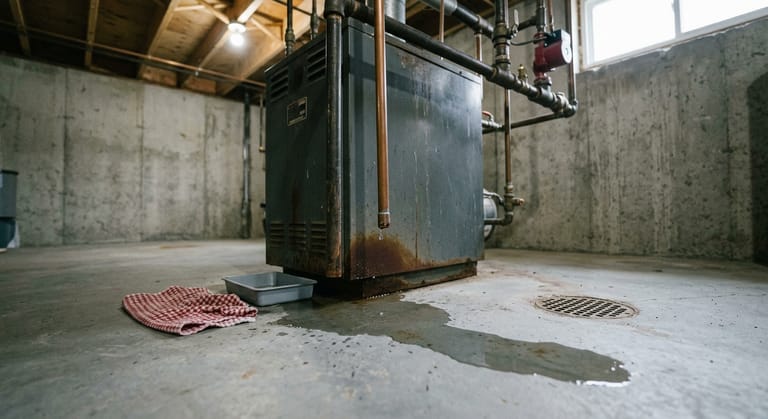
The drip that is the safety valve doing its job
The first row is the most common and least likely to be the valve's fault. Weil-McLain's EG/PEG Series 6 manual ships the water boilers with a 30 PSI relief valve and the steam boilers with a 15 PSI valve. Watts lists a standard setting of 30 psi on the Series 174A, offered in 5 psi increments up to 150 psi. That setting is picked when the valve is bought, never turned up on a dripping boiler.
Watts explains the drip: "As thermal expansion conditions develop, pressure builds up to the setting of the relief valve. This causes discharging of small quantity of water and indicates the relief valve is operating as designed and intended."
Two rules govern that pipe. The 2021 IRC at M2002.4 requires the discharge to fall under gravity into a drain and stop within 18 inches of floor level, or to reach an open receptor, and those 18 inches cap how high the end may sit, not how low. Whichever edition your state adopted is the one with force behind it. ICC's Building Safety Journal adds that the line cannot end in a threaded connection and must terminate where occupants see it.
Reading the dial and photographing the pipe is yours; whether the valve failed or the system pushed it open is bench work. What the gauge and the safety valve say together goes further, and no charge attaches to (800) 555-0163.
Water leaking from the boiler under the circulator
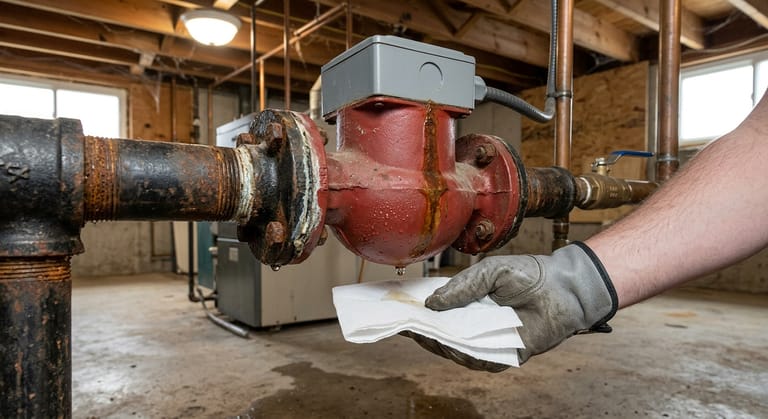
The pump is suspect number two, and in Northeast basements often the first part to go visibly wet. One seeping at the flange leaves a rust-stained trail down the casting, not a puddle from nowhere.
Taco rates the 007-IFC at a maximum working pressure of 125 psi; Grundfos rates the UP 15-42 F/FR at 145 psi maximum system pressure. Both sit far above the 24 psig Weil-McLain gives owners as a gauge limit, so a wet flange points at a worn seal rather than at system pressure. HomeGuide's July 14, 2025 page prices a circulating pump replacement at $300 to $1,100, HomeAdvisor's June 20, 2026 page at $300 to $1,000 all in.
One question before dialing: does it weep only when the pump runs? The junction box on top is boiler wiring, where a homeowner stops. The model off the tag saves a trip, and what an annual boiler service covers catches this early.
When a waterlogged expansion tank is the real reason
If the safety valve keeps letting go, the tank is usually why. Amtrol puts its job plainly: a tank exists so that pressure never climbs to the point where a safety relief valve has to lift. Weil-McLain's service section reads the same symptom the same way: a valve that weeps again and again is usually reporting a tank that waterlogged or was sized short. The 2021 and 2024 IRC at M2003.1 require hot water boilers to be provided with expansion tanks for that reason.
An expansion tank runs $200 to $800 on HomeGuide's July 14, 2025 page and $200 to $550 for a gas unit on HomeAdvisor's June 20, 2026 page. Log how often the valve lets go and what the dial reads; charging and swapping a tank is contractor work, and how a waterlogged tank is diagnosed has the detail. The call costs nothing.
Talk to someone who sees these boilers every week
Call (800) 555-0163Free to dial. Whoever answers works on boilers and holds whatever license or registration your state requires.Partner contractors who work on boilers and hydronic systems- Contractors who work on boilers, not just furnaces
- Answered at 2 a.m. in January
- Dialing costs nothing and books nothing
- The price is the contractor's own, set with you
Seepage from the cast iron is a replacement conversation
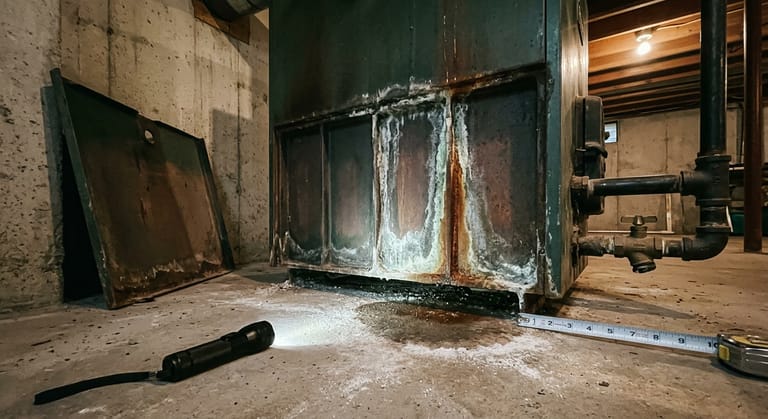
The fifth row is the expensive one. Weeping from the seams or base of the block is not a fitting, and no gasket kit brings it back. It lands on old equipment. EIA's RECS 2020 counts 6.01 million Northeast homes on steam or hot water heat. A separate row counts 6.79 million Northeast homes whose main heating equipment, of any type, is 20 or more years old.
Age, fuel and the old piping decide the road, and what a replacement boiler costs installed works through it. Find the rating plate, note the model and year, and stop topping a leaking block up. Calling costs nothing.
Why is my condensing boiler leaking water
A high-efficiency unit makes moisture on purpose: flue gas cools below its dew point inside the heat exchanger and the condensate drains through a small plastic tube, where people find a drip and assume the worst. It shows at a drain line or a condensate pump, not at a casting or a flange.
Trouble starts when the path blocks. HomeGuide's December 31, 2025 page lists installing a condensation drain for high-efficiency models at $200 to $600. No manual read for this page puts a flow rate on residential condensate.
Follow the tube and look for standing liquid at its end. Venting, ignition and the gas train are licensed work; the free line reaches someone who services them.
A new boiler leaking water, and a drip that runs brown
A recent installation puts the installing contractor first, not a repair call. New work is proved before sign-off: the 2021 IRC at M2101.10 has hydronic piping tested hydrostatically at fifty percent above the system's design pressure, never below 100 psi, for a quarter hour. That is an acceptance test, not a diagnostic for a running system.
Color is the second question. Nothing in the codes, manuals or agency material read for this page grades hydronic water by color, so treat brown as a hint about age and iron in a closed loop, not a diagnosis.
What to do when the boiler is leaking, in order
- Read the gauge, write the number down. Weil-McLain's 12 psi cold fill and 24 psig ceiling are the reference. Note it cold and again after a burn.
- Find the wet spot, not the puddle. Dry everything, wait an hour, look for the first drop.
- Stop the system asking for heat. Turn the thermostat down, then kill the boiler at its service switch if you can reach it from a dry floor with dry hands. If water has reached the switch or the boiler's wiring, leave both alone and make the call.
- Leave the discharge pipe alone. Nothing is capped, plugged or tied off, and no valve gets forced.
- Think about the cold. Weil-McLain's user manual warns that outages and failed boiler components in cold weather can mean frozen plumbing and water damage "in a matter of hours." A January shutdown means same-day help.
- Call with facts in hand. Model, age, fuel, both gauge readings, which spot is wet.
Five minutes on the phone beats a guess: (800) 555-0163 is free, and the contractor on the other end sees these systems weekly. If the heat is off too, what to do when a boiler stops working comes first.
When a leak stops being a plumbing question
Weil-McLain's danger notice is absolute. A boiler whose body, burner or controls have been sprayed down or left standing in water does not run again as it is: the choice is a new appliance, or a full repair with an inspection behind it. If wiring or an electrical component has, or is suspected to have, met water, the same manual says replace the boiler. ESFI is blunter: never touch submerged electrical equipment, since it may still be energized.
On a carbon monoxide alarm, CPSC says get everyone out to fresh air first, then call 911 or the fire department, check that everyone is accounted for, and stay outside until responders say it is safe. On a smell of gas, PHMSA's own list starts with closing every gas appliance down and getting clear, with the 911 call placed from well away and a warning to anyone nearby where that is safe. Nothing inside gets started, struck or switched: no engine, no match, no light switch or phone. Those are emergency calls, not appointments.
Talk to someone who sees these boilers every week
Call (800) 555-0163Free to dial. Whoever answers works on boilers and holds whatever license or registration your state requires.Partner contractors who work on boilers and hydronic systems- Contractors who work on boilers, not just furnaces
- Answered at 2 a.m. in January
- Dialing costs nothing and books nothing
- The price is the contractor's own, set with you