
Boiler Not Working? Four Causes, Checked in Order
Straight to it
- Four causes, in the sequence a heating pro rules them out: nothing is calling for heat, nothing has power, the gauge sits under its cold fill mark, or the burner will not light. Free to expensive, and the first two belong to the homeowner.
- Read the gauge before phoning anyone. Weil-McLain's CGa Series 3 manual states the typical cold water fill pressure for a residential system as 12 psi, while Weil-McLain's user manual will not have a water boiler reading past 24 psig.
- No manufacturer document names a normal hot running pressure. The span between the 12 psi cold fill and the 24 psig owner ceiling is genuinely unpublished, so any site quoting 18 to 20 psi is guessing.
- Cause four is licensed work. The 2021 and 2024 IRC, at M2001.1.1, put ASME CSD-1 over the controls and safety devices of boilers with fuel input ratings of 12,500,000 Btu/hr or less.
- A rotten egg smell or a sounding carbon monoxide alarm ends the checklist. CPSC's instruction is to get out into open air and call 911, not to go looking for the source.
A boiler not working in winter usually comes down to four things, checked in this order: no call for heat, no power, low pressure, or a burner that will not light. The first two take a minute. Cold fill on a residential hot water system is 12 psi, called typical in Weil-McLain's CGa Series 3 manual.
This is the heating boiler, not the water heater beside it.
Check 1: something has to be calling for heat
Push the setpoint five degrees above the room and listen. A dead screen is usually dead batteries; a lit screen with silence below means the call is dying before the boiler hears it. Note the hour heat was last working.
If the thermostat is working and the basement stays quiet, (800) 555-0163 is free.
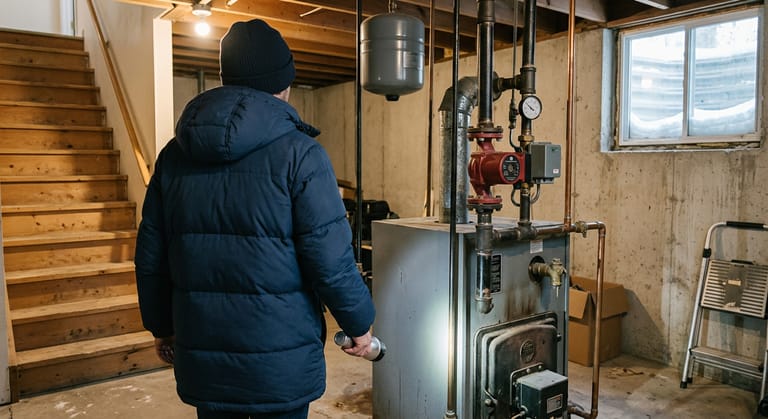
Check 2: power, the service switch and a tripped limit
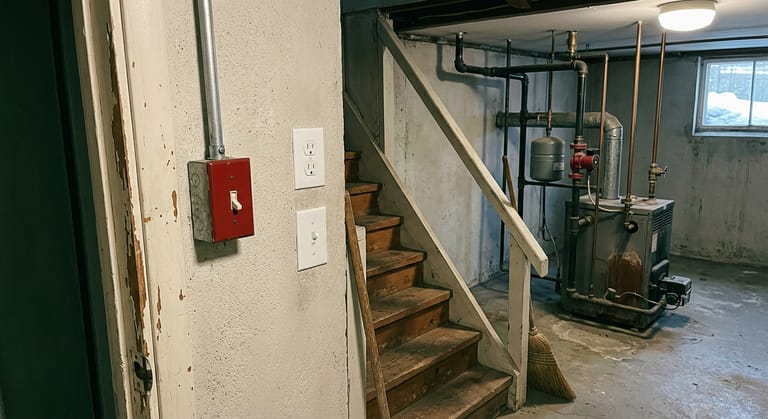
Two switches come first: the breaker, and the toggle at the top of the basement stairs.
Resideo describes the aquastat relay as an immersion type hydronic controller combining high limit protection with relay control of burner and circulator motors, so one tripped limit silences flame and pump together.
Resideo's L8124 data sheet gives that family a 130 to 240 degrees F adjustable high limit with a fixed 10 degree F differential, set by the boiler manufacturer's recommendation in its L8148 literature. That dial is set by the installer, not turned by the homeowner when the heat quits. Its L7224 adds an anti short-cycle delay up to five minutes, so a silent control may be working through it. More in how the aquastat runs the burner.
Check 3: read the gauge before anyone quotes a price
The 2021 IRC, at M2002.2, has every hot water boiler carry a pressure gauge and a temperature gauge reading within the system's normal operating range.
Weil-McLain's CGa Series 3 manual gives 12 psi as the typical cold water fill for a residential system, and says correct pressure varies with each application. Its user manual sets a ceiling instead: 24 psig at the gauge, or 15 psig on steam, waterline halfway up the glass, both assuming a gauge in working order.
A gauge that keeps sinking says water is leaving the system, often in plain sight: where a boiler leaks and what each spot means. Climbing pressure with a dripping valve is the other direction, which Weil-McLain's CGa manual ties to a waterlogged or undersized expansion tank: the relief valve and the tank behind it. Weil-McLain rates that CGa line at 50 psig ASME working pressure.
Photograph the gauge before dialing: it is the first figure a licensed heating contractor asks for at (800) 555-0163.
Talk to someone who sees these boilers every week
Call (800) 555-0163Free to dial. Whoever answers works on boilers and holds whatever license or registration your state requires.Partner contractors who work on boilers and hydronic systems- Contractors who work on boilers, not just furnaces
- Answered at 2 a.m. in January
- Dialing costs nothing and books nothing
- The price is the contractor's own, set with you
Check 4: the burner will not light, and that is licensed work
On gas the suspects are the boiler's own gas valve, ignitor and flame sensing; on oil, the nozzle, electrodes and the primary control with its reset button. That reset is not a restart: press it once, and if the burner will not stay lit, call a technician. More in what keeps an oil boiler working through a winter.
IRC M2001.1.1, in the 2021 and 2024 editions, puts ASME CSD-1, now in its 2024 edition, over the controls and safety devices of boilers with fuel input ratings of 12,500,000 Btu/hr or less.
The same July 14, 2025 HomeGuide table prices an ignitor at 100 to 400 dollars and a gas valve at 200 to 900. A burner that lights rough is banging, kettling and rumbling, and (800) 555-0163 books the visit.
No heat but the boiler is running
Flame lit, supply pipe hot, rooms cold: heat is being made and not moved. A boiler not working in that sense has three suspects.
- Compare the supply pipe against the return, a brief touch with the back of the fingers and nothing more, because that piping runs at water temperature, 180 degrees F and up. Hot out and cold back means the burner is working and the water is not.
- Look for a zone valve lever left in the manual position. Resideo's V8043 submittal notes a manual opener for power failures, with the valve back to automatic once power returns.
- Count cold zones. One is a valve or a loop; all of them, with a hot supply pipe, is the pump.
Those valves swing open or shut inside 15 seconds at most on Resideo's rating, so a cold zone is not a timing problem. A humming pump that moves no water runs 300 to 1,100 dollars on that same HomeGuide table: circulator pumps that stall or scream. Single cold rooms point to a radiator that will not heat.
Those two checks and counting zones are free. Whether the parts past them are in working order is a contractor's call at (800) 555-0163.
A gas smell or a CO alarm ends the checklist
Both are exits, not diagnostic steps.
What not to touch while the house cools
A boiler not working overnight puts the house on a clock. Weil-McLain's user manual warns that power outages or boiler component failures in cold weather can end in frozen plumbing and water damage "in a matter of hours." These calls do not wait for morning in the Northeast, where EIA's RECS 2020 counted 6.01 million homes on steam or hot water heat.
Leave the relief valve alone, and leave its outlet open. Watts states that its 174A series exists to dump pressure in an emergency and may not be used to regulate a system. The 2021 IRC at M2002.4 has that discharge drop under gravity to a drain or open receptor, ending no higher than 18 inches off the floor.
No water into a hot, dry system, no repeated oil resets, no running a unit that has been wet because it was working yesterday. The annual boiler service sets out what a technician does, and costs less before winter. When the safe checks run out, (800) 555-0163 is free.
Talk to someone who sees these boilers every week
Call (800) 555-0163Free to dial. Whoever answers works on boilers and holds whatever license or registration your state requires.Partner contractors who work on boilers and hydronic systems- Contractors who work on boilers, not just furnaces
- Answered at 2 a.m. in January
- Dialing costs nothing and books nothing
- The price is the contractor's own, set with you