
What an Oil Boiler Costs to Buy, Burn and Keep Running
Straight to it
- Installed price: $4,800 to $9,000 with a $7,500 average on Fixr's oil page of January 26, 2026. HomeAdvisor's fuel table of June 20, 2026 prints the same range. HomeGuide splits the job by class instead, $3,300 to $7,200 standard and $6,300 to $9,000 high efficiency.
- Federal floor: 86 percent AFUE heating water, 85 percent making steam. The table at 10 CFR 430.32(e)(2)(iii)(A) applies those levels by date of manufacture, January 15, 2021 onward, so the data plate decides and the installer does not.
- Fuel is the recurring bill. In EIA's monthly series the US residential average held at $3.693 a gallon through December 2025 and January 2026; its weekly series ended the season at $5.535 on March 30, 2026, in a quarter that took Brent crude from $61 a barrel to $118.
- The tank is its own invoice every time: $1,200 to $4,600 for a new one, $400 to $3,400 to pull the old one, and remediation adds $2,500 to $15,000 or more where a buried tank leaked.
- Converting to gas is a project, not a swap: $6,000 to $20,000 for most homes on HomeGuide's December 30, 2025 page, burner, chimney liner and old tank each priced apart.
An oil boiler costs $4,800 to $9,000 installed, Fixr's range on its January 26, 2026 page against a $7,500 average. The federal floor for a hot water model made from January 15, 2021 onward is 86 percent AFUE, and the yearly burner visit runs $150 to $500 with parts and labor (HomeGuide, July 14, 2025).
The machine, and where this page stops
This is hydronic heat: water warmed in the cellar and sent to radiators, baseboard or floor tubing. ENERGY STAR scopes the appliance as self-contained and fuel burning, under 300,000 Btu per hour, water at or below 250 degrees F and 160 psig. An oil furnace blowing warm air through ducts is another machine, and electric baseboard is wired heat rather than hydronics, so an electrician owns it.
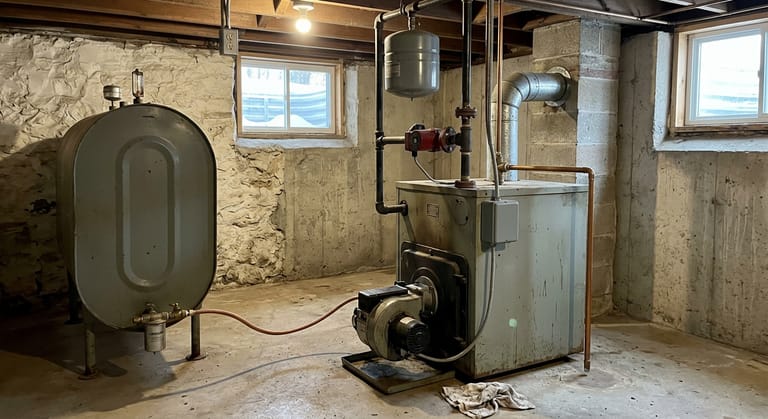
The fuel adds a supply chain: a tank, a line filter, a burner with its own motor and pump, a nozzle atomizing the spray, and the primary control that governs the sequence. Circulator, expansion tank and relief valve are as on any boiler.
Who still heats this way
ACS 2024 counted 3,844,459 occupied Northeast units on fuel oil or kerosene, against 203,612 in the Midwest; it measures fuel and never equipment, so some of those homes run an oil furnace. Maine is the extreme, fuel oil heating 50.3 percent of its occupied homes, and NOAA's 1991-2020 normals put Portland International Jetport there at 6,795.2 heating degree days, base 65 degrees F. EIA places about 82 percent of US heating oil households in the Northeast Census Region, winter 2023-24.
What a new oil boiler costs
Three national cost publishers price this work, each with its own scope and date.
| Source and date | Scope | Printed figure |
|---|---|---|
| Fixr, January 26, 2026 | Installed, national | $4,800 to $9,000, average $7,500; non-condensing $4,000 to $8,000, condensing $6,000 to $11,500 |
| HomeAdvisor, June 20, 2026 | Oil row of its fuel table | $4,800 to $9,000 |
| HomeGuide, December 31, 2025 | By class, then unit alone | $3,300 to $7,200 standard, $6,300 to $9,000 high efficiency, $1,700 to $6,500 appliance only |
A small oil boiler in a ranch and a condensing model on four zones sit at opposite ends of those rows, so the number follows a site visit. Permits and removal are priced in what a replacement costs; condensing gear brings venting and drainage rules to high efficiency systems.
The 86 percent floor, and the label
ENERGY STAR asks one point more, 87 percent AFUE, in Boilers Eligibility Criteria Version 3.0, a specification in force since October 1, 2014 and revised in January 2024. EPA's own comparison is that certified oil boilers are "approximately 1% more efficient than the federal standard": one point of a rating, not a line on a delivery bill.
The EnergyGuide sticker puts a model on that scale: the oil range of comparability, published October 12, 2022 at 87 FR 61475, runs 85 low to 88.2 high, revised ranges due in 2027. Two provisions of 16 CFR 305.20 matter here. A multi-nozzle boiler carries the AFUE of its lowest-rating nozzle setup, and one that can be piped either way takes its label from the hot water test, so a unit run as steam delivers less than its rating.
Talk to someone who sees these boilers every week
Call (800) 555-0163Free to dial. Whoever answers works on boilers and holds whatever license or registration your state requires.Partner contractors who work on boilers and hydronic systems- Contractors who work on boilers, not just furnaces
- Answered at 2 a.m. in January
- Dialing costs nothing and books nothing
- The price is the contractor's own, set with you
What the fuel costs, October to March
| Month | US average residential heating oil |
|---|---|
| December 2025 | $3.693 a gallon |
| January 2026 | $3.693 |
| March 2026 | $5.126 |
New England paid $5.578 that same week against $4.491 in the Midwest. EIA collects these prices only October through March, so March 30 stands until October 2026.
Service, the burner trade and the tank
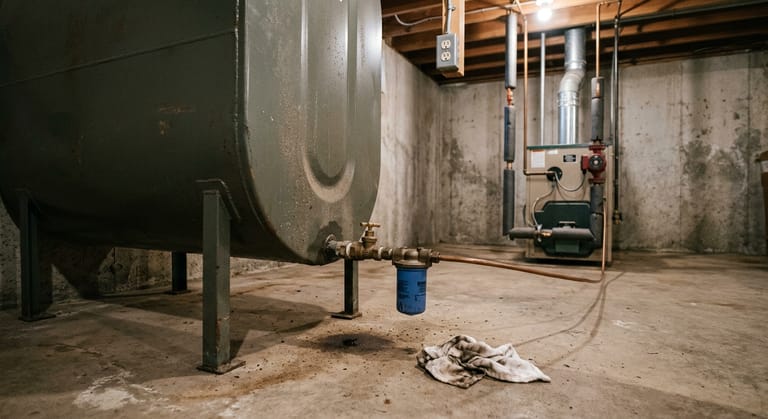
CDC puts every fuel-burning appliance on a yearly service by a qualified technician, and CPSC asks the same of the heating system. Neither prints a checklist. Price separates by fuel: HomeGuide's July 14, 2025 table puts oil boiler service at $150 to $500 with parts and labor against $100 to $400 for a gas boiler.
The tank carries its own money, in scopes that never reduce to one number.
- New tank. $1,200 to $4,600 (HomeGuide, December 31, 2025).
- Removal. $400 to $2,800 above ground, $800 to $3,400 underground (HomeGuide, December 30, 2025).
- Contaminated soil. Remediation adds $2,500 to $15,000 or more (same page).
Who may open the burner
Who may open the burner is a state question. Massachusetts issues an Oil Burner Technician Certificate, covering the service, installation and repair of oil burners that burn fuel oil and associated equipment, on an exam of five subjects from 527 CMR 1.00 to automatic, pneumatic and electronic controls, at $75 for the certificate and $50 every two years to renew. New York City licenses oil-burning equipment installers by class, Class A for any oil-burning equipment and Class B for equipment using "domestic grade fuel oils from one to four".
Your share between visits is short and free: read the pressure gauge against the ceiling printed in your manual, check that the thermostat is calling and the service switch is on, test the CO alarm monthly as CPSC asks.
Past that, nozzle, electrodes, pump and burner motor are instrumented work for a licensed technician, and kettling or banging comes off the water side, taken apart in what those noises mean. A call to (800) 555-0163 is unbilled, and the contractor picking it up works on boilers and holds whatever license or registration your state requires; the service checklist is on what a boiler service covers, and the order of checks on an oil boiler that will not fire is in a boiler that will not run.
A carbon monoxide alarm outranks every appliance in the house. CPSC's instruction is to stop looking for the source: everyone outside into clean air, 911 phoned from the road, a count of the household, no re-entry before responders say so. Where the culprit turns out to be a malfunctioning appliance, CPSC's rule is no further operation until a properly trained service technician has dealt with it.
Weil-McLain oil boilers and their manuals
The Weil-McLain manuals read for this page are its gas-fired lines (CGa Series 3, EG/PEG Series 6 and the user manual that covers them), so on a Weil-McLain oil boiler the governing paper is that model's own manual and data plate. What carries across is water-side discipline.
Its manual puts one relief valve task in the owner's hands, at least monthly through the heating season: with a discharge line connected and nobody near its outlet, at operating pressure, hold the test lever fully open five seconds or more to flush the seat free of sediment, then release it and let the valve snap shut. Hot water comes out, so this is never done on a bare valve. If no water flows, valve maker Watts calls that valve inoperative: turn the boiler off and call a plumber immediately.
The manufacturer requires that line to be metal, run out to a spot where the water is harmless, terminated where a discharge cannot scald and installed by a qualified heating installer or service technician. Deeper than that is not an owner job: the manual's reinspection, at least once every three years, goes to a licensed plumbing contractor, or to an inspection agency with authority, not the owner.
Weeping afterwards is a message. The maker splits the cause by boiler type: an expansion tank that has stopped working on a water boiler; on a steam boiler, a limit control sitting too high, or other system faults. Both end with a qualified service technician called immediately. That is the honest answer when a Weil-McLain oil boiler is leaking water at the valve; other leak points are in where a boiler leak starts.
Oil to gas conversion, arithmetic first
Converting brings four or five invoices. HomeGuide's December 30, 2025 page puts most homes between $6,000 and $20,000: $6,000 to $12,000 where gas already reaches the property, $12,000 to $20,000 where a line has to be brought in. Inside that, the new gas boiler or furnace is $3,500 to $12,000, a chimney liner $1,500 to $4,000 and up, pulling the old equipment $500 to $3,000 and up, labor 20 to 30 percent or more of the whole. The tank still goes, at the prices above.
Piping in the walls is a licensed gas fitter's trade, not this page's subject; what happens inside the replacement is on gas-fired boilers and their fuel train. Federal credits and utility programs exist, at amounts that move too often to belong here.
After a changeover the appliance is a gas appliance. PHMSA's emergency list for the rotten egg odor rules out ignition first: no light switch, no garage door opener, no phone used indoors. Leave the area without starting an engine of any kind, dial 911 once you have reached another building, and keep others out if that is safe.
There is no best oil boiler, only a right-sized one
Rankings sell equipment. Sizing decides whether a boiler short-cycles for twenty winters, and a Manual J calculation costs $200 to $500 (HomeGuide, December 31, 2025), the cheapest line on the sheet. RECS 2020 counted 4.02 million steam or hot water homes built before 1950, insulated and reglazed many times since, so an old nameplate describes a heat loss the building no longer has.
Two things outrank the badge. The label is one: retailers must show the EnergyGuide and let a buyer read it before any agreement to purchase, under 16 CFR 305.22(b)(2), so ask, then set the model's AFUE against that 85 to 88.2 scale. Parts are the other: a make nobody nearby stocks parts for means a cold weekend. Brand specifications, no ratings and no reviews, are on how the brands compare.
Zone count, emitter type, house age and fuel are what a first call needs. Nobody is billed for it at (800) 555-0163, and any figure that follows is the contractor's own.
Talk to someone who sees these boilers every week
Call (800) 555-0163Free to dial. Whoever answers works on boilers and holds whatever license or registration your state requires.Partner contractors who work on boilers and hydronic systems- Contractors who work on boilers, not just furnaces
- Answered at 2 a.m. in January
- Dialing costs nothing and books nothing
- The price is the contractor's own, set with you