
Weil-McLain and Four Other Boiler Brands, Read as Specifications
Straight to it
- One construction standard sits under all of them: the 2021 and 2024 IRC, at M2001.1.1, send boiler construction to the ASME Boiler and Pressure Vessel Code, Section I or IV.
- The only cross-brand number with a legal definition is AFUE on the EnergyGuide label, and federal rules make manufacturers post that label on a public website.
- Federal floors bind by build date: 84 percent AFUE gas hot water and 82 gas steam, on equipment carrying a build date of January 15, 2021 or later.
- Manuals, not badges, carry the operating numbers. Weil-McLain rates the CGa Series 3 for 50 psig working pressure and puts the typical residential cold fill at 12 psi.
- Who may legally touch it changes at the state line, from an S-3 license in Connecticut to a three-year oil burning equipment installer license in New York City.
A Weil-McLain boiler is read from its own manual, not from a rating: the CGa Series 3 is ASME rated for 50 psig and ships a 30 PSIG relief valve. The same maker treats 12 psi as a usual cold fill in a house, varying with the application. Five names appear below and none is scored here.
One construction standard sits under all five names
The 2021 and 2024 IRC, at M2001.1.1, hand the vessel itself to ASME: designed, built and certified to Section I or IV, and send the controls on to ASME CSD-1, 2024 edition. The governing edition is the one your state adopted.
ASME BPVC Section IV, 2025 edition, covers construction of heating boilers and the H, HV and HLW certification marks; the National Board's NBIC, 2025 Edition, takes over once equipment is in service.
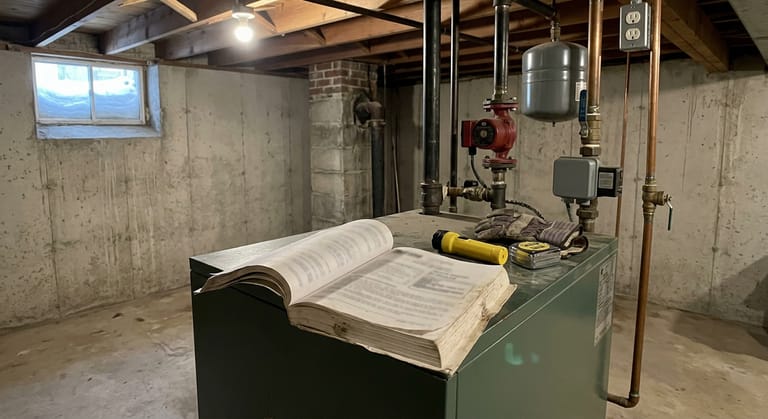
The one number that puts two makers on the same scale
That number is AFUE. The EnergyGuide tag carries two things: the model's own AFUE, and a range of comparability spanning the lowest and highest rating for that type.
| Type on the label | Range of comparability |
|---|---|
| Gas, other than steam | 84 to 96.4 |
| Gas steam | 82 to 83.4 |
| Oil | 85 to 88.2 |
| Electric | 100 to 100 |
Those spans were adopted at 87 FR 61475 on October 12, 2022, with revised ranges due in 2027. One quirk: a unit set up as either steam or hot water is labeled from the hot water test, so the tag flatters a steam install.
You can pull any model's label yourself. Under 16 CFR 305.22, manufacturers must post the EnergyGuide label on a public website and keep it there six months after that model stops being built, and retailers must let you read it before you buy.
ENERGY STAR asks 90 percent AFUE for a certified gas unit and 87 for oil, under Eligibility Criteria Version 3.0, revised January 2024. The floors underneath bind manufacturers by build date: 84 percent gas hot water and 82 gas steam, on equipment carrying a build date of January 15, 2021 or later. The condensing class is on high efficiency systems.
What a Weil-McLain boiler manual actually prints
Three Weil-McLain documents and one Utica manual sit behind this table.
| Specification | Figure as printed | Document |
|---|---|---|
| ASME working pressure | 50 psig | Weil-McLain CGa Series 3, ratings |
| Relief valve shipped as trim | ASME, 30 PSIG, 3/4 inch male inlet | CGa Series 3, parts figure |
| Cold fill pressure | 12 psi typical, varying with the application | CGa Series 3, filling |
| Relief valve by service | 30 PSI on water, 15 PSI on steam | EG/PEG Series 6, standard equipment |
| Maximum limit setting | 220 degrees F water, 10 PSI steam | EG/PEG Series 6, start-up checklist |
| Owner gauge ceiling | Not above 24 psig water, 15 psig steam | Weil-McLain user manual, daily checks |
Weil-McLain gas boiler maintenance, as the manual schedules it
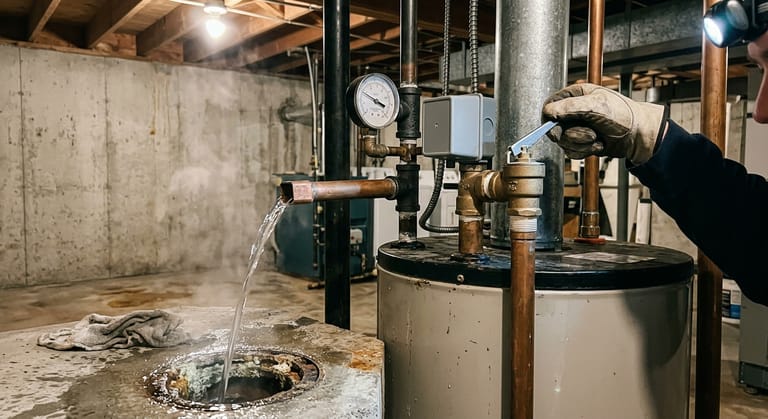
Weil-McLain wants the relief valve tested monthly through the heating season, and two things come before the lever. A discharge line has to run from the valve outlet to a safe termination, piped by gravity to a drain under IRC M2002.4, and nobody may stand near that outlet: the test dumps hot water at operating temperature.
Only then the test itself. At running pressure, hold the lever wide for a full five seconds and let it snap closed. If no water flows, Watts calls the valve inoperative: shut the boiler off and call a plumber immediately. If it keeps dripping afterward, that is a service call, not a second try.
- Monthly: that lever test, and a look at the gauge against the 24 psig water ceiling.
- Monthly on steam: Utica has the low water cut-off checked for proper protection, and has the probes pulled before each heating season for inspection and cleaning, a technician's job, not the owner's.
- At every steam fill, Weil-McLain: water halfway up the gauge glass, pH 7.0 to 8.5, then skimming.
- Never the owner's job: Weil-McLain recommends safety relief valves be reinspected at least once every three years, by a licensed plumbing contractor or an authorized inspection agency. That is the maker's minimum, not a code interval, and not a task for the owner.
Flushing is priced by scope, not badge: HomeGuide's July 14, 2025 page puts a flush and descaling at $150 to $600, and an annual gas boiler service (tune-up, cleaning and repairs) at $200 to $500. More is on the annual service call.
A relief valve is never plugged, capped or leaned on. Watts states it plainly for the 174A series: the valve exists to relieve an emergency and was never meant to regulate anything. The IRC at M2002.4, in the 2021 and 2024 editions, has the valve set at the maximum rating of the boiler, with the discharge falling by gravity to a drain and ending no more than 18 inches above the floor, or into an open receptor. A valve that keeps discharging is licensed work, on site.
A Weil-McLain boiler leaking water, and short cycling
Weeping at the relief valve usually points elsewhere. Weil-McLain has the technician rule out the system before condemning the part, since a waterlogged or undersized expansion tank drives pressure up and the valve is only doing what it was built to do. Amtrol prints the mirror image: a drip after a restart may mean a tank too small or wrongly charged.
Weil-McLain also warns against automatic air vents on closed-type tanks: air escapes instead of returning, the tank waterlogs and stops controlling pressurization, and the valve weeps. On a diaphragm tank the same manual has it removed and the charge read, 12 psig being the usual figure in a house; Amtrol warns a pre-charge reads true only on an isolated, empty tank, and puts the yearly check on a professional plumber. The trail runs through the expansion tank and where the water is coming from.
Short cycling has no brand-level answer: no manufacturer document read here names a single cause, only the settings that shape a cycle. Resideo publishes a high limit adjustable from 130 to 240 degrees F on one aquastat relay family, and in a second family's manual declines to pick a number: the boiler maker's own recommendation is the setting to follow. Banging and kettling get their own trail in the noises a system makes.
Yours to check: that the thermostat calls, that the switch and breaker are on, what the gauge reads cold, whether the valve drips. Stop at the fuel train, the ignition side and any limit inside the jacket. (800) 555-0163 is free to call, and a licensed heating contractor answers it.
Talk to someone who sees these boilers every week
Call (800) 555-0163Free to dial. Whoever answers works on boilers and holds whatever license or registration your state requires.Partner contractors who work on boilers and hydronic systems- Contractors who work on boilers, not just furnaces
- Answered at 2 a.m. in January
- Dialing costs nothing and books nothing
- The price is the contractor's own, set with you
Weil-McLain boiler replacement parts, and the documents behind them
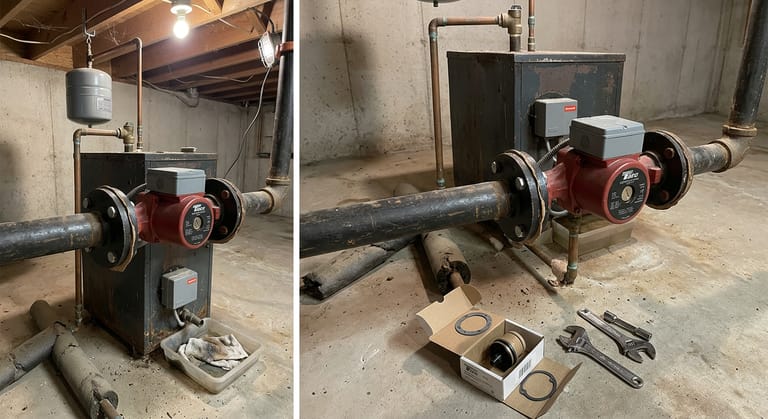
Weil-McLain lists the CGa Series 3 relief valve as an ASME 30 PSIG unit with a 3/4 inch male inlet, part number 383-500-095, and the component classes around it carry their own sheets: Watts on relief valves, Resideo on aquastats, Amtrol on expansion tanks, Taco and Grundfos on circulators, McDonnell & Miller on low water cut-offs. Which of them sits inside a given boiler is answered by that model's parts list.
Component sheets are precise where brand pages are not: Taco prints 0 to 23 GPM and 0 to 10 feet of head for the 007 cartridge circulator, 0 to 17 GPM and 0 to 8.5 feet for the 007-IFC. Two pumps, not one range. HomeGuide's July 14, 2025 repair table puts a circulating pump at $300 to $1,100 and an expansion tank at $200 to $800, and no aggregator read here prices an aquastat at all. Pump symptoms sit on the circulator.
Lochinvar: the questions searches ask, and where they land
Queries around a Lochinvar boiler carry a second word: condensing, cost, noise. A search for a Lochinvar Knight condensing boiler asks for one data sheet: pull the label the maker keeps online, then the manual for relief valve setting and venting.
Cost tracks the class, not the badge: HomeGuide, December 31, 2025, separates standard equipment at 80 to 89 percent AFUE, $2,200 to $7,000 replaced, from high-efficiency equipment at 90 to 95 percent and up, $4,000 to $10,000. Nothing read here ties a Lochinvar boiler vibrating in a basement to its badge. The nearest documented ground is Caleffi's list of what air does in a hydronic system: noises in the piping and emitters, poor flow when a circulator handles water mixed with air.
Navien: pressure, flushing and where the combi line sits
A Navien boiler pressure question has a general answer and a specific one: Weil-McLain puts a typical residential fill at 12 psi cold and holds owners to a 24 psig ceiling, but your unit's governing figure is in its own manual.
Flushing is the same, at that $150 to $600 HomeGuide figure and an interval the manual sets. A search for a Navien electric boiler crosses into a class the federal table leaves alone: 10 CFR 430.32(e)(2) sets no AFUE minimum for electric hot water or electric steam boilers built on and after January 15, 2021, even while the FTC label carries an electric range of 100 to 100. One appliance that heats the house and makes hot water is on combination units.
Viessmann: reviews are not specifications
A Viessmann condensing boiler review tells you how a stranger's install went, which is not a specification and has no place in a comparison table. Letter-band efficiency grades come from a European scheme and are not AFUE, the only efficiency figure a US label carries. Hot water and steam systems are the subject; electric baseboard belongs to an electrician instead.
Weil-McLain boiler repair near me: coverage beats the badge
The badge you can buy anywhere; the technician you cannot. Who may legally work on it changes at the state line.
| Where | What the law licenses |
|---|---|
| Connecticut | The S-3 limited license reaches heating work end to end: fitting, repairing, replacing, maintaining or altering the piping, appliances and accessories of a heating system, boilers included, along with steam apparatus and the pumps that serve it |
| Massachusetts | An Oil Burner Technician Certificate from the Department of Fire Services lets its holder install, repair and service fuel oil burners and the equipment around them, and it runs two years before renewal |
| New York City | Class A Oil Burning Equipment Installers are "licensed to install any type of oil-burning equipment," on a three-year license term |
Coverage outranks reputation: parts on a local supply shelf, installed by someone licensed for your fuel, beat a nameplate nobody nearby will open. Repair money is modest next to the machine: Fixr, January 26, 2026, puts boiler repair at $150 to $750.
Typing "Weil-McLain boiler repair near me" on a January night is a search for that coverage. The burner, the gas train and the control wiring are licensed work. The line at (800) 555-0163 carries no charge and a licensed heating contractor picks it up.
Replacing it, and what the brand line really moves
EIA's RECS 2020 counted 6.79 million Northeast homes whose main heating equipment was 20 or more years old, and 6.01 million on steam or hot water, out of 21.92 million homes in the region.
Three publishers, three scopes, one job. HomeGuide, December 31, 2025: $3,200 to $9,000 installed, of which $1,400 to $6,500 is the unit. Fixr, January 28, 2026: $3,000 to $8,500. HomeAdvisor, June 20, 2026: a $5,911 average. Brand sits in HomeGuide's factor list behind system and fuel type, size and efficiency.
So a Weil-McLain replacement quote written from a model number alone is a guess. Sizing, venting and fuel decide the invoice: the steps of a changeover are on what installation involves, the full breakdown on replacement cost, the fuel-side detail on gas-fired equipment.
Have the fuel, the emitter type, the house's age and a photo of the rating plate ready: enough for a load calculation and a venting check. That call at (800) 555-0163 costs nothing, and the work is priced by the licensed heating contractor who would do it.
Talk to someone who sees these boilers every week
Call (800) 555-0163Free to dial. Whoever answers works on boilers and holds whatever license or registration your state requires.Partner contractors who work on boilers and hydronic systems- Contractors who work on boilers, not just furnaces
- Answered at 2 a.m. in January
- Dialing costs nothing and books nothing
- The price is the contractor's own, set with you