
What a Boiler Expansion Tank Does, and How It Fails
Straight to it
- Amtrol gives the part one job: to prevent an increase in pressure to a level where safety relief valves may operate. Everything else on this page follows from that sentence.
- The 2021 and 2024 IRC both say at M2003.1 that hot water boilers shall be provided with expansion tanks, so this is not optional equipment. Your state's adopted edition governs.
- Weil-McLain's CGa manual puts the residential air charge at usually 12 psig and says a membrane that will not hold pressure has been damaged, so the tank gets replaced.
- Repeat weeping at the safety valve is the loudest symptom, and both Weil-McLain's manual and Amtrol's instructions point at the tank.
- HomeGuide (July 14, 2025) and Fixr (January 26, 2026) each print $200 to $800 for the swap; HomeAdvisor (June 20, 2026) shows $200 to $550 on a gas boiler. Read those matching spans as one market estimate.
A boiler expansion tank holds an air cushion so heated water has room to expand; Weil-McLain's manual puts that charge at usually 12 psig on residential systems. Amtrol states the job: "to prevent an increase in pressure to a level where safety relief valves may operate."
Why the code puts one on every hot water system
Water gains volume as it heats and will not compress, so a sealed loop needs an air cushion or the rise lands on the safety valve. The 2021 and 2024 IRC settle it at M2003.1: a hot water boiler is not allowed to run without one. The edition in force is whichever your state adopted.
The modern version keeps that cushion from dissolving. Amtrol's Extrol line gives "a pneumatic cushion capable of continued operation without the loss of air into the system through absorption," because "a flexible diaphragm (or bladder) separates the water and air in the tank."
Minimum operating pressure is arithmetic: Amtrol adds static pressure, height in feet above the tank times 0.433, to the pressure that prevents boiling, 5 PSIG at 210 degrees F or 9 PSIG at 220 on its nine-row table.
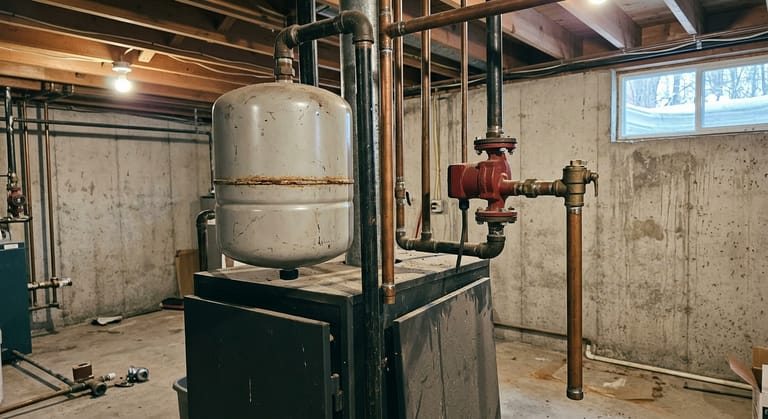
Diaphragm, bladder, and the older steel type
Two families sit in American basements, failing in opposite ways.
| Type | How the air is kept | How it quits |
|---|---|---|
| Diaphragm or bladder (Extrol and similar) | Membrane separates water from a sealed air charge | Charge bleeds off or the membrane tears, so nothing cushions the rise |
| Closed-type steel, no membrane | Air sits on the water and must return to the vessel | Air is carried away and absorbed until the vessel floods |
The older steel style punishes one mistake. Weil-McLain's CGa manual is blunt. No automatic air vents on a closed-type tank: the air they release was meant to travel back up to the vessel, and once it leaves the tank waterlogs, stops controlling pressure, and the safety valve weeps.
Orientation belongs to the model: Amtrol's EXTROL PRO mounts "vertically in downward position only," so a horizontal unit is a question for its own sheet.
5 signs the expansion tank on a boiler has failed
- The safety valve weeps again and again. Weil-McLain's user manual splits that symptom by type: on a water boiler the tank may not be working properly, and the owner is told to call a service technician at once. Amtrol reaches the same door from the tank side, blaming a drip on a wrong charge or a vessel too small.
- Pressure climbs hard on heat-up. The CGa manual has the technician watch the gauge as the system warms, since a sharp climb is how a waterlogged or undersized tank shows itself. No manual read here says how sharp, so record both readings.
- The needle passes 24 psig. The user manual makes that a daily owner check on water systems, with two suspects behind a higher reading: the tank, or the gauge reporting it.
- It will not hold air. The CGa manual again: a vessel that leaks down has a torn membrane, and a torn membrane is replaced, not repaired.
- It has flooded solid. A vessel full of water is the closed-type failure above, controlling nothing.
Yours to do: read the gauge cold, read it again once the burner has run, count how often water shows at the discharge pipe. Stop at the charging valve, the feed valve and the burner controls. (800) 555-0163 puts those readings in front of a licensed heating contractor, at no cost.
How the pre-charge is actually checked
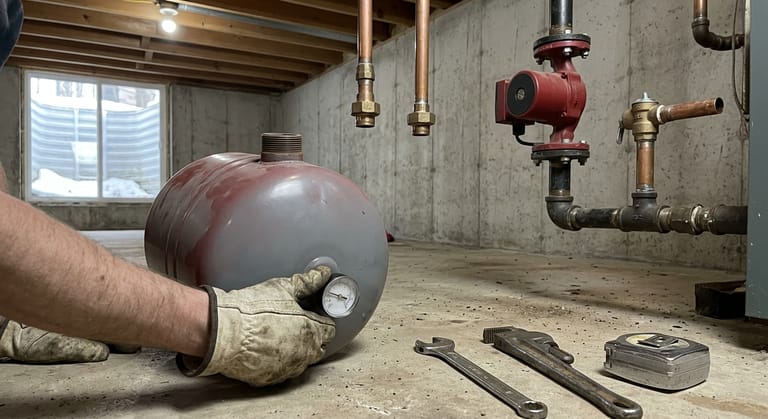
Tapping the shell for a hollow ring, or lifting one end for weight, is field habit rather than manufacturer procedure: it says only that a gauge is due. The published method for a boiler expansion tank is stricter.
Weil-McLain writes it in three sentences: take a large enough tank off the system, read its charge, usually 12 psig in a house, and replace it if it will not hold, because the membrane is gone. Amtrol adds the setting rule, matching the air charge to the fill valve setting, which is why 12 is typical rather than universal.
Amtrol explains why guessing costs air: every gauge reading bleeds off charge, so repeat checks leave the vessel short. The technician reads it once, with the tank valved off and drained. The same maker bans adjustment on a corroded tank, and allows it only at ambient temperature.
Draining this part is not the radiator job people picture: bleeding air out of radiators covers trapped air upstairs. Here water leaves the vessel so the air side can be read, contractor work inside a yearly boiler service.
Talk to someone who sees these boilers every week
Call (800) 555-0163Free to dial. Whoever answers works on boilers and holds whatever license or registration your state requires.Partner contractors who work on boilers and hydronic systems- Contractors who work on boilers, not just furnaces
- Answered at 2 a.m. in January
- Dialing costs nothing and books nothing
- The price is the contractor's own, set with you
Where it belongs on the piping
Amtrol is specific: the vessel goes on the boiler supply, upstream of the pump so the circulator draws away from it. Dead-end stubs and high spots that collect air are ruled out, since both invite corrosion and a leak.
The fill valve is the other half. Pre-charge matches what that valve delivers, and on Amtrol's combination Fill-Trol unit the two are one adjustment: it "is shipped with a factory precharge of 12 PSIG which automatically sets the minimum fill pressure to 12 PSIG." Partner heating contractors set both together.
Sizing, and why cast iron needs a bigger one
Water volume decides the size: cast iron holds more water than a fin tube element at the same output. Amtrol's EXTROL PRO chart shows it: at 50,000 BTU/hr net output, an EX-15PRO on finned tube baseboard but an EX-30PRO on cast iron radiators or cast iron baseboard; at 100,000 BTU/hr, the EX-30PRO for finned tube and the EX-60PRO for cast iron.
Those rows are computed for "15 psig Fill; 30 psig Relief Valve; 180 degrees F Average Temperature," and the maker's radiant chart uses another basis, so a chart lifted without its footnote is useless. The 2021 IRC Table M2003.2 assumes 195 degrees F average water, 12 psig fill, 30 psig maximum operating pressure: build assumptions, not settings to hit.
Ceilings travel with the product line: Amtrol rates the EXTROL PRO to a 200 degrees F maximum operating temperature and its ASME Extrol tanks to 240 degrees F, factory pre-charge 12 PSIG.
Replacing one, and what it costs
Three publishers price the swap, each on its own line. HomeGuide's July 14, 2025 service page lists a boiler expansion tank replacement at $200 to $800. Fixr's January 26, 2026 repair page prints $200 to $800 in its parts table. HomeAdvisor's June 20, 2026 table splits it by fuel: $200 to $550 gas, $250 to $530 oil, $200 to $550 electric.
Does the system have to be drained? Not all of it, and the hardware answers that, not a rule. The 2021 and 2024 IRC at M2003.1 want a nonpressurized tank drainable on its own, without dumping the loop, which speaks to the old open attic tank, not to a closed steel compression tank or a sealed diaphragm unit. For a diaphragm unit the Weil-McLain check assumes the vessel comes off while the loop stays put. Where no isolation valve is installed, more water leaves, and that belongs in the estimate.
The last step gets skipped. Amtrol has the installer "restart the boiler system and check for relief valve discharge": a new unit at the wrong charge behaves like the old one.
Have the system's age, fuel and gauge reading ready. Amtrol puts even the yearly look at the tank in the hands of "a professional plumber." The call is free and reaches a contractor who prices the job on sight.
Steam boilers, combi units, and the other tank people mean
The code sentence names hot water boilers; steam behaves differently. Weil-McLain's user manual splits the diagnosis: a weeping steam relief valve points at a limit control set too high or at system problems, not at a tank. The same manual caps the steam owner's gauge at 15 psig.
On a combi unit, whether the cushion sits inside the cabinet or on the near-boiler piping is answered by that model's manual; what a combi boiler is and who it suits covers the type. Thermal expansion tank usually means the domestic hot water side of a house, a different appliance under different rules. Everything here is hot water (hydronic) space heating.
Water where it should not be is how this part announces itself. Where a leak under a boiler comes from walks the puddle back; how the loop fits together sets the cushion, the circulator and the safety valve in order. If the needle keeps climbing, (800) 555-0163 is free to dial.
Talk to someone who sees these boilers every week
Call (800) 555-0163Free to dial. Whoever answers works on boilers and holds whatever license or registration your state requires.Partner contractors who work on boilers and hydronic systems- Contractors who work on boilers, not just furnaces
- Answered at 2 a.m. in January
- Dialing costs nothing and books nothing
- The price is the contractor's own, set with you