
What Is a Boiler? The Heat Loop, Part by Part
Straight to it
- A boiler heats water rather than air, and a pump sends that water to radiators, baseboard or floor tubing. Nothing is used up; the same water goes around for years.
- 10 CFR 430.2 draws the federal line at 15 psig on steam, or 160 psig and 250 degrees F on water, with residential coverage stopping below 300,000 Btu per hour of input.
- Weil-McLain gives the typical cold fill on a residential system as 12 psi and tells owners nothing above 24 psig belongs on the gauge. No manufacturer document read here prints a running figure between the two.
- Federal AFUE minimums for units off the line on or after January 15, 2021: 84 percent gas hot water, 82 gas steam, 86 oil hot water, 85 oil steam. Electric models carry no AFUE standard at all.
- Steam and hot water share a basement and little else: a 15 PSI relief valve against 30, a gauge glass instead of a temperature gauge, and a cut-in set in fractions of a psi.
A boiler is a closed metal vessel that burns gas or oil, or uses electricity, to heat water and push it through radiators, baseboard or floor tubing. 9.29 million US homes heat this way, 8 percent of the stock, and 6.01 million of them sit in the Northeast (EIA RECS 2020).
Nothing in that loop gets used up: the same water circulates for years, and every part below moves it, holds it, measures it or shuts the fire off.
What is a boiler under federal law
10 CFR 430.2 describes a low pressure steam or hot water unit as one fired by electricity, gas or oil, built to send low pressure steam or hot water out to heat rooms, and held at or below 15 psig on steam, or 160 psig and 250 degrees F on water. Residential coverage stops below a heat input rate of 300,000 Btu per hour.
IRC M2001.1.1, in both the 2021 and 2024 editions, puts the design, the build and the certification of the vessel under Section I or IV of the ASME code. Which edition binds a given house depends on what that state adopted. Construction rules sit in ASME BPVC Section IV, 2025 edition; the National Board Inspection Code, 2025 Edition, takes over once the unit is in service.
The federal wording says furnace, drafting shorthand rather than a merger of two machines: one heats air, the other water. See boiler versus furnace side by side. A water heater is a third thing, serving faucets rather than rooms.
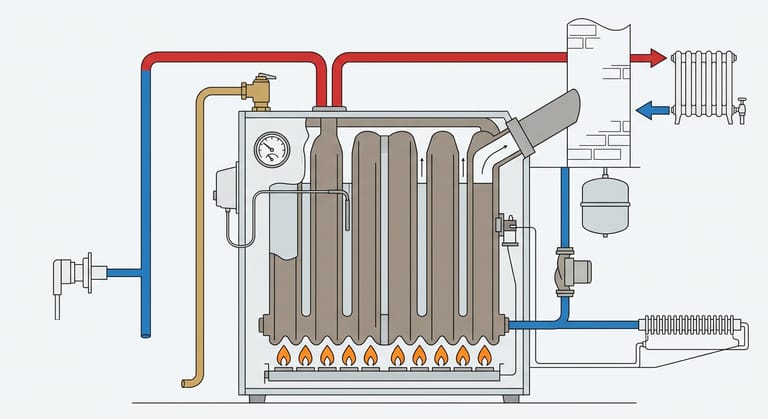
The loop: what happens after the thermostat closes
- The thermostat closes its contacts and asks for heat.
- A gas or oil burner ignites, or electric elements come on.
- The heat exchanger carries that energy into the water in the vessel.
- A circulator pushes the hot water out along the supply main.
- Radiators, fin-tube baseboard or floor tubing shed it into the rooms.
- Cooled water returns, and the high limit cuts the burner when water temperature passes its setpoint.
Water is the carrier for a reason Caleffi puts a number on: "A given volume of water can absorb almost 3500 times more heat than the same volume of air." Layout lives on the hydronic heating system hub; pump noise belongs with the circulator pump.
Eight parts on and around a home boiler
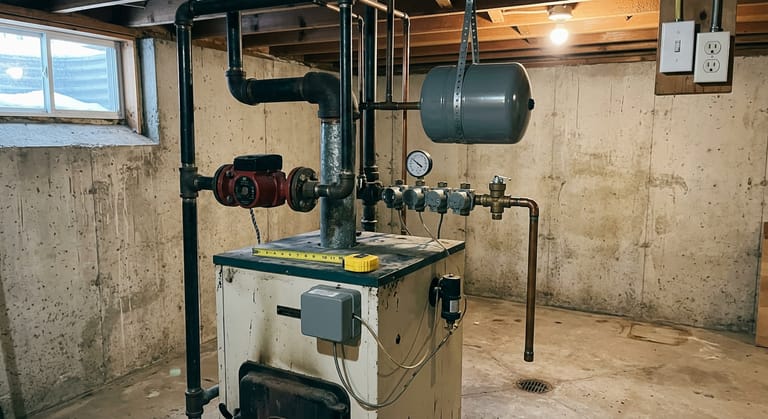
| Part | What it does | A published figure |
|---|---|---|
| Burner and heat exchanger | Turns fuel into heat | ASME BPVC Section IV, 2025 edition, governs it |
| Circulator | Moves water out and back | Taco 007: 0 to 23 GPM, 0 to 10 ft of head; Grundfos UPS 15-58 at 115 V: 87, 80, 60 W by speed |
| Expansion tank | Absorbs the volume hot water gains | Pre-charge 12 psig on a typical house system (Weil-McLain) |
| Pressure relief valve | Opens before pressure hurts anything | Watts 174A standard setting 30 psi; Watts 415M1 steam valve 15 psi |
| Aquastat, the high limit | Cuts the burner at a set temperature | Resideo L8124 high limit: adjustable 130 to 240 degrees F, 10 degree fixed differential |
| Low water cutoff | Stops combustion if the level falls | 2021 and 2024 IRC M2002.5 requires one, with a flow-sensing exception |
| Gauges | Report pressure and temperature | 2021 IRC M2002.2 accepts two gauges or one combination gauge |
| Zone valves | Feed one part of the house | Resideo V8043: 24 Vac, 7.2 VA, nominal timing 15 seconds |
Two get their own pages: the expansion tank and the aquastat.
Residential boiler pressure, and the manual's ceiling
Weil-McLain's installation manual puts the typical cold water fill for a residential system at 12 psi and says correct pressure varies with each application. The user manual gives the ceiling: nothing past 24 psig on that dial, a reading above it throwing suspicion on the tank or on the instrument.
Between those two numbers, nothing. No manufacturer document read here states a normal hot running pressure, which leaves the popular "18 to 20 psi" answer with no source.
Reading the gauge cold is free. Refilling the system, touching the fill valve or chasing a weeping valve is not owner work: (800) 555-0163 is free to dial for a licensed heating contractor.
Steam or hot water: two machines, one basement
No federal survey separates the two: RECS 2020 counts steam and hot water in one category, though it does split geography and age. The Northeast shows 6.01 million such homes out of 21.92 million, the Midwest 1.97 million out of 27.04 million. Houses built before 1950 hold 4.02 million of the national 9.29 million.
Age is why steam survives: the water boils, vapor climbs to the radiators without a pump, and pressures are fractions of a psi. In a single family house where the one pipe system is clean and the radiation cast iron, the Utica manual puts cut-in at its minimum 1/2 psi and the differential at 1 psi, landing cut-off at 1-1/2 psi; larger, two pipe, convector and fan coil systems are set one at a time. 2021 IRC M2002.3 puts the gauge glass midpoint at the normal water level.
Relief valves differ too: Weil-McLain's standard equipment list ships its water boilers with a 30 PSI relief valve and its steam boilers with a 15 PSI valve. Surging and a wandering water line are steam problems, covered on steam boiler repair.
Talk to someone who sees these boilers every week
Call (800) 555-0163Free to dial. Whoever answers works on boilers and holds whatever license or registration your state requires.Partner contractors who work on boilers and hydronic systems- Contractors who work on boilers, not just furnaces
- Answered at 2 a.m. in January
- Dialing costs nothing and books nothing
- The price is the contractor's own, set with you
Zones: one heat source, rooms that ask separately
Zoning lets a bedroom wing stay cool while the kitchen runs, each zone with a thermostat and either a circulator or a valve on the supply. Resideo's submittal for the V8043 describes a two position, straight-through body, normally closed when de-energized, nominal timing 15 seconds, 7.2 VA on 24 Vac.
The sheet adds a lever for an outage, which forces the port open with no power on the coil and gives control back once the circuit is live. Worth knowing before a lever is blamed for a zone that will not cool down.
Gas, oil and electric: what the fuel changes
DOE's FEMP office gives the plain sentence for the efficiency number: AFUE states what portion of the fuel bought becomes heat in the house over one heating season. Federal minimums for units off the line on or after January 15, 2021 are 84 percent AFUE gas hot water, 82 gas steam, 86 oil hot water and 85 oil steam. Electric models carry no AFUE standard in that table.
Two design rules carry the same date: no constant burning pilot on gas fired units, and an automatic means of adjusting water temperature on hot water models, except where the boiler has a tankless domestic water heating coil. Standby power is capped at 9 watts for a gas fired hot water unit.
Venting and combustion air sit on the gas boiler page. One boundary: the machines here run hot water and steam, meaning hydronic systems. Electric baseboard and floor mats hold no water, and that work is an electrician's.
What is a boiler doing when nothing calls for heat
Less than it used to. Where the automatic means requirement applies, 10 CFR 430.32 holds boiler water to no more than 140 degrees Fahrenheit whenever the control infers no heat load: a ceiling for an idle boiler, not a high limit setting. Under load, Resideo names no number of its own: heating systems differ, so the correct setting varies from system to system, and the installer is sent to the boiler manufacturer for it.
Boiler house, boiler room, or a corner of the cellar
In American housing it usually stands on the basement floor, near the chimney or a sidewall vent. Boiler house is the older term: in industry it still means a building, at home it has shrunk to a room.
Searches that name a city, a Denver boiler company for instance, mix two trades: residential hydronic contractors who work in basements, and commercial outfits that service steam plants at hospitals and schools.
CPSC frames the yearly visit as a safety matter rather than an efficiency one, and wants professional hands on the heating system every year. What that visit covers is on annual boiler service.
Next to a furnace or a heat pump
The question behind most of these searches is not what is a boiler but which machine a house should have. A furnace heats air and blows it down ducts; a heat pump relocates heat instead of producing it; a hydronic system heats water and lets metal or tubing radiate it.
Antifreeze is a manual by manual question. Weil-McLain's user manual for the CGa Series 3, CGi Series 4, EG/PEG Series 6 and LGB Series 2 and 3 tells owners never to put automotive or standard glycol into those systems, glycol sold for hydronic use included; Raypak's guidance calls for inhibited propylene glycol where incidental contact with drinking water may occur. Read your own manual first, because the wrong fluid can bear on the warranty, and US Boiler notes that all such chemicals require annual testing.
What you can check, and where to stop
Three things are yours: the thermostat and its batteries, the service switch that kills power, and the gauge read against the 24 psig ceiling. Past that it is licensed work: gas valve and ignition, oil burner, control wiring, relief valve, pressure vessel. The monthly low water cutoff check the Utica manual asks for belongs on that second list.
A gauge that will not settle, one zone that never warms, a burner that lights and quits: all basement diagnoses. (800) 555-0163 is free, and the person on the other end works on boilers and holds whatever license or registration your state requires.
Talk to someone who sees these boilers every week
Call (800) 555-0163Free to dial. Whoever answers works on boilers and holds whatever license or registration your state requires.Partner contractors who work on boilers and hydronic systems- Contractors who work on boilers, not just furnaces
- Answered at 2 a.m. in January
- Dialing costs nothing and books nothing
- The price is the contractor's own, set with you