
How Hot Water Baseboard Heating Works, Foot by Foot
Straight to it
- Output is sold by the foot at a stated temperature. Slant/Fin rates the Fine/Line 30 element at 580 BTU/hr per linear foot at 180 degrees F and 1 GPM, with 65 degrees F entering air, on active finned length, and a 15 percent heating effect factor inside it.
- Wall length is the capacity. Caleffi's idronics 25 shows 111 feet of baseboard at 120 degrees F releasing the same 20,000 BTU/hr as 31 feet at 180 degrees F, which is the trade a cooler boiler asks for.
- Gurgling is air. Caleffi states that water holds close to 3,500 times the heat of an equal volume of air, and that air filled cavities in piping act as acoustic amplifying chambers.
- Cast iron baseboard is a different animal. Governale's Gov-Board is published at 480 BTUH a linear foot, 180 degrees F, 500 lb/hr, and Amtrol's EXTROL PRO chart, drawn for a 15 psig fill, puts it on a larger tank than fin tube.
- HomeGuide priced a hydronic unit at $430 to $1,200 installed on a page dated July 7, 2025. Prices are published per unit, not per linear foot.
Hot water baseboard heating runs boiler water through a finned copper tube, and Slant/Fin publishes 580 BTU/hr a foot for that element at 180 degrees F. That is the Fine/Line 30 figure at 1 GPM, with air entering at 65 degrees F.
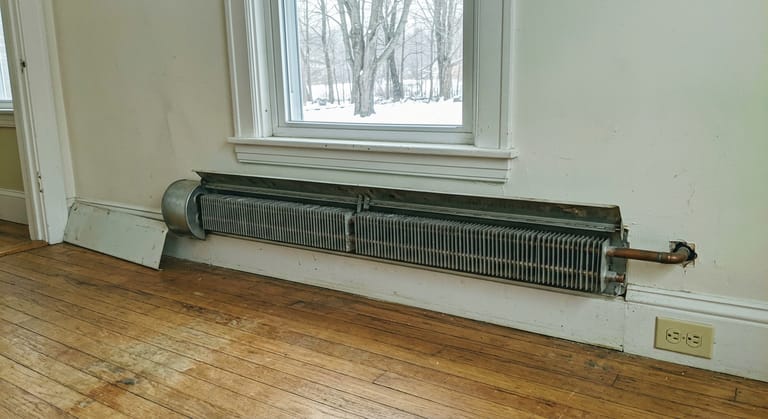
The tube sits behind a thin wall enclosure and the room warms by convection. The run of wall is the capacity, and anything blocking airflow through it takes some back.
The hot water in the name is the boiler's loop water, not the tap water in the house. Everything below is hydronic baseboard heating, fed by a boiler. Electric baseboard warms a resistance element, has no boiler behind it, and belongs to an electrician.
What sits behind the front cover
Slant/Fin bases the Fine/Line 30 ratings on 3/4 inch nominal copper tubing carrying aluminum fins spaced 55 to the foot, unpainted. Those fins are the machine: room air enters low, crosses the element, leaves through the slot on top.
The rest is sheet metal. Anyone hunting a diagram wants the loop, not the box: boiler, circulator, zone valve, the run in each room, back to the boiler, on how a hydronic loop fits together.
How much heat one foot actually gives
| Average water temperature, degrees F | BTU/hr per foot |
|---|---|
| 140 | 320 (derived, not measured) |
| 170 | 510 |
| 180 | 580 |
| 200 | 710 |
| 220 | 840 |
The 140 degree row at the top is derived, not measured: Slant/Fin computes 140 degrees and below from the 150 degree rating by a factor in the rating standard. Worth knowing before a low temperature retrofit.
Three conditions ride with every figure: air entering at 65 degrees F, output stated on active finned length, which Slant/Fin puts 5 to 6 inches under overall length, and a 15 percent heating effect factor inside it. The flow column carries its own printed rule: "Use 4 gpm ratings only when flow is known to be equal to or greater than 4 gpm; otherwise, 1 gpm ratings must be used."
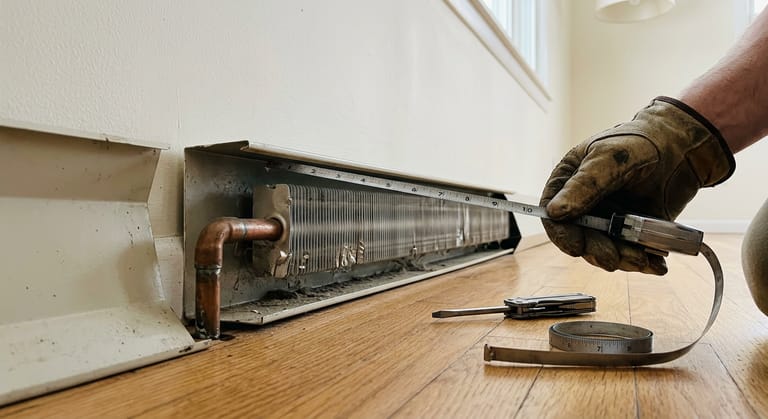
So an 8 foot enclosure is not 8 times 580, and another model is another number: the Base/Line 2000 with a BL-75 element is rated 570 BTU/hr per foot at the same conditions.
Water temperature, and how hot the unit runs
Caleffi's idronics 25 gives the premise for older American systems: an existing distribution of standard fin tube "requires a supply water temperature of 180 degrees F at design load conditions".
The limit control sets the ceiling. Resideo publishes a standard scale of 180 to 240 degrees F for its L8148 aquastat relay, and prints the instruction to take the setting from the boiler maker's own literature, since systems differ.
Running cooler works when there is more wall. Caleffi puts two halves on one figure: 111 feet at 120 degrees F releases the same 20,000 BTU/hr as 31 feet of baseboard at 180 degrees F. Surface area buys low temperature, which a condensing boiler wants.
What moves the water through the loop
The circulator does the work the fins get credit for. Taco rates the 007 cartridge circulator at up to 23 GPM and 10 feet of head. Pump symptoms and flange drips sit on what a circulator does and how it fails.
Zoning is what people genuinely like. Resideo's V8043 zone valve runs on 24 Vac, opens or closes in 15 seconds maximum, and carries a manual opener for a power failure.
A thermostat, a damper and listening for the pump are yours. Wiring a valve, moving a limit setting or touching a burner is licensed work, and dialing (800) 555-0163 costs nothing.
Baseboard radiators, and the cast iron kind
Homeowners often call these hot water baseboard radiators, though the finned type is strictly a convector: it warms passing air rather than radiating from a mass. Cast iron baseboard is the closer relative of a true radiator, more mass and more water doing the same job along an outside wall.
Governale's Gov-Board is published at 480 BTUH a linear foot, 180 degrees F, 500 lb/hr, which its own notes call 1 GPM. Its ratings use active length equal to total length, where fin tube does not.
Water volume is the practical difference. Amtrol's EXTROL PRO chart, computed at 180 degrees F average temperature on a 15 psig fill, puts 50,000 BTU/hr of net output on an EX-15PRO with finned tube but an EX-30PRO with cast iron radiators or cast iron baseboard. Heavier emitters hold more water to expand. Output per section and whether an old run is worth keeping sit on what cast iron radiation still delivers.
Talk to someone who sees these boilers every week
Call (800) 555-0163Free to dial. Whoever answers works on boilers and holds whatever license or registration your state requires.Partner contractors who work on boilers and hydronic systems- Contractors who work on boilers, not just furnaces
- Answered at 2 a.m. in January
- Dialing costs nothing and books nothing
- The price is the contractor's own, set with you
Why the system sounds like running water
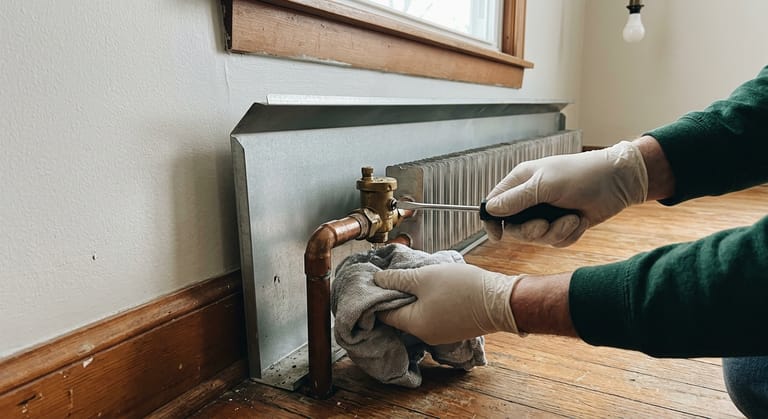
Air, nearly always. Caleffi's idronics 15 puts numbers on it: deaerated water at 4 feet per second or less produces sound virtually undetectable by human ears, while a mixture of water and air is far more acoustically active. Air filled cavities within piping act as acoustic amplifying chambers.
It explains the cold spot arriving with the noise: water carries roughly 3,500 times the heat that the same space of air can, so a run holding air heats poorly and talks loudly.
The device for it is a small valve. Manual air vents thread into 1/8 inch or 1/4 inch FPT tappings, come open with a screwdriver, or with a square head key, and Caleffi places them on top of every emitter. Noise right after a fill is expected; noise that keeps coming back is not, since Hoffman Specialty's guide says very little air should re-enter a filled system.
Order of work, and what pressure does afterward, sits on venting air without losing system pressure. Air arriving week after week means something is feeding the loop, and finding it belongs to a licensed heating contractor. Asking at (800) 555-0163 costs nothing.
Curtains, shelves and what may sit against the enclosure
Every baseboard rating here assumes air entering along the floor and leaving at the top. Break that path and the number stops applying. Curtains across the outlet, a shelf over the run, a sofa against it, a damper painted shut years ago: none is a failed part, and all four cost heat. Paint counts too, since Slant/Fin rates unpainted fins.
Crushed fins and a run that heats at one end only are diagnosed on why one length of baseboard stays cool.
What it costs to install and keep
Prices exist for the box, not for the wall. Dated July 7, 2025, HomeGuide's baseboard page gives $430 to $1,200 for a hydronic unit installed, $180 to $320 for the unit by itself, and $75 to $150 an hour for an HVAC contractor's labor to install baseboard heaters.
Running it costs more than the emitters anyway: HomeGuide's July 14, 2025 page puts the annual gas visit at $200 to $500 for tune-up, cleaning and repairs. When a tired run is worth pulling is on what replacing a run actually costs.
Is it good, or just old
Hot water baseboard heating is neither obsolete nor fashionable. It rewards wall length and punishes clutter: excellent in some rooms, mediocre elsewhere.
What it does well
- Quiet convection, no blower, no ducts to leak or clean.
- Zoning by floor or room, on valves that swing in 15 seconds or less.
- Takes cooler supply when length is added, suiting a modern boiler.
What it asks of you
- Wall length is capacity, so furniture and output compete.
- Fins bend, and bent fins lose heat no control can recover.
- It heats only. Central air is a separate system beside it.
Four checks that are yours, and where to stop
Read the boiler gauge cold against the 12 psi the manual calls typical. Lift a baseboard cover and look for crushed fins, a shut damper or furniture against the outlet. Confirm the thermostat is calling and that the enclosure warms up, without touching the supply pipe, which runs at boiler temperature. Open the manual air vent Caleffi puts at the top of each emitter on a run that hisses, watching the gauge.
Everything behind the boiler jacket stays off that list: the burner, the gas valve, an oil train, the aquastat and the wiring between them. Where the trade is regulated, that is licensed work.
The rest is a conversation, not a purchase. (800) 555-0163 costs nothing to dial, obliges nothing, and puts a licensed heating contractor on the line.
Talk to someone who sees these boilers every week
Call (800) 555-0163Free to dial. Whoever answers works on boilers and holds whatever license or registration your state requires.Partner contractors who work on boilers and hydronic systems- Contractors who work on boilers, not just furnaces
- Answered at 2 a.m. in January
- Dialing costs nothing and books nothing
- The price is the contractor's own, set with you