
Bleeding Radiators: The 5 Steps, and the One Kind You Never Bleed
Straight to it
- The tool is a square head key or a flat screwdriver. Caleffi describes the manual air vent as a small valve threaded into a 1/8-inch or 1/4-inch FPT tapping, placed at the top of each heat emitter.
- Air is expensive. Caleffi's idronics 15 puts the heat a volume of water absorbs at almost 3500 times what the same volume of air absorbs, and names cool spots as the usual sign of trapped air.
- Read the gauge before and after. Weil-McLain's CGa Series 3 manual gives 12 psi as the typical cold water fill on a residential system, and Weil-McLain's user manual for that series tells owners the needle on a water boiler has no business above 24 psig. Nothing between those two figures is published.
- One-pipe steam is a different machine. Hoffman Specialty's catalog separates steam vents from water vents, lists Models 1A and 40 as float-type radiator steam vents, and neither is worked with a key.
- Air returning every few weeks is a fault, not maintenance. Hoffman writes that once a system is filled, very little air should re-enter it.
Bleeding radiators means opening the small manual air vent at the top of each unit with a square head key or a screwdriver until water pushes the trapped air out. The gauge says whether it worked: 12 psi is the cold fill figure Weil-McLain's CGa Series 3 manual calls typical for a residential system. Air is no cosmetic problem: Caleffi's idronics 15 states that a given volume of water soaks up nearly 3500 times the heat an equal volume of air can.
Scope, in one line: hot water (hydronic) systems here, plus the steam radiators still working in older Northeast houses. Electric baseboard holds no water to vent and is wired work anyway.
Why air makes the top of a radiator go cold
Caleffi gives the mechanism: where air displaces water away from heat transfer surfaces inside heat sources or heat emitters, the rate of heat transfer can be significantly reduced. The same page names the symptom plainly, that cool spots on radiators usually indicate entrapped air.
Bleeding is therefore not a calendar job. It is due when the top of a unit stays cool while the bottom runs hot, or when a zone gurgles.
Caleffi lists seven problems air causes, and a cold radiator is only one of them. The rest reach the whole system: noise, starved circulators, corrosion from oxygen against ferrous metals, dry circulator bushings, balancing valves that stop performing, and total loss of flow behind a large air pocket. Corrosion is the one that quietly shortens everything iron in the basement.
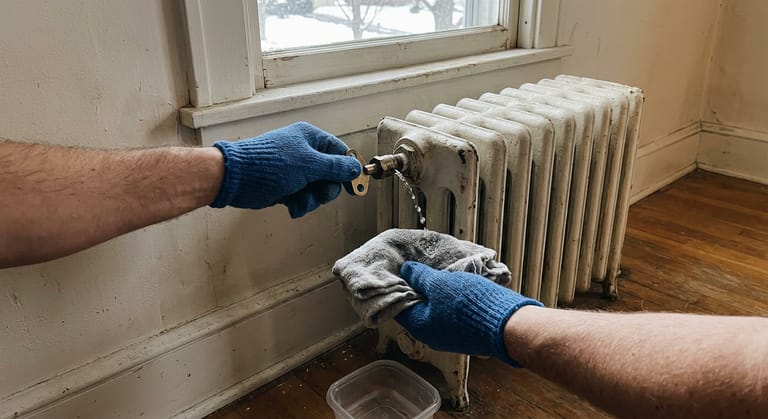
Where the bleed valve is, and what fits it
Caleffi's description is exact: manual air vents are small valves that thread into 1/8-inch or 1/4-inch FPT tappings, open under a screwdriver blade or a square key, and pass air through the valve seat and out of a small side opening, commonly at the top of every emitter.
So the radiator bleed valve is thumbnail sized and sits at an upper corner. A square port takes the four-sided key sold in any hardware aisle; a slotted port takes a flat screwdriver. Different radiator bleed valves, one job.
| What you find | What opens it | Which system |
|---|---|---|
| Square nub in small brass body, upper corner | Square head key | Hot water, per Caleffi |
| Slotted screw, same position | Flat screwdriver | Hot water, per Caleffi |
| Dome that hisses on its own | Nothing. Automatic | One-pipe steam, per Hoffman |
| Nothing on the upper header | Nothing yet | Usually a converted unit |
That last row has a real fix behind it. Caleffi's idronics 25 writes that a cast iron radiator carried over from steam needs a connection at its upper header able to take an air vent, and that a unit with only one lower connection needs a lance valve, a tube carrying hot water to the far lower end so water rises by natural convection. Pipe work, not a five minute chore.
Bleeding radiators in five steps
- Let the zone go quiet. Turn the thermostat down and give the loop a few minutes with the circulator off, so air gathers at the vent.
- Read the boiler gauge and write it down. You need a figure from before bleeding, because venting air lowers system pressure.
- Start on the lowest floor. Rag in one hand, key in the other, container underneath. Working upward saves chasing one pocket twice.
- Open a quarter turn, no further. Air hisses first. The moment the hiss becomes a steady dribble, close the vent. Snug is enough; leaning on the key rounds off soft brass.
- Finish at the top floor, then read the gauge again. A drop is normal; what its size means is the next section.
What the gauge should read afterward
Bleeding radiators lowers system pressure, so the reading matters more after than before. Weil-McLain's CGa Series 3 manual sets the reference at filling: correct pressure varies with each application, and 12 psi is the typical cold water fill on a residential system. The same maker's user manual hands owners a ceiling instead of a target: 24 psig is the top of the range on a water boiler, and pressure past it may indicate a problem with the tank or with the instrument.
Between those two figures sits a gap nobody publishes. No boiler manual prints a normal hot running pressure, which is why the 18 to 20 psi figure repeated online has nothing under it.
Adding water is where the line falls. Reading a gauge, noting the number and closing a vent are owner tasks. A fill valve, the relief valve, a gas train, an oil burner or boiler wiring is licensed work. (800) 555-0163 is free, and the heating contractor who takes the call can say whether that pressure loss fits a bleeding session or a leak nobody has found. More in what a boiler gauge and its relief valve are telling you.
Talk to someone who sees these boilers every week
Call (800) 555-0163Free to dial. Whoever answers works on boilers and holds whatever license or registration your state requires.Partner contractors who work on boilers and hydronic systems- Contractors who work on boilers, not just furnaces
- Answered at 2 a.m. in January
- Dialing costs nothing and books nothing
- The price is the contractor's own, set with you
Steam radiators take a vent, not a key
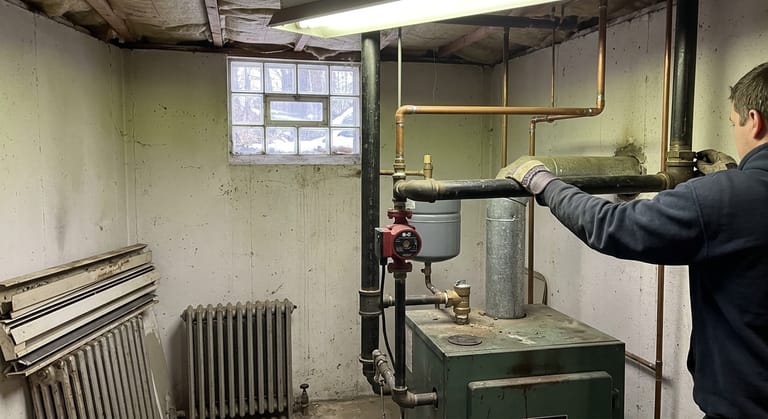
This is where the how-to advice found online goes wrong: the bleed-key articles were written for another country's plumbing. Bleeding with a key is a hot water idea. On one-pipe steam the device on the side of the unit is not a manual vent at all.
Hoffman Specialty divides its own catalog by service: steam vents are used in one-pipe steam heating systems, water vents in hydronic and chilled water systems. Under the heading for radiator steam vents sit two models, 1A and 40, both described as a float-type vent. Neither is key-operated or screwdriver-operated. The Model 1A adds an adjustable port with six settings from slow to fast and a maximum operating pressure of 1-1/2 psig.
Hoffman also explains why such a unit stays cold when the boiler runs high: the vent's rated operating pressure must exceed the system's maximum, and once pressure passes that rating the vent cannot open, so air stays put. The catalog calls steam vents primarily replacement items.
A hot water thermostatic valve is no substitute. Danfoss states that its RA 2000 valves serve free-standing radiators, baseboards and convectors alike, on hot water systems and on two-pipe steam. One-pipe is not in that application list. Which valve suits which unit: radiator valves, thermostatic heads and steam air vents.
Bleeding radiators changed nothing. Now what
One radiator not heating up after bleeding has moved on to a different cause. Three come up most.
The valve is first. Danfoss notes that its valves remain normally open with no operator mounted, which is why a unit missing its head runs hot all season; the reverse is a pin seized shut under a head that turns freely.
Balance is second. Taco describes its TacoSetter balancing valves as a way of adjusting flow rates through the circuits of a closed loop hydronic system, with measuring accuracy printed as +10% of indicated value. A loop nobody balanced starves whatever sits furthest from the pump.
The zone is third, and that is where a homeowner check ends. A zone valve that will not open, a circulator humming without turning, or a boiler not making temperature leaves every unit on that circuit cold. One cold unit against a whole floor of them is the tree in why a radiator is not getting hot. Thermostat, switch and gauge are yours; past the zone valve wiring it is licensed work, and that call is free.
Air that keeps coming back is a fault
Hoffman writes the rule that turns a chore into a diagnosis: once a system is initially filled with water, very little air should re-enter it. A loop needing bleeding every few weeks is taking on water, and water carries dissolved air in with it.
Two suspects cover most of it. Weil-McLain's CGa manual ties frequent relief valve weeping to an expansion tank that may be waterlogged or undersized. Amtrol says the same: a relief valve dripping after start-up means the tank is either undersized or charged wrong. Two manufacturers, one answer: how a boiler expansion tank waterlogs covers the tap test and the pre-charge.
What bleeding radiators costs if you would rather not
HomeGuide's radiator repair table, bylined September 1, 2023 under a 2026 title, lists the job at $150 to $300, an air vent replacement at $100 to $320 and balancing at $100 to $300. Fixr, updated January 31, 2025, puts the same line at $100 to $200.
The split is simple. Opening a vent, closing it and reading a gauge sit at the owner's end of bleeding radiators. A vent that will not seat, pressure that will not come back, a valve that discharges, or a system swallowing air every month is work for someone licensed. (800) 555-0163 is free to dial, books nothing, and the person answering is a licensed heating contractor, working through the heating season.
Talk to someone who sees these boilers every week
Call (800) 555-0163Free to dial. Whoever answers works on boilers and holds whatever license or registration your state requires.Partner contractors who work on boilers and hydronic systems- Contractors who work on boilers, not just furnaces
- Answered at 2 a.m. in January
- Dialing costs nothing and books nothing
- The price is the contractor's own, set with you