
Thermostatic Radiator Valve Stuck? Start at the Head
Straight to it
- The head is the first suspect, not the body. Danfoss states its valves remain normally open with no operator mounted, so an emitter that stays cold with the head off has a fault somewhere past this fitting.
- The dial is a room setting, not a boiler setting. Danfoss puts positions 1 to 5 at approximately 57 to 79 degrees F, with the frost mark sitting outside that numbered scale.
- It comes off without tools. The datasheet has standard operators snapping on and off by hand, with a plastic cap in the box for manual control while the job is under way.
- One-pipe steam is excluded. Danfoss names hot water and two-pipe steam systems, so a single-pipe emitter takes a radiator steam vent instead: Hoffman prints a maximum operating pressure of 1-1/2 psig on the Model 1A.
- Prices sit low against the rest of the system. HomeGuide lists $100 to $350 to replace a valve on its radiator repair page bylined September 1, 2023, and HomeAdvisor $180 to $330 all-in in June 2026.
A thermostatic radiator valve throttles hot water by itself, no wiring and no battery: Danfoss puts its RA 2000 dial positions 1 to 5 at roughly 57 to 79 degrees F. The same datasheet rates that unit to 250 degrees F and 145 psi static pressure on the hydronic side.
Two pieces sit here and they fail differently: the snap-fit operator on top, which lifts off without tools, and the body threaded into the emitter underneath. Start with the operator, because ruling it in or out costs nothing but ten minutes.
Five parts people mean by a radiator valve
The phrase covers at least five devices in an American basement and on the walls above it, sitting in different places and failing in ways that have nothing in common.
| Part | What it does | Where it lives |
|---|---|---|
| Hand or supply valve | Opens and shuts flow to one emitter by hand, straight or corner pattern depending on how the pipe arrives | At the inlet of the emitter |
| Thermostatic type (TRV) | Two pieces: a body in the pipe and a snap-on operator that reads room air | Inlet, with the dial in the room |
| Manual air vent | Caleffi describes small valves threading into 1/8-inch or 1/4-inch FPT tappings, "operated with a screwdriver or square head key" | Top of each heat emitter, hydronic only |
| Steam air vent | Hoffman Specialty lists these for one-pipe steam only, rated by drop-away pressure: the highest pressure the vent can still open against | Side of a steam emitter, near the top |
| Zone valve | Resideo's V8043 is a two-way, straight-through, normally closed motorized unit on 24 Vac | Near-boiler piping, never on the emitter |
The plain one, often labeled the radiator supply valve on a plan, only opens and shuts. Everything on this page belongs to hot water (hydronic) heat and two-pipe steam. Electric baseboard carries no water and no such fitting, and it is an electrician's job.
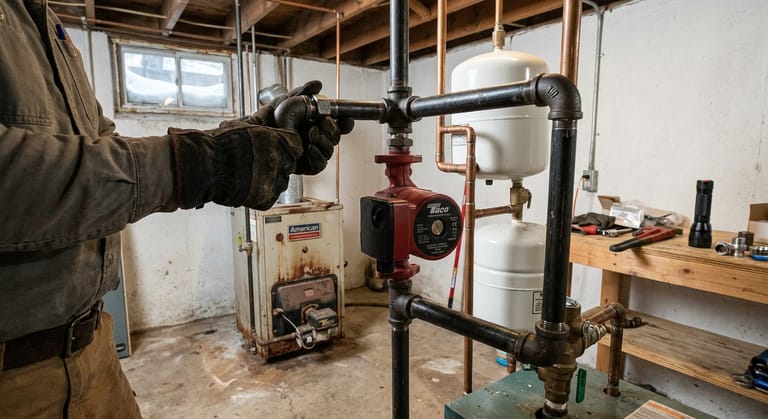
How a thermostatic radiator valve reads the room
A thermostatic radiator valve carries no thermostat wire and no circuit board. Inside the head Danfoss puts a bellows holding a charge that swells and shrinks with room temperature, working against a spring, and the spring is what drives the valve open or shut. As the room warms, that charge expands and throttles the hot water down.
The operator runs on "a patented vapor charge" for fast modulating control, with no outside energy source behind it.
What the numbers on the dial actually mean
A radiator thermostat valve sets one room, not the house. The dial carries "a numbered scale of 1 to 5 corresponding to temperatures of approximately 57 degrees F to 79 degrees F," and the setting-position graphic prints those five positions against 14, 17, 20, 23 and 26 degrees C. Position 3 sits at 20 degrees C on that graphic, the middle of the span Danfoss states in words, which is why a head wound down in October leaves a corner room cold in January.
Two numbers get confused with that scale. The frost mark sits outside the numbers altogether, and the datasheet's separately published Adjustable Temp. Range reads 45 to 86 degrees F. Neither one is dial position 1.
Talk to someone who sees these boilers every week
Call (800) 555-0163Free to dial. Whoever answers works on boilers and holds whatever license or registration your state requires.Partner contractors who work on boilers and hydronic systems- Contractors who work on boilers, not just furnaces
- Answered at 2 a.m. in January
- Dialing costs nothing and books nothing
- The price is the contractor's own, set with you
Why the head sticks, and the check that costs nothing
A TRV that will not open has three suspects: the operator, the pin beneath it, and the valve body threaded into the radiator. Three tests separate them, and ten minutes covers all three.
- Turn the dial to 5 and wait. Danfoss puts the reaction time of its own gas-charged model at 10 minutes, so a minute of impatience proves nothing.
- Lift the operator off. Standard versions snap on and snap off by hand, with no tool involved, and a plastic cap rides along in the box to keep the pushpin safe.
- Watch the bare body. Danfoss states that "valves remain normally open with no operator mounted," so the emitter should warm up. Hot without the head and cold with it means the operator is finished. Refit the head either way, because a bare body runs wide open.
- Cold either way? The fault is past this fitting. Air, balance and zoning are walked in order on why one radiator is not getting hot, and trapped air at the top of an emitter is worked out under bleeding a radiator the right way.
- Read the boiler gauge before you call anyone. Weil-McLain's CGa manual puts a residential system at a typical 12 psi cold fill, and the same maker's user manual caps the gauge on a running water boiler at 24 psig.
Setting a dial, lifting a snap-fit head and photographing a gauge are all yours. Stop where the loop has to be opened: a body that comes out only with the system drained, unions on an old cast iron column, and anything on the burner or its wiring. (800) 555-0163 costs a minute and no money, and the person on the other end works on boilers and holds whatever license or registration your state requires.
One-pipe steam takes a vent, not this valve
Danfoss names hot water and two-pipe steam systems in its application line, and that exclusion is the whole point: put a thermostatic head on a single-pipe emitter and the steam going in and the condensate draining out have to share one throttled opening. Air has to leave before steam arrives, so on one pipe the regulating part is the vent on the side, not a dial in the room.
Hoffman Specialty publishes two radiator vents, and the difference is whether the room can be tuned at all. The Model 1A is the tunable one: a float-type vent whose port adjusts across six settings, slow at 1 to fast at 6, which Hoffman calls true proportional venting. The Model 40 has one fixed port for an ordinary one-pipe system. Hoffman also calls its steam vents "primarily replacement items," which is the honest answer to anyone hoping to rebuild one.
How to fix a leaky radiator valve, and what a swap costs
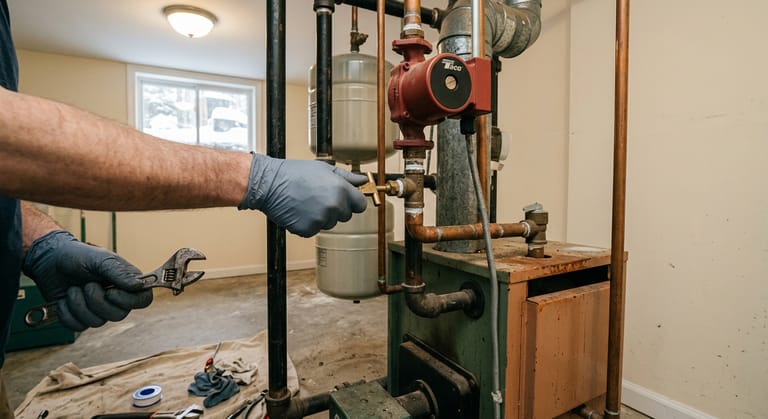
A radiator control valve rarely fails cleanly. It weeps at the gland, or the disc no longer seats and the room cooks with the dial at 1. Fixing one is really a choice between two jobs, since repairing a radiator valve in place is rarely what happens: the head gets swapped, or the body comes out with the loop drained. Three publishers price the work across five rows, each with its own scope and page date rather than one merged range.
| Publisher and page date | Job | Published range |
|---|---|---|
| HomeGuide, radiator repair page bylined September 1, 2023 | Replace a valve | $100 to $350 |
| Fixr, updated January 31, 2025 | Valve repair | $125 to $250 |
| Fixr, updated January 31, 2025 | Valve as a replacement part | $150 to $350 |
| HomeGuide boiler service page, July 14, 2025 | Radiator valve as a boiler repair part | $125 to $300 |
| HomeAdvisor, updated June 20, 2026 | Radiator valve, all-in | $180 to $330 |
No document read for this page publishes a repacking procedure for a residential thermostatic radiator valve, and there is a reason: the gland sits under system pressure at temperatures the maker rates to 250 degrees F. Volume is the other reason: Governale prints 0.61 gallon of water per section on its Victoria line, so taking a body off a long cast iron column drains real weight onto a floor; sections, ratings and restoration sit on what a cast iron radiator still delivers.
Note which room it is, which position the dial was on, and whether the drip shows at the top nut or at the union: that much is yours. Opening a fitting on a filled loop is not. There is no fee for the call, and the contractor who comes out sets the price after seeing the fitting, never before.
When the valve is innocent and the loop is not
A radiator at the end of a long circuit can be cool with every fitting on it working perfectly. Taco sells the correction as hardware. Its TacoSetter balancing valves are sold for setting flow rates through closed-loop hydronic circuits and read out directly in GPM, with a measuring accuracy Taco prints as plus 10 percent of the indicated value.
That is a wrench-and-meter job, not a dial job. Your half is knowing which rooms run cold, at what settings, and what the gauge read while it happened. Hand those three facts to a licensed heating contractor on (800) 555-0163: the call is not billed, and it often turns two visits into one, because whoever comes out knows what to bring.
Talk to someone who sees these boilers every week
Call (800) 555-0163Free to dial. Whoever answers works on boilers and holds whatever license or registration your state requires.Partner contractors who work on boilers and hydronic systems- Contractors who work on boilers, not just furnaces
- Answered at 2 a.m. in January
- Dialing costs nothing and books nothing
- The price is the contractor's own, set with you