
Steam Radiator Repair: Hissing, Banging and a Cold Far End
Straight to it
- The hiss is the air vent doing its job. A whistle that never stops means the vent cannot close; silence with a cold far end means it cannot open.
- Banging is water, not steam. On one pipe the same tube carries steam up and condensate back, so a run that no longer drains gets hit every time the burner fires.
- Boiler pressure decides what the vents can do. A vent rated below the pressure the boiler actually runs at cannot open, and Hoffman gives the Model 1A a maximum operating pressure of 1-1/2 psig.
- Utica's PEG-E procedure for a single family house on clean one pipe with cast iron radiation: cut-in 1/2 psi, differential 1 psi, cut-off 1-1/2 psi. Larger and two pipe buildings are set case by case.
- Repair money is small next to replacement. Fixr's January 31, 2025 page puts steam repair at $150 to $550; HomeGuide's radiator page, bylined September 1, 2023, puts a steam unit installed at $300 to $2,500.
A steam radiator hisses on purpose and bangs when something is wrong. The hiss is air leaving ahead of steam that Caleffi's idronics 25 puts at 215 to 220 degrees F. Banging, half heat and a wet floor are the faults, and most of them sit in three parts: the vent, the pitch, the valve.
Scope in one line: heat raised by a basement boiler and pushed up through cast iron. Plug in electric radiators and electric baseboard have no boiler behind them and belong to an electrician.
What each sound and cold spot means
| What you hear or feel | What it usually is | Where it ends |
|---|---|---|
| A hiss for a few minutes, then quiet | Air pushed out ahead of the heat | Nothing |
| Whistling that never stops, or a vent spitting water | Vent stuck open or worn out | New vent |
| Hammering under the floor | Condensate trapped in a run that will not drain | Pitch and piping, a contractor call |
| Inlet hot, far end cold all winter | Vent failed shut, air parked in the sections | New vent, then balance |
| Drip at the stem | Packing at the valve | Repack or replace |
Age is the backdrop. Of the 9.29 million US homes EIA's RECS 2020 put on steam or hot water heat, 4.02 million sit in houses built before 1950, and 6.01 million are in the Northeast against 21.92 million homes there. That survey files steam and hot water together on a single row.
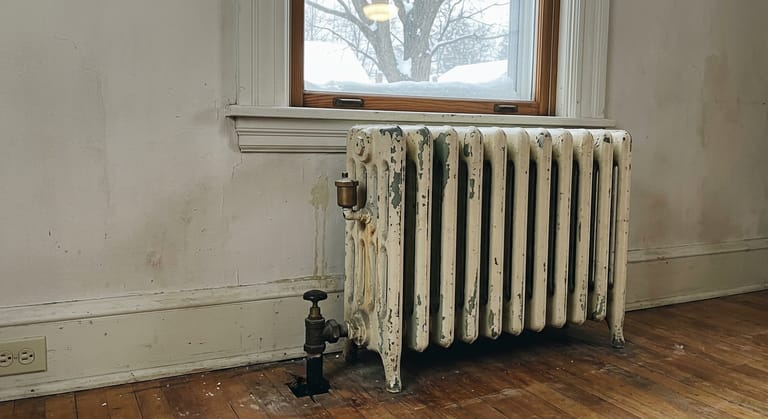
Hissing: the vent working, or the vent finished
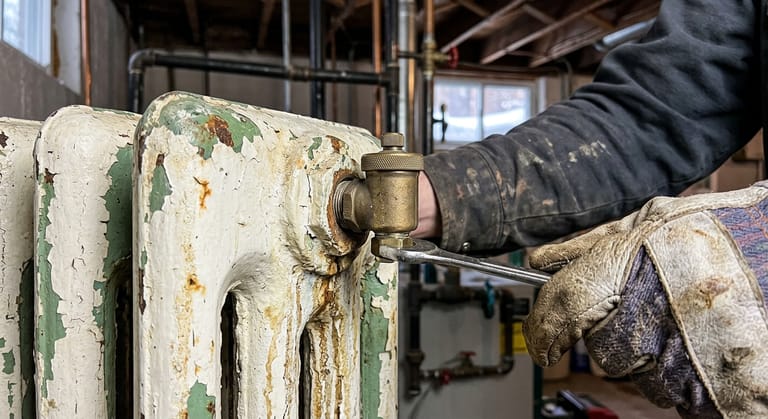
Air has to leave before heat arrives, and a small brass vent near the far end does it alone. Hoffman Specialty lists these for one-pipe steam heating and calls them "primarily replacement items", the honest word for a part nobody rebuilds.
Two radiator models set the choice. On the Model 1A the port itself adjusts, six settings running from slow at 1 to fast at 6, and Hoffman rates that float type vent to a maximum operating pressure of 1-1/2 psig. Its plainer sibling, the Model 40, gives you one fixed port and nothing to turn; Hoffman gives it a maximum operating pressure of 6 psig.
Two failures, opposite symptoms. A vent that cannot shut whistles all evening and spits water. One that cannot open leaves the steam radiator cold while its feed pipe stays too hot to hold.
Swapping one is the cheapest line here: HomeGuide lists air vent replacement at $100 to $320 on a page bylined September 1, 2023. Noting which vents hiss and which rooms lag is free; sizing them, and judging whether the boiler lets them breathe, is what (800) 555-0163 answers at no charge.
Banging is water, not heat
One pipe means one tube in and one out, the same tube: steam climbs, gives up its heat, turns back to water and runs home against the traffic. Whatever stops that water leaving, a sagged floor, a settled joist, a badly shimmed radiator, leaves a puddle for the next cycle.
So partner heating contractors put a level on the radiator before pricing anything. Pitch is not a figure to copy off a page; what matters is that condensate runs downhill to the valve.
The boiler end bangs too. For the main vent models that carry its installation note, Hoffman prints minimum elevations of 6-10 inches above the horizontal return and 18 inches above the boiler water line, to keep them from sputtering water or taking water hammer damage. A vent set lower, or a Model 76 vacuum vent left where a house went from coal to gas and Hoffman says a non vacuum type such as the Model 75 should be used, makes the noise blamed on the radiators.
Knocking at the 5 a.m. setback is not a part you buy. Cellar noises, kettling and gurgling, sit on the sounds a boiler makes and what each means.
Only half of the steam radiator gets hot
- Find where the heat stops. Hold a hand near, not on: the iron runs at steam temperature. Hot inlet, cold outer sections all winter, and the air never left.
- Look at the vent. Paint over the port, eight coats deep, seals it as surely as a failed float.
- Check the supply valve and the pitch. Half open on one pipe traps condensate; tipped away from its valve, the radiator holds water in the bottom sections.
- Then the mains. Several rooms filling late is one shared cause, not five coincidences.
Balancing a floor is billable: HomeGuide puts it at $100 to $300 on that 2023 page. The room by room version of this tree, hot water included, is on one cold radiator when the rest are hot.
Talk to someone who sees these boilers every week
Call (800) 555-0163Free to dial. Whoever answers works on boilers and holds whatever license or registration your state requires.Partner contractors who work on boilers and hydronic systems- Contractors who work on boilers, not just furnaces
- Answered at 2 a.m. in January
- Dialing costs nothing and books nothing
- The price is the contractor's own, set with you
Turning the steam radiator down without breaking it
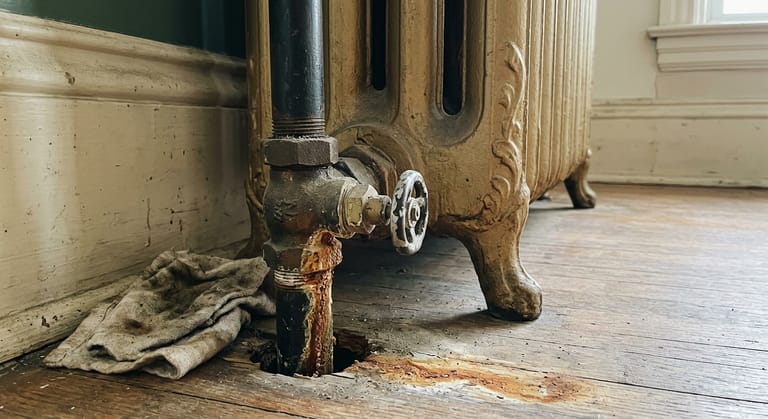
The supply valve on a one pipe unit has two honest positions, open and shut. Using it as a throttle turns a quiet room into a knocking one.
Two pipe houses have an option. Danfoss builds the RA 2000 to meter hot water in one system and low pressure steam in another, on free standing radiators, baseboards or convectors, and names two-pipe steam alongside hot water. Its EPDM disc seals to 15 psig in low pressure steam service. Read what that line does not say: one pipe. Installed there it traps condensate, and the room gets colder and louder.
On one pipe the adjustment lives in the vent: the Model 1A's six port settings let an overheated bedroom fill slower and a lagging one fill faster. Valve bodies, packing nuts and lookalike thermostatic heads sit on radiator valves, thermostatic heads and one pipe air valves.
Repacking a dripping stem is a boiler-off, system-cold job on steam, since the valve sits above the water line; HomeGuide's September 2023 page prices a valve replacement at $100 to $350.
Boiler pressure decides what every vent can do
Vent choice is downstream of one number at the boiler. Hoffman's rule for picking a steam vent is that its rated pressure "must be higher than the maximum operating pressure in the steam system". Run the boiler above what the vent is rated for and it stays shut, the air never leaves, and the radiators stay part cold.
Utica's PEG-E manual gives the residential target it was written for: in a single family house with a clean one pipe system and cast iron radiation, cut-in sits at the minimum 1/2 psi and the differential at 1 psi, for a cut-off of 1-1/2 psi. That cut-off is the figure Hoffman prints as the Model 1A's maximum operating pressure, so pressure setting and vent choice are one decision. Larger buildings, two pipe layouts and convectors are set case by case.
What the control and the code expect. Honeywell's L404F1060, the house sized pressuretrol, has an operating range of 2 to 15 psi and a subtractive differential of 2 to 6 psi, so raising the differential lowers the restart point instead of raising the shutoff. The 2021 IRC at M2002.3 requires a water-gauge glass and a pressure gauge on every steam boiler, the glass midpoint at the normal water level, in whichever edition your state adopted. Weil-McLain's user manual caps the owner's gauge reading at 15 psig, and reads more as a fault in the gauge or the limit control.
Reading that gauge is a homeowner job. Moving a setting on a fired appliance is not, nor is the control behind it: McDonnell & Miller's Series 67 float type low water cut-off breaks current to the burner when water drops to the cut-off level, and the weekly blow down its manual schedules discharges boiler water at operating temperature, which puts it in licensed hands. A swinging water line, dirty water and surging belong on what a steam boiler needs when the level will not hold.
How hot it runs, and how much heat it makes
Caleffi's idronics 25 gives the operating reality: cast iron radiation in these houses was sized for low pressure steam supplied at 215 to 220 degrees F. That is a burn risk at toddler height, and the reason a cover is not decoration.
Each radiator is the heater itself: steam condenses against its own iron, and the room takes that heat back as the metal cools.
Output belongs to the maker's table. Governale's steam ratings per Gov-Free section are 384 BTU for a 4 x 19 inch section and 720 for a 6 x 25; on the Victoria line it prints 3.05 square feet of EDR per section, and a steam output of 734 BTU per hour for a single section at a 215 degrees F average temperature in a 70 degrees F room. Every Governale line shares one ceiling: 15 psi maximum working pressure on steam. Weights and section counts sit on cast iron radiators and what they put out.
Never size a radiator from a price table. BTU bands printed beside dollar figures on cost sites carry no water temperature, no flow rate and no rating standard: they label a shopping category. Real sizing sets a rated output at a stated temperature against what the room loses on a design day.
Repair, or a new steam radiator
Two publishers price repairs close to each other. Fixr, updated January 31, 2025, puts steam repair at $150 to $550 and hot water at $150 to $500. HomeAdvisor, updated June 19, 2026, shows $175 to $600 for steam against a $350 average across all radiator repairs, plus a $100 to $200 service fee.
Replacement is another order of money. HomeGuide puts one steam radiator at $300 to $2,500 installed on that 2023 page, and the $8,600 high end on Fixr's 2025 page is explicitly every unit in the house at once. Removal is quoted separately: HomeGuide says $75 to $400 added to a replacement estimate, Fixr $250 to $400 for labor and disposal.
Converting to hot water later changes the shopping list. Caleffi says a former one pipe radiator needs an upper header connection that can take an air vent, and that a cast iron radiator reused on two pipe should be checked for internal corrosion and pass a minimum 30 psi pressure test. That is a manufacturer journal's guidance, not a code rule.
What to ask whoever answers a "steam radiator near me" search
Steam is a specialty; many good technicians meet a pressuretrol twice a season. Ask three things before booking: whether they work on one pipe weekly, whether they will look at main venting and boiler pressure, not only the noisy steam radiator, and what cut-in and differential they set.
Gather answers first: which rooms are cold, which vents hiss, what the gauge reads, whether knocking follows the thermostat. Stop at the controls, the burner, the gas train and anything wired. The line at (800) 555-0163 costs nothing; a licensed heating contractor picks it up.
Three situations that are not repair questions. For the sulfur smell PHMSA attaches to a natural gas leak: no engine started, no flame struck, no telephone or light switch touched indoors, leave the area, then dial 911 once you are standing at someone else's door.
An alarm going off for carbon monoxide sends you out the same door, minus the detective work: CPSC has the household outdoors first, with emergency services or 911 called from a neighbor's step, a headcount taken there, and everybody waiting outdoors until responders sign off on going back, because CPSC's warning is that you could lose consciousness and die if you go in the home. Whatever appliance is named as the source stays dead until service personnel with the training have been at it.
A relief valve that is discharging is not a fitting to plug, cap or hold shut; Weil-McLain reads a weeping valve on a steam boiler as a limit set too high or another system problem, and sends it directly to a service technician with the right qualification.
Talk to someone who sees these boilers every week
Call (800) 555-0163Free to dial. Whoever answers works on boilers and holds whatever license or registration your state requires.Partner contractors who work on boilers and hydronic systems- Contractors who work on boilers, not just furnaces
- Answered at 2 a.m. in January
- Dialing costs nothing and books nothing
- The price is the contractor's own, set with you