
Steam Boiler Repair: Sight Glass, Cutoff, Pressuretrol
Straight to it
- Four faults cover most winter calls: a low water cutoff that trips, a surging water line, a pressure limit set too high, and a relief valve that weeps. Three of the four can be read from across the basement.
- Pressure is tiny here. Utica's PEG-E manual sets a clean one pipe house with cast iron radiation at a 1/2 psi cut-in and a 1-1/2 psi cut-off, and Weil-McLain's user manual puts the owner ceiling on the gauge at 15 psig.
- A water line that jumps is a water quality symptom. McDonnell and Miller builds a ten second delay into its probe controls to ride out a surging line, and its Series 67 manual names surging water levels among the conditions that shorten a float control's life.
- The 2021 and 2024 IRC require a low water cutoff at M2002.5 and a gauge glass whose midpoint sits at the normal water level at M2002.3, in whichever edition your state has adopted.
- Fixr's January 26, 2026 page puts a boiler repair at $150 to $750 with a $450 average, a third party market range rather than a quote anyone here can honor.
Steam boiler repair starts at the sight glass, the low water cutoff and the pressuretrol, on a boiler whose gauge, Weil-McLain tells owners, should never read past 15 psig. Four faults cover most winter calls: a cutoff that trips, a surging water line, a limit set too high, and a relief valve that weeps.
Residential steam heat is the subject, one pipe and two pipe, in Northeast and Midwest basements; electric baseboard never touches a boiler and is wired work. EIA's RECS 2020 counts 6.01 million Northeast homes on steam or hot water heat out of 9.29 million nationally, and a separate RECS table puts 4.02 million of that national total in homes built before 1950.
The gauge glass reads the whole machine
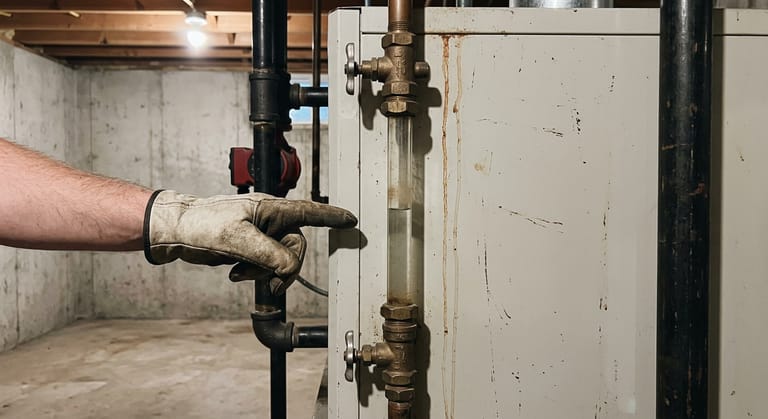
The tube on the boiler's side is the one instrument a homeowner reads without tools. McDonnell and Miller's glossary calls it a gauge glass, sight glass in the trade, and steam boilers do not go without one. The citable rule is 2021 IRC M2002.3: a water-gauge glass and a pressure gauge on every steam boiler, the glass set so its midpoint sits at the normal water level, in whichever edition your state adopted.
Weil-McLain's filling instructions say where that level belongs: the normal waterline, halfway up the gauge glass, with boiler water pH of 7.0 to 8.5 recommended, then the skimming procedure.
- Cold, burner off. The line should sit near the midpoint and hold still.
- Ten minutes in. Movement is normal; a line that climbs out of sight or drops below the glass is not.
- Color. Cloudy or discolored water is a finding, not cosmetics.
Reading the glass is yours. Draining or blowing it down is not, because that water leaves at operating temperature. (800) 555-0163 costs nothing, and a licensed heating contractor answers.
The cutoff decides whether it fires at all
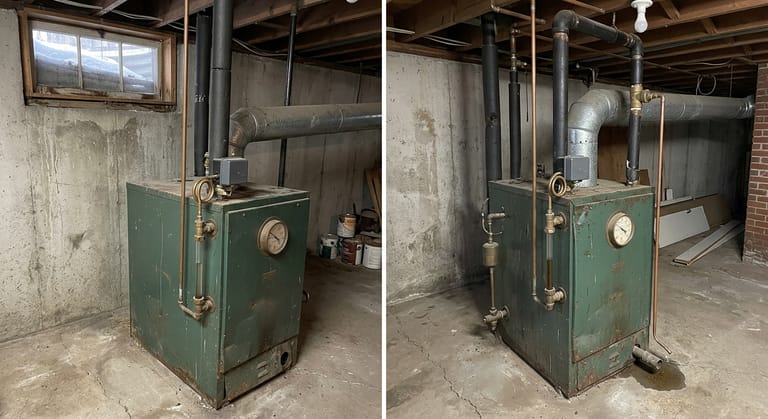
M2002.5 of the 2021 and 2024 IRC makes that control mandatory on steam and hot water boilers alike. Two designs sit outside it: coil-type and water-tube-type units built for forced circulation, each carrying a flow-sensing control. M2002.6 defines the duty: shut the burner down by itself once water falls under the lowest level the boiler's maker calls safe.
Xylem's McDonnell and Miller catalog describes the float version: the level in the control's chamber mimics the level in the boiler, the float drops with it, and at the critical point trips a switch wired in series with the burner, stopping the fire. The same catalog rates the Series 67 to a maximum 20 psi steam, for boilers of any steaming capacity. A probe control works electrically: water completes a circuit past an insulator to a ground, and once it leaves the probe for ten continuous seconds the burner shuts down.
Utica's PEG-E manual asks for a monthly check that the cutoff is still providing proper protection, and for the probes to come out each heating season for inspection and cleaning. Past a look, blow down included, this is licensed work at a live burner circuit, and booking it costs nothing.
Surging: a water line that will not sit still
Surging is the fault most often mistaken for a broken control. Probe controls from McDonnell and Miller carry what the maker calls a delay on break: ten seconds of burner run after the probe loses the water, so a heaving water line does not shut the boiler down. A delay on make adds 30 seconds of feed time once water returns.
Water chemistry drives it, not worn iron. McDonnell and Miller's Series 67 instruction manual groups surging water levels with rapid switch cycling and water treatment chemicals among the severe conditions that pull replacement forward.
Note what the line does and when: surging that started after a recent fill points somewhere different than surging that crept up over two seasons. Watching the glass is yours, the blow down valve is not, and the free line hands that note to a contractor.
Pressuretrol settings, and which way the differential runs
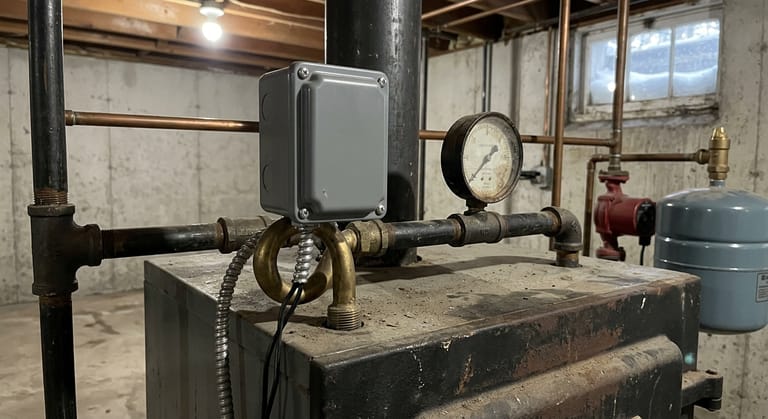
Pressuretrol is a Honeywell name. The L404F family gives operating control with automatic limit protection, snapping a circuit open or closed on a pressure rise; every model in it resets automatically and has an adjustable differential. The one normally found on a residential steam boiler, the L404F1060, works over 2 to 15 psi with a subtractive differential of 2 to 6 psi, nominal at midscale in Honeywell's own footnote.
Subtractive trips people up: cut-in equals the cut-out setting minus the differential, so turning that dial up lowers the restart point instead of raising the shutoff.
| Setting or limit | Published figure | Source |
|---|---|---|
| Cut-in, clean one pipe house, cast iron radiation | 1/2 psi, the minimum setting | Utica PEG-E manual |
| Differential, same case | 1 psi, giving a 1-1/2 psi cut-off | Utica PEG-E manual |
| Maximum limit at start-up | 10 PSI steam | Weil-McLain start-up checklist |
| Owner ceiling on the gauge | 15 psig | Weil-McLain user manual |
Utica limits those figures to a clean one pipe system with cast iron radiation in a single family house; larger, two pipe and convector systems get set one at a time. The limit shuts gas off to the main burners at cut-off, and they refire at cut-in.
Too much pressure shows at the far end of the house first, and Hoffman Specialty says why. Every vent has a rated operating pressure the boiler must stay under; past that rating the vent will not open, leaving the air in the pipe. Hoffman's Model 1A radiator vent is rated to a maximum operating pressure of 1-1/2 psig, so a boiler held too high leaves cold rooms and noise: hissing, banging and cold one pipe radiators, then what each boiler noise means.
Reading the dial is yours; moving it is not, since it is a limit control on a live gas train. That call is free.
Talk to someone who sees these boilers every week
Call (800) 555-0163Free to dial. Whoever answers works on boilers and holds whatever license or registration your state requires.Partner contractors who work on boilers and hydronic systems- Contractors who work on boilers, not just furnaces
- Answered at 2 a.m. in January
- Dialing costs nothing and books nothing
- The price is the contractor's own, set with you
Steam pressure is a fraction of the hot water side
Federal law draws the line. The definition at 10 CFR 430.2 caps a low pressure steam boiler at 15 psig, a hot water boiler at 160 psig and 250 degrees F. Watts rates its 415M1-015 at a 15 psi set pressure for saturated steam service under ASME Section IV, a maker stating its own valve's rating rather than a code line.
| What differs | Steam side | Hot water side | Source |
|---|---|---|---|
| Relief valve in the standard equipment list | 15 PSI | 30 PSI | Weil-McLain EG/PEG Series 6 manual |
| Daily gauge ceiling for owners | 15 psig | 24 psig | Weil-McLain, owner manual |
A weeping valve carries its own meaning here. Weil-McLain's user manual splits it by type: on the water side an expansion tank that has failed, on the steam side a limit control sitting too high or other system problems; either way the manual calls for a qualified service technician right away. Water on the floor is a different search: where boiler leaks come from.
What the work costs on a steam system
No publisher prices steam boiler repair on its own, so these figures cover boiler repair generally, each a market estimate rather than a quote. Fixr's January 26, 2026 page gives $150 to $750 nationally, average $450. HomeGuide, July 14, 2025, prints $150 to $700 for the average repair and a $75 to $200 minimum call out. HomeAdvisor, June 20, 2026, puts labor at $150 to $300 flat, or $75 to $130 per hour.
HomeGuide's December 31, 2025 page puts the steam unit alone at $1,800 to $6,000, material only, the arithmetic behind replacement pricing and what moves it. The cheaper protection is the yearly visit: what a full service includes.
The faults that end the conversation
Carbon monoxide. CPSC says do not look for the source if the alarm sounds. The house empties, all of it, and emergency services or 911 get dialed from outside, somebody counts the people who came out, and nobody sets foot back inside until responders permit it; CPSC's own words are that you could lose consciousness and die if you go back in. If a malfunctioning appliance is the source, CPSC says it stays off the fuel until a trained technician has gone through it.
A discharging relief valve. Weil-McLain's user manual sends a valve that often weeps straight to a qualified service technician. ICC's plumbing code explainer adds that a relief discharge line cannot end in a threaded connection, precisely so that nobody can cap it.
What to have ready before you call
Steam boiler repair moves faster when the contractor hears these five things first.
- The glass. Where the line sits cold, where it goes under fire, and its color.
- The gauge. The reading at rest and the highest you have seen, against 15 psig.
- The cutoff. Whether it tripped, and whether it needed a reset button.
- The pattern. Short cycling, cold upstairs, banging, or a level that will not hold.
- The boiler. Gas or oil, roughly how old, one pipe or two.
If the heat is off entirely, start at the checks that come before the call.
Steam boiler repair is a diagnosis trade, not a parts trade: one cold radiator traces back to venting, water quality or a limit setting. Call (800) 555-0163 at three in the morning if that is when it fails; nothing is billed, and whoever picks up works on boilers and holds whatever license or registration your state requires.
Talk to someone who sees these boilers every week
Call (800) 555-0163Free to dial. Whoever answers works on boilers and holds whatever license or registration your state requires.Partner contractors who work on boilers and hydronic systems- Contractors who work on boilers, not just furnaces
- Answered at 2 a.m. in January
- Dialing costs nothing and books nothing
- The price is the contractor's own, set with you