
What It Costs to Replace a Boiler, Fuel by Fuel
Straight to it
- Three publishers, three scopes, never averaged together: HomeAdvisor (June 20, 2026) gives a $3,605 to $8,445 normal range and a $5,911 average; HomeGuide (December 31, 2025) gives $3,200 to $9,000 with a $6,100 average; Fixr (January 28, 2026) gives $3,000 to $8,500, also averaging $6,100.
- Efficiency class moves the invoice more than brand does. HomeAdvisor separates standard units at 80 to 89 percent AFUE from high-efficiency units at 90 percent AFUE and above, and the two bands barely overlap.
- A unit price is not an installed price. HomeGuide puts the appliance alone at $1,400 to $6,500, then adds $1,200 to $3,200 for replacement labor and fitting.
- Federal AFUE minimums bind the factory, not the installer: 84 gas hot water, 82 gas steam, 86 oil hot water, 85 oil steam for units built on and after January 15, 2021 (10 CFR 430.32).
- Switching fuel is a separate project. HomeGuide's December 30, 2025 page puts an oil-to-gas conversion at $6,000 to $20,000 for most homes, before the old tank is dealt with.
Boiler replacement cost lands between $3,605 and $8,445 for most homes, HomeAdvisor's normal range on its June 20, 2026 page, against a $5,911 average. Three national pricing sites cost this same job and no two agree.
The gap is not sloppiness. Each publisher measures a different scope, and the distance between a unit price and an installed cost is where sticker shock is born. Every figure below carries its publisher and date.
Three published ranges, three different scopes
| Publisher, page date | Scope | Published figure |
|---|---|---|
| HomeAdvisor, June 20, 2026 | Replacing a unit | Normal $3,605 to $8,445, average $5,911 |
| HomeGuide, December 31, 2025 | Installing a new unit | $3,200 to $9,000; average $6,100, low $1,500, high $12,000 |
| Fixr, January 28, 2026 | Replacement | $3,000 to $8,500, average $6,100 |
Read boiler replacement cost as three publisher estimates, not one market number. HomeAdvisor also runs a gas page, updated June 17, 2026, averaging $5,883, and its boiler pages disclose that the article was created using automation technology and edited in house. None is survey data.
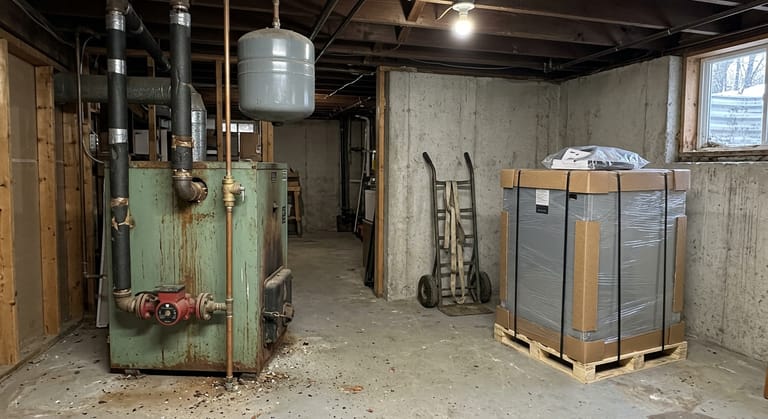
Gas boiler replacement costs, and why gas sits mid-market
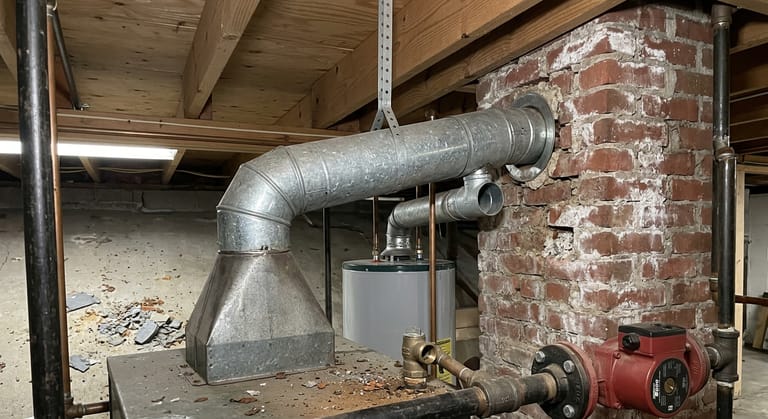
Gas boiler replacement cost is $4,000 to $9,000 installed on HomeGuide's December 2025 page, of which $1,400 to $5,600 is the appliance. Fixr's January 2026 table runs to $10,000. HomeAdvisor's June 2026 fuel table prints HomeGuide's range word for word.
Gas sits mid-market because fuel supply and venting are usually already there. What moves a quote is what the old equipment left behind. In Northeast basements the first thing to go sideways is the chimney: an atmospheric cast iron unit vented into masonry gets replaced by something that cannot share the flue, and HomeGuide's December 2025 page lists a liner at $1,500 to $4,000.
Read the data plate for input rating and build year, count the zones, photograph the flue. Stop at the gas valve, the burner and the wiring, which the manufacturers' manuals route to a qualified service technician. (800) 555-0163 is free to dial; whoever answers is a licensed heating contractor. How these units differ inside is on gas boilers in American homes.
Cost to replace a boiler by fuel
| Fuel | HomeGuide, December 2025 | Fixr, January 2026 |
|---|---|---|
| Natural gas | $4,000 to $9,000 | $4,000 to $10,000 |
| Oil, standard | $3,300 to $7,200 | $4,800 to $9,000, all oil |
| Oil, high efficiency | $6,300 to $9,000 | |
| Propane | $2,800 to $7,500 | $2,800 to $9,000 |
| Electric | $1,800 to $8,000 | $2,500 to $6,000 |
Outdoor wood is the outlier at $7,000 to $16,000 on the HomeGuide page. Fixr's dedicated oil page of January 26, 2026 averages $7,500 and reaches $11,500 for a condensing unit. Oil heats a wide slice of this region: ACS 2024 counts 3,844,459 Northeast households on fuel oil or kerosene.
Across ten winters the fuel bill outweighs the equipment gap. EIA's residential heating oil series closed the season at $5.535 a gallon in the week of March 30, 2026, up $1.865 year over year after Brent crude ran from $61 to $118 a barrel in one quarter; mid-season was calmer, December 2025 and January 2026 both at $3.693. Tanks and nozzles sit on oil boilers and their fuel systems, and electric boilers, which the federal table does not rate, have their own page.
What the efficiency class does to the cost
Efficiency class moves boiler replacement cost more than brand does. HomeAdvisor's June 2026 page separates standard models at 80 to 89 percent AFUE ($2,200 to $7,000) from high-efficiency ones at 90 percent AFUE and above ($6,000 to $11,000). HomeGuide's December 2025 page draws its own high-efficiency band lower, $4,000 to $10,000.
ENERGY STAR sets its bar higher, at 90 percent AFUE for gas and 87 for oil under Boilers Eligibility Criteria Version 3.0 (Rev. January 2024). EPA calls certified gas units "approximately 6% more efficient than the federal standard": a percentage-point gap in a rating, not a promise about a fuel bill. The rating sits on the EnergyGuide label, which under 16 CFR 305.22(b)(2) a retailer must show before a buyer agrees to purchase. Venting and condensate drainage are on high-efficiency condensing boilers.
New boiler cost for the unit alone
New boiler cost, meaning the appliance before anyone touches a pipe, is $1,400 to $6,500 on HomeGuide's December 2025 page, with labor and fitting a separate $1,200 to $3,200. That page prices hardware by design, material only and pegged to top-selling sizes: hot water $1,200 to $4,000, steam $1,800 to $6,000, condensing $1,900 to $7,000. A conventional sealed-system swap runs $2,200 to $7,000 with labor.
The type tables tell it twice. Fixr in January 2026 and HomeAdvisor in June 2026 both open a system unit at $3,000 and top a condensing or high-efficiency one at $11,000. A system boiler replacement is the narrowest row in each, $3,000 to $6,500 on Fixr and $3,000 to $6,000 on HomeAdvisor, while a combination unit, which also makes domestic hot water, runs wider on both; what it supplies is on combi boilers in US homes.
Fixr also prices by house size, which shifts the band without changing the equipment. No table here prices a Navien or a Weil-McLain by name; brand specifications belong on how the main boiler brands compare.
Talk to someone who sees these boilers every week
Call (800) 555-0163Free to dial. Whoever answers works on boilers and holds whatever license or registration your state requires.Partner contractors who work on boilers and hydronic systems- Contractors who work on boilers, not just furnaces
- Answered at 2 a.m. in January
- Dialing costs nothing and books nothing
- The price is the contractor's own, set with you
The line items that decide the invoice
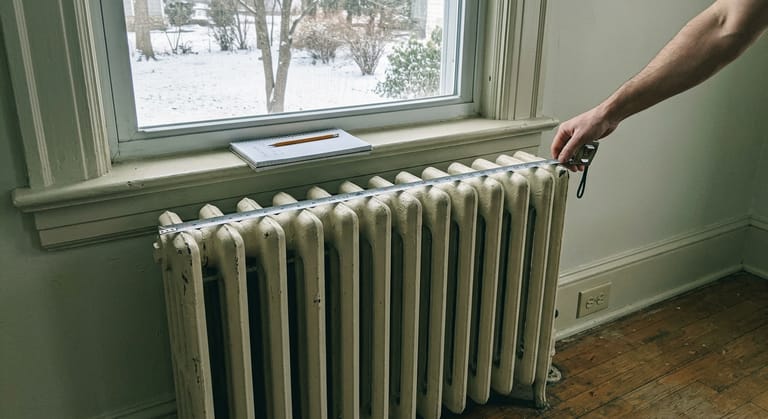
A headline range covers a straight swap. HomeGuide's December 2025 line items are what separate it from the boiler replacement cost on a real invoice.
| Line item | HomeGuide figure |
|---|---|
| Removal and disposal of the old unit | $200 to $500 |
| Permits | $50 to $250 |
| Condensate drain, high-efficiency models | $200 to $600 |
| Manual J load calculation | $200 to $500 |
| Labor and fitting | $1,200 to $3,200 |
Labor gets quoted three ways, so ask which you are holding: HomeGuide has plumbers at $45 to $150 an hour, HomeAdvisor plans on $100 to $250 for a first visit and the same again hourly, Fixr gives a flat $1,000 to $3,500.
Count the radiators, measure the heated area, dig out the old permit card. Sizing, venting and near-boiler piping are the installer's judgment. A call to (800) 555-0163 costs nothing and puts a licensed contractor whose trade is boilers on the line. The day-of sequence is on what a boiler installation involves.
Change boiler cost: switching fuel or switching type
Change boiler cost is a different budget from a like-for-like swap, and mixing the two is how bids get compared wrongly. HomeGuide's oil-to-gas page of December 30, 2025 puts a conversion at $6,000 to $20,000 for most homes: the lower half where a gas line already reaches the house, the upper half where a new one is needed. Its breakdown puts the new furnace or boiler, installed, at $3,500 to $12,000.
Then the tank, treated on that page as separate scopes rather than one range: above-ground removal, underground removal, abandonment in place, and soil remediation that can add $2,500 to $15,000 or more. Some utilities, it notes, cover part of a main extension.
Changing emitters at once is a third budget. Hydronic baseboard runs $430 to $1,200 installed per heater on HomeGuide's July 7, 2025 page, covered on replacing baseboard heaters; the systems priced here are hot water (hydronic), and electric baseboard heaters, which hold no water, are an electrician's job. A radiant floor changes everything, since the same publisher's September 24, 2025 page puts a whole hydronic system at $13,700 to $43,000 for a 1,500 to 2,000 square foot home, heat source included: see what radiant floor heating costs.
Replace or repair, and how that call usually goes
Repair is cheap until it repeats. HomeGuide's July 14, 2025 service page puts an average repair at $150 to $700, Fixr in January 2026 at $150 to $750, and HomeAdvisor's June 2026 service page at a $425 average. Against a $5,911 replacement, one repair is the better buy; three across three winters is not, since HomeGuide prices a circulator at $300 to $1,100.
Repairing still wins when
- The fault is a control, a circulator or a zone valve, not the vessel
- The block and sections hold pressure with no weeping seams
- The unit was built after January 15, 2021 and meets the federal floor
Replacing wins when
- A section or the heat exchanger leaks, which is the vessel itself
- The unit predates September 1, 2012, when the floor was 80 AFUE and 75 for gas steam
- The equipment has been under water, or a third fault lands mid-season
Age is the quiet driver. EIA's RECS 2020 counts 6.79 million Northeast homes with main heating equipment 20 or more years old out of 21.92 million, and 4.02 million US homes on steam or hot water were built before 1950. Old is not unsafe by itself, but it does mean the vessel, not the controls, is what a quote should be about.
Prices near you, and what a state actually changes
Boiler replacement cost near me is really a question about who may legally do the work and what the paperwork costs, because no publisher here prints a regional figure. HomeAdvisor renders a geolocated range beside its national one, and only the national numbers appear above.
Fixr's August 29, 2025 permit page is the only one of the three pricing a mechanical permit separately, at $60 to $600. Licensing splits by state too: New Jersey requires a Master HVACR contractor license under N.J.S.A. 45:16A-1, Massachusetts runs a separate Oil Burner Technician certificate out of its Department of Fire Services, and Pennsylvania has no state licensure for most construction contractors while exempting single-family residences from its boiler law, which its Department of Labor and Industry pairs with a warning that exempt work may still fall under the Uniform Construction Code.
Massachusetts and New Jersey searches are common for a reason: RECS 2020 puts 26 percent of Massachusetts homes and 25 percent of New Jersey homes on steam or hot water, against 35 percent in New York. Running cost varies more than installation. EIA's 2025 annual state series puts residential natural gas at $25.06 per thousand cubic feet in Massachusetts against $10.74 in Wisconsin, and NOAA's 1991-2020 normals give Boston Logan 5,545.4 annual heating degree days at base 65 degrees F.
Rebates, cheap bids, DIY and midnight failures
Four things move the number in ways those tables do not show.
- Programs. State, utility and federal incentives exist for efficient equipment, and no amount appears here because terms change by program and year. Never let an incentive pick the size of the unit.
- Cheap bids. HomeGuide's $1,500 low end is real and so is its $12,000 high end. A bid far under the pack is usually a unit price with the labor missing, an output smaller than the house needs, or a permit nobody intends to pull.
- Doing it yourself. Michigan exempts an owner occupying a single family dwelling from holding a mechanical license, yet its rule says a licensed mechanical contractor must secure the permit for a residential steam or vapor boiler at or below 15 psig.
- Emergencies. Nobody publishes an out-of-hours replacement price. The labor premium is published: HomeGuide's July 2025 service page shows emergency work at $140 to $210 an hour against $75 to $150 standard.
A January failure carries a risk no invoice shows: that same Weil-McLain manual warns that a boiler component failure in cold weather can result in frozen plumbing and water damage in a matter of hours. Partner heating contractors treat that as the argument for deciding in September.
What to have ready before you ask for a price
Five minutes of note-taking turns a vague callback into a real number.
- The data plate: build year, input in BTU per hour, fuel, and steam or hot water.
- The distribution: cast iron radiators, fin-tube baseboard, radiant floor or a mix, and how many zones.
- The venting: masonry chimney, metal flue or PVC through a sidewall, and what else shares it.
- What has already failed, with dates and amounts, and whether a control or the vessel was involved.
- Whether a fuel switch is on the table, since that is a separate project and budget.
With that list, two written quotes become comparable instead of guesses. The call is free, books nothing, and reaches someone who works on boilers and holds whatever license or registration your state requires: (800) 555-0163. If the choice is still open between hydronic heat and forced air, boiler versus furnace sets the two side by side.
Talk to someone who sees these boilers every week
Call (800) 555-0163Free to dial. Whoever answers works on boilers and holds whatever license or registration your state requires.Partner contractors who work on boilers and hydronic systems- Contractors who work on boilers, not just furnaces
- Answered at 2 a.m. in January
- Dialing costs nothing and books nothing
- The price is the contractor's own, set with you