
What a Hydronic Warm Floor Costs to Put In
Straight to it
- Two rates, two publishers, never averaged: HomeGuide (September 24, 2025) puts a hydronic floor at $7 to $17 a square foot without new flooring, Fixr (January 31, 2025) at $6 to $20 installed.
- Scope decides the total. HomeAdvisor's June 19, 2026 page runs partial work from $200 up to $14,000 and whole-home jobs $13,800 to $48,000, which are two projects, not one span.
- The heat source is a separate line. HomeGuide's $13,700 to $43,000 whole-house figure is quoted for a 1,500 to 2,000 square foot home and already carries a new boiler at $3,200 to $9,000.
- Tearing up a finished house is the premium: HomeGuide and Fixr each put a retrofit 50 to 80 percent above new construction, and floor removal adds $1.50 to $3.00 a square foot.
- Labor is the bigger number. Fixr prints $2 to $3 of materials a square foot and $10 to $15 of labor as two separate lines, not as a breakdown of its own installed rate.
Radiant floor heating cost runs $7 to $17 per square foot for a hydronic system, before any new flooring goes over it, on HomeGuide's page dated September 24, 2025. Fixr's hydronic row, updated January 31, 2025, sits at $6 to $20 a square foot installed. Both rates price tubing in a floor and neither includes the boiler feeding it, which is where budgets break.
Radiant floor heating prices: four published figures and what each measures
Prices for radiant floor heat arrive in two shapes: a rate for every square foot of warmed floor, and a project total that also buys the heating equipment. Reading the first as if it were the second is how a $10 figure turns into a $30,000 surprise.
| Publisher, page date | What the figure prices | Published number |
|---|---|---|
| HomeGuide, September 24, 2025 | Hydronic floor heat, no new flooring above | $7 to $17 a square foot |
| Fixr, January 31, 2025 | Hydronic row, installed | $6 to $20 a square foot |
| Fixr, January 31, 2025 | Materials and labor, printed as separate lines | $2 to $3 materials, $10 to $15 labor |
| HomeAdvisor, June 19, 2026 | A heated floor, installed professionally | $1,653 to $6,656, average $4,128, or $6 to $20 a square foot |
Three publishers, three market estimates, not one industry number. HomeAdvisor prints a note on its cost pages saying they are drafted with automation technology and then fact-checked by its own editor.
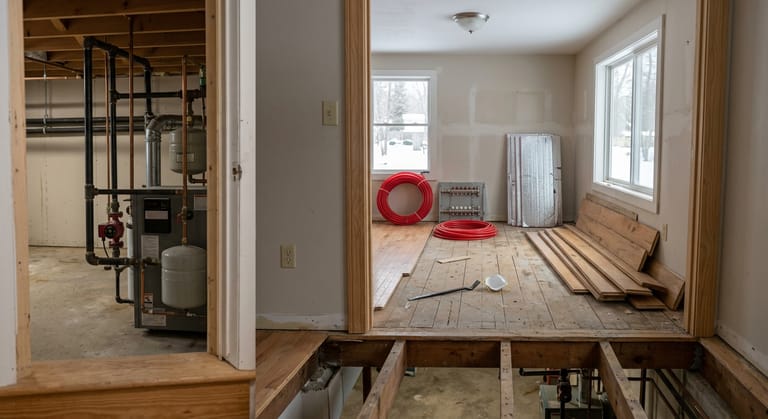
Cost of a warm floor by scope, one room or the whole house
HomeAdvisor's June 19, 2026 page sorts the market by scope rather than by rate: partial in floor heating jobs from $200 up to $14,000, whole-home installations $13,800 to $48,000. Two projects, two spans, never blended into one. That same page prices hiring the installer separately again, $550 to $2,500.
HomeGuide's whole-house number is $13,700 to $43,000 for a 1,500 to 2,000 square foot home, and it already contains a new boiler at $3,200 to $9,000 on top of $7 to $17 for every square foot of the in-floor part. Quote that total without the house size and the boiler attached and it stops meaning anything.
Pace off the rooms you want warm and note which sit over an unheated basement or crawl space. Loop layout, supply temperature and the choice of heat source are where homeowner work ends. Dialing (800) 555-0163 carries no charge and commits you to no visit, and a licensed heating contractor picks up.
New construction against a retrofit
Building from scratch is the cheap version. HomeGuide puts hydronic floor heating in new construction at $10,500 to $34,000, for a 1,500 to 2,000 square foot home and excluding the flooring above, and describes it as installing the system and connecting it to an existing boiler or heat source.
Cutting one into a finished house is that same work with demolition in front of it. HomeGuide says a retrofit runs 50 to 80 percent more than new construction, and Fixr's January 2025 page prints the same 50 to 80 percent. Treat it as a rule of thumb rather than a measured premium. Floor removal then adds $1.50 to $3.00 a square foot on average, and HomeGuide treats the adjustments a house needs for the raised floor height as work in its own right rather than pricing them.
What sits inside the per square foot rate
Fixr prints two more figures for the same work: $2 to $3 of materials for every square foot, and $10 to $15 of labor. They are separate lines, not a breakdown of its $6 to $20 installed row, and they do not sum to it. Labor is the bigger number either way, which is why access and floor build-up move a quote more than the brand of tubing ever will.
Permits get their own line. HomeGuide's September 2025 radiant page allows $75 to $180 for permits and inspections, while Fixr's August 29, 2025 permit page is the only one of the three that prices a mechanical permit on its own, at $60 to $600. Which permit a floor loop falls under is a local question; either way the fee is billed by the jurisdiction rather than earned by the crew, so a bid that folds it into labor is hiding a pass-through.
Talk to someone who sees these boilers every week
Call (800) 555-0163Free to dial. Whoever answers works on boilers and holds whatever license or registration your state requires.Partner contractors who work on boilers and hydronic systems- Contractors who work on boilers, not just furnaces
- Answered at 2 a.m. in January
- Dialing costs nothing and books nothing
- The price is the contractor's own, set with you
The heat source is a budget of its own
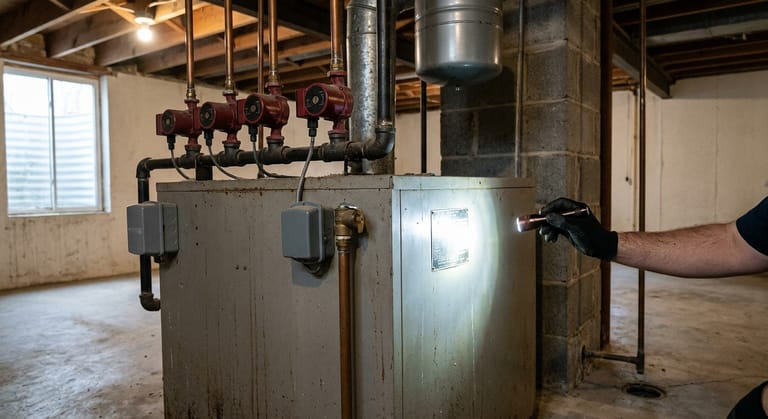
A radiant floor heating cost that leaves out the boiler is half an answer. HomeGuide carries a new one at $3,200 to $9,000 inside its whole-house figure, and what drives that number sits on what replacing a boiler costs, with the day-of sequence on how a boiler installation runs.
Which unit ends up on that line is decided by temperature. Caleffi puts most radiant panel systems well below the water temperatures a fin-tube baseboard or a cast iron radiator is built around, and Uponor lists 80 to 165 degrees F as typical residential supply water, on a table its own caption marks as not for system design. Equipment that runs happily down there tends to be condensing, and condensing sits at the expensive end of every boiler table.
Federal law sets 84 percent AFUE for a gas-fired hot water boiler carrying a January 15, 2021 or later build date (10 CFR 430.32(e)(2)(iii)), a manufacture date rather than an installation date, while ENERGY STAR asks 90 percent AFUE for gas under its Boilers Eligibility Criteria Version 3.0 (Rev. January 2024). Compare two bids on the AFUE each one names, not on the word condensing.
An old boiler sized for cast iron radiators is not automatically a saving either, because the floor still wants the lower supply temperature, and the mixing or reset control that holds it there has to come from somewhere. Read the data plate for fuel, input rating and build year, then count the zones it already serves. The reading stops at the jacket: gas trains, burner components and boiler wiring are a licensed heating contractor's work and never a homeowner's, and asking one what the plate means costs nothing.
What the floor covering changes
Uponor recommends that finished surface temperatures not exceed 80 degrees F unless the wood flooring manufacturer rates it higher, a note printed for poured underlayment under hardwood, tile or carpet. A covering that insulates rather than conducts is a design constraint before it is a price.
The assembly under the finish is what the labor line actually buys. A poured floor adds concrete, sleepers for the finish to grip and the height work that follows. Working from below is a different shape of bill: clips, insulation in every bay and hours spent overhead in a basement, with no pour and no demolition upstairs. That is what the underfloor radiant heating cost buys. Two methods, two labor totals, and the one an estimator picks sets the hours before anything is bought.
One number is deliberately absent above. HomeGuide's with-new-flooring rate contradicts itself between its banner and its body, so every figure on this page is its without-flooring one. Where a bid includes the finished surface, ask for that surface as a separate line.
In floor radiant heating cost on a written quote
No published band is a quote. Six items turn a callback into a radiant floor heating cost you can compare.
- Heated area in square feet, room by room, and which rooms sit over unheated space.
- New construction, an addition, or a retrofit into a finished floor.
- The finish going down, and whether the bid includes buying and laying it.
- The heat source: an existing boiler with capacity to spare, or a new one.
- Floor removal and height adjustments, each priced on its own line.
- Permit and inspection, named with the fee rather than described as included.
With that list in hand, two bids become comparable instead of two guesses, and the questions worth asking on site are on what an installation week involves. There is no fee for dialing (800) 555-0163 and no obligation attached to it, and the contractor who answers works on boilers and holds whatever license or registration your state requires.
Why a bid lands above every table
Radiant floor heating cost climbs past the published bands for reasons visible before anyone quotes. A partial job set against a whole-home figure will always look cheap. A retrofit carries its 50 to 80 percent premium plus demolition and carpentry. A house with no usable heat source is buying two systems at once.
Incentives run the other way. State, utility and federal programs for efficient heating equipment exist, but no amount appears here, because terms change by program and by year, and a rebate is never a reason to size equipment differently. How loops, manifold and controls fit together is on how a hydronic warm floor works, and a zone that stopped heating belongs on radiant floor repair rather than in a replacement budget.
Talk to someone who sees these boilers every week
Call (800) 555-0163Free to dial. Whoever answers works on boilers and holds whatever license or registration your state requires.Partner contractors who work on boilers and hydronic systems- Contractors who work on boilers, not just furnaces
- Answered at 2 a.m. in January
- Dialing costs nothing and books nothing
- The price is the contractor's own, set with you