
Radiant Floor Heating Repair Starts at the Manifold
Straight to it
- Air outranks everything. Caleffi's idronics 15 counts complete loss of flow and heat output from large air pockets among the seven problems air causes in hydronic systems.
- One circuit cold is a manifold question. Every circuit cold is a pump, a valve or a burner question, and those live at the boiler rather than under the tile.
- A sinking gauge is the cheapest leak detector a homeowner owns, provided nothing is quietly topping the system up. The CGa Series 3 manual prints 12 psi as a typical residential cold fill.
- The 2021 IRC M2103.4 tests embedded tubing at 100 psi or better for half an hour. That is acceptance testing for new or altered work, not something to try on a finished floor.
- Parts close most calls: HomeGuide's July 14, 2025 table lists $300 to $1,100 for a circulating pump and $100 to $500 for a zone valve.
Radiant floor heating repair splits into 6 faults, and 4 are found without opening a floor: air, a stalled pump, a closed manifold valve, or a boiler that never fired. The other two, a punctured tube and a weeping fitting, need a gauge and a pressure test first.
This page stays with hot water (hydronic) heat. Electric radiant mats under tile carry no water and belong to an electrician.
Read the symptom before anyone opens a floor
| What the house is doing | Usual cause | Where it goes |
|---|---|---|
| One circuit cold, the rest warm | Air in that circuit, or its manifold valve turned down | Purge, then balance |
| Every circuit cold, burner firing | Stalled pump, shut zone valve, or a mixing control that quit | Licensed work past the switch |
| Nothing fires at all | Thermostat, service switch, breaker, or a lockout | Boiler side first |
| Gauge sinking between fills | A pinholed tube, a fitting, or a tank that stopped working | Pressure test |
| Relief valve dripping | Expansion tank waterlogged or undersized | Tank before valve |
| Warm at the manifold, cold at the far wall | Flow too low for a long circuit | Balancing |
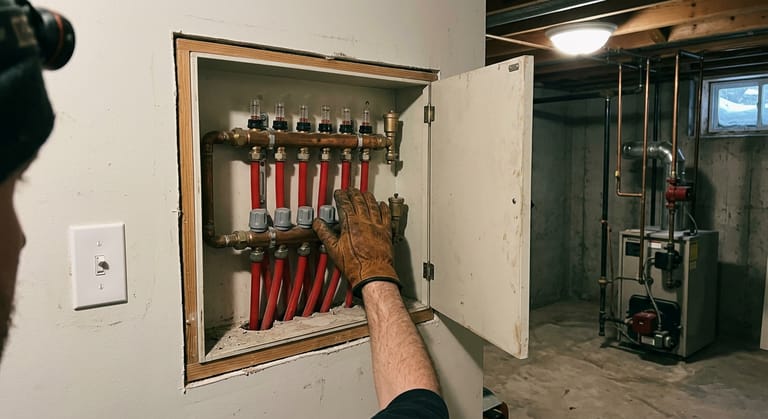
Only the fourth row puts a saw near concrete, which is why the manifold cabinet opens first: every circuit can be felt there.
Air first, because it costs nothing to suspect
Water carries heat that air cannot: Caleffi's idronics 15 puts the gap at almost 3,500 times, volume for volume, and reads cool spots on radiators as a sign of entrapped air. Its list of seven problems air causes in hydronic systems ends with complete loss of flow.
In a radiant slab that reads as one dead circuit while neighbors run warm: nothing is broken, water has stopped going around that loop.
- Call for heat. Raise the thermostat for the cold zone and give it ten minutes.
- Touch both ports briefly, back of the fingers. Radiant supply water reaches 165 degrees F in Uponor's residential column, so touch and let go, never grip a pipe. A live loop reads warm out, cooler back.
- Look at the valves. Balancing knobs get bumped by other trades, and a circuit turned down to nothing behaves like an airbound one.
- Read the gauge. Note the boiler's cold pressure, then read it again a week later.
- Stop at the purge valves. Purging pushes water through one loop with the return shut, and the wrong order drives air into the next circuit.
Touching the ports briefly, reading the gauge and photographing the manifold are yours. Purging in sequence, wiring and the burner are not. (800) 555-0163 is picked up by a licensed heating contractor, and nothing is charged for it.
Every radiant circuit cold: pump, valve, or boiler
Warmth at the manifold means the heat source works. Nothing warm anywhere means it does not, and a dead boiler gets checked in order: thermostat, service switch, breaker.
Where the burner fires and the manifold stays cool, water is not moving, and the usual reason is a circulator that hums, stalls or weeps at the flange.
The valve is the other candidate. Resideo rates the V8043 to open or close in 15 seconds, normally closed when de-energized, with a manual opener on every listed model that reverts once power returns. A lever left on manual after an outage holds one zone open: see zone valves that stick, buzz or sit on the lever.
Watching whether the manifold warms during a heat call costs nothing. Metering that 24 Vac actuator is a state question: Michigan requires a mechanical contractor licensed for hydronic heating, and exempts only an owner living in the single family home. On the free call a licensed contractor hears those symptoms and says which fault to chase first.
The gauge is the leak detector you own
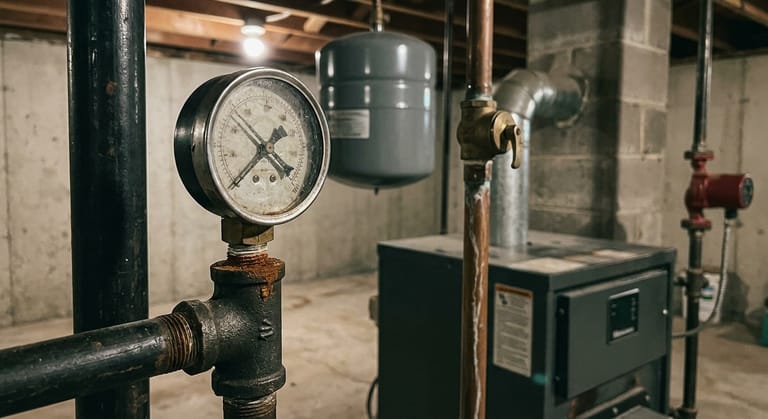
Two numbers bracket that gauge. At filling, Weil-McLain's CGa Series 3 manual puts a residential system at 12 psi cold, adding that the right figure varies from one system to the next. In service, that family's user manual publishes no running band, only a ceiling: not past 24 psig, above which the tank or the gauge becomes the suspect.
A system needing a top up every few weeks is losing water, and with tubing under the floor that means a manifold fitting, a boiler connection, or the tube itself. Steady pressure clears a system only where nothing is refilling it: Amtrol's Fill-Trol combines an expansion tank with an automatic fill valve, and a device like that hides a slow leak by making it up.
Pressure climbing is the opposite fault. Weil-McLain ties frequent relief valve weeping to a tank that is waterlogged or undersized, and Amtrol's Extrol instructions land in the same place: a dripping relief valve may mean the tank was never charged right or never big enough. Sizing follows the cooler slab: the EXTROL PRO radiant chart is computed at 15 psig fill, 30 psig relief valve and 120 degrees F average, where the boiler chart for that same tank assumes 180 degrees F. More on what a dripping relief valve means.
Reading the gauge cold and again a week later is yours; test rigs and buried loops are not.
Talk to someone who sees these boilers every week
Call (800) 555-0163Free to dial. Whoever answers works on boilers and holds whatever license or registration your state requires.Partner contractors who work on boilers and hydronic systems- Contractors who work on boilers, not just furnaces
- Answered at 2 a.m. in January
- Dialing costs nothing and books nothing
- The price is the contractor's own, set with you
Narrowing a floor leak to one circuit
The manifold saves the concrete: each radiant loop closes on its own and can be shut one at a time until the pressure loss stops. Uponor lists residential circuits of 200 to 330 feet at 6 to 12 inches on center, typical published data rather than a design specification. That geometry is why a thermal camera sees a live loop as a warm serpentine and a dead one as a cold band.
Sketching which rooms went cold and finding the original paperwork is homeowner work. Camera work, circuit isolation and cutting are not. Radiant floor heating repair that reaches the concrete stage is rare, and a free call with a licensed contractor is where to find out whether yours needs to.
A cool floor is not always a broken one
Uponor's residential column gives 80 to 165 degrees F supply water, a 10 to 20 degrees F drop across the circuit, 10 to 30 Btu/h per square foot of output and a floor surface at 72 to 84 degrees F, all flagged as typical data rather than a specification. Caleffi states the principle: most radiant panel systems require much lower water temperatures than fin-tube baseboard or cast iron radiators.
So a mixing valve or reset control is a repair item in its own right, and water arriving at boiler temperature is worth a question even when the rooms feel warm. Uponor's poured underlayment section also recommends floor surfaces not exceed 80 degrees F unless the wood flooring manufacturer allows more.
What a radiant floor repair costs
Permits sit outside a repair invoice: HomeGuide's September 24, 2025 radiant page puts them at $75 to $180 on average, charged to the permit holder.
Bigger numbers sit elsewhere: what an in-floor system costs per square foot, how the tubing is laid and tested, and how a hydronic floor system works.
What to have ready when you call
Have the cold fill reading, the date of the last top up, which rooms went cold, and a photo of the manifold valves.
That is the homeowner half of radiant floor heating repair. Purging, isolating circuits, metering actuators and anything touching the burner is licensed work. Dial (800) 555-0163: the call costs nothing and a licensed heating contractor who works on hydronic systems picks it up.
Talk to someone who sees these boilers every week
Call (800) 555-0163Free to dial. Whoever answers works on boilers and holds whatever license or registration your state requires.Partner contractors who work on boilers and hydronic systems- Contractors who work on boilers, not just furnaces
- Answered at 2 a.m. in January
- Dialing costs nothing and books nothing
- The price is the contractor's own, set with you