
When the Boiler Circulator Pump Stops Moving Water
Straight to it
- Four faults are worth ruling out in order: no power at the switch or relay, a stalled rotor, a weeping flange gasket, or a mismatch to the loop.
- Heat in the body is not proof of flow. Taco lists the cast iron 007-IFC at 0.71 A, 3,250 RPM and 1/25 HP on an impedance protected motor, so a stalled rotor can sit there warm.
- Speed matters more than brand. Grundfos publishes 87, 80 and 60 watts for the three speeds of one UPS 15-58 at 115 V, in a single table.
- Three cost sites print nearly the same swap price, $300 to $1,100, so read that span as one market estimate rather than three.
- Water reaching the junction box ends the home diagnosis. Weil-McLain's user manual forbids operating a boiler whose controls have been sprayed or submerged; read your own model's manual.
A boiler circulator pump usually fails in one of 4 ways: no power reaching it, a stalled rotor, a leaking flange gasket, or a unit mismatched to the loop it serves. Two cost nothing to rule out.
Everything here is hot water (hydronic) heat: a circulator pump only turns up where water carries the heat, not air. Electric baseboard has no pump in it and is an electrician's work.
What a boiler circulation pump does, and the names on the box
The circulator moves water between the fire and the radiators. Stop it and the burner still lights while the far bedroom stays cold.
Supply houses do not agree on a name. A circulation pump for a boiler, a circulating pump, boiler circulation pump, hot water circulator pump: one device, four labels, printed as circulator in most parts books. A recirculation pump on a domestic hot water line shares the nickname but is a different device.
The motor is small: Grundfos publishes 0.74 amps and 85 watts at 115 V for its UP 15-42 F/FR.
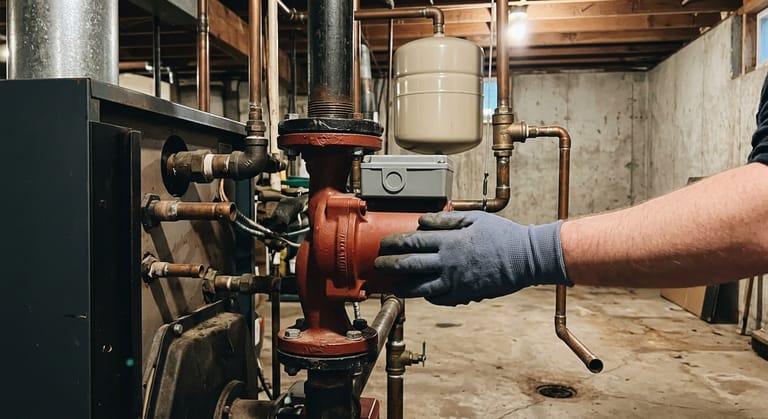
Where it sits, and how to spot yours
Follow the pipe leaving the boiler, or the one returning, within a few feet of the jacket: a cast iron or stainless body between two bolted flanges, junction box on top.
Taco lists flanged connections at 3/4 inch, 1 inch, 1-1/4 inch and 1-1/2 inch for its 007-IFC, so the interrupted pipe is small. Where three bodies stand in a row, each feeds a zone: how a hydronic heating system is put together.
Nothing spinning: the order to check
- Call for heat. Raise one thermostat well above room temperature and stand at the boiler.
- Find the two switches. The red plated toggle by the basement stairs, then the breaker. Both get flipped by accident.
- Watch what follows. Burner lit and the body dead means the fault is on the pump side. Nothing at all: start from what to check when the boiler quits.
- Check for vibration, carefully. Touch the motor end briefly with the back of your fingers, not the cast body or the pipes, which run at water temperature and can burn. A working circulator carries a fine vibration and warms within a minute.
- Stop there. Past that it is line voltage on a live control.
Warmth proves current, not flow. Taco's Submittal Data #101-077 lists the cast iron 007-IFC at 115 volts, 0.71 amps, 3,250 RPM and 1/25 HP on a permanent split capacitor motor called impedance protected, so a seized rotor can draw and heat without tripping the panel.
The switching sits elsewhere. Resideo's L8148 combines high limit protection with relay switching of burner and circulator motors, and rates that circulator circuit at 7.4 A full load, 44.4 A locked rotor at 120 Vac. A body that never stirs can be the relay, not the pump. More on what the aquastat controls.
Thermostat, switch, breaker and a brief touch at the motor end are yours. Opening that junction box or metering leads is licensed work on live wiring. (800) 555-0163 puts that question to a licensed heating contractor, free and with nothing to sign.
It spins, and the rooms stay cold
Air is the first thing to rule out, and Caleffi's idronics 15 names the mechanism. Among the seven problems it attributes to air are inadequate flows from a mixture of water and air in circulators, improper lubrication of circulator bushings, and complete loss of flow where pockets grow large. That is a purge, not a part.
Where one zone alone goes cold, the valve is the suspect: Resideo rates its V8043 to open or close in 15 seconds maximum. More on zone valves that stick or buzz.
Balance is the third possibility, and a balancing valve settles it: Taco's TacoSetter reads flow in GPM, at a measuring accuracy the company prints as +10 percent of indicated value. One cold room is usually an emitter question, covered on why a radiator will not get hot; a cold slab loop runs through finding the fault in a radiant floor.
Bleeding a vent and noting which rooms went cold are yours. Balancing and anything wired are not, and a free minute on (800) 555-0163 sorts which it is.
Noise: hum, whine and gravel
Check the speed setting before the brand plate. Grundfos publishes three rows for one UPS 15-58 FC/FRC at 115 V: 87 watts on speed 3, 80 on speed 2, 60 on speed 1, inside a 0 to 17 gpm, 0 to 19.5 ft envelope. Top speed on a short loop pushes more water than the piping needs, and fast water in copper is audible.
Reading the speed tap and timing the noise against the heat call are yours; bearings and cartridges are a service visit.
Talk to someone who sees these boilers every week
Call (800) 555-0163Free to dial. Whoever answers works on boilers and holds whatever license or registration your state requires.Partner contractors who work on boilers and hydronic systems- Contractors who work on boilers, not just furnaces
- Answered at 2 a.m. in January
- Dialing costs nothing and books nothing
- The price is the contractor's own, set with you
Water at the flange
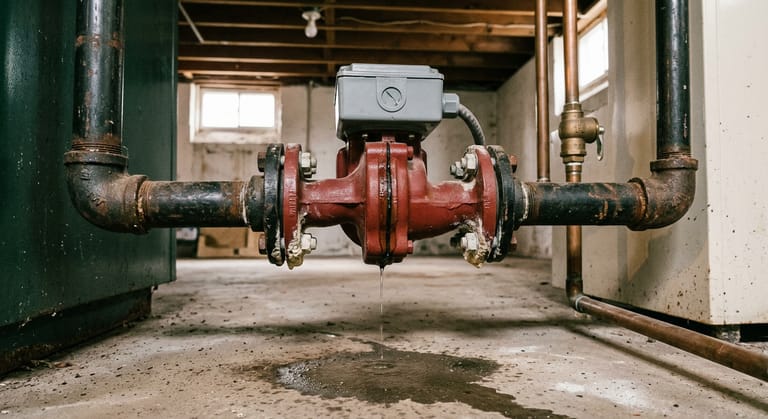
Two gasket faces and a shaft seal are the usual places one weeps. Pressure is rarely the reason: Taco rates the 007e at 125 psi in cast iron and 150 psi in stainless, and the same Taco sheet allows water to 230 degrees F. A house loop sits far below both, filled cold at the 12 psi Weil-McLain's CGa manual calls typical, a figure the same manual says varies with each application.
Age is the usual answer, and the drip pattern narrows it: wet only while the pump spins points at the seal, wet all the time at the gaskets or the bolts.
Where the water lands, and whether it drips only under power, is yours to note. Pulling flange bolts on a filled loop is not.
The one that never shuts off
Continuous running is sometimes design, sometimes a stuck contact. Two checks are free: no thermostat still calling, and no zone valve left on its manual lever, which Resideo says returns to automatic when power is back.
Past that the relay is holding closed, on line voltage inside the aquastat. A boiler circulator pump still running in July is a call worth making before the next season, not an emergency.
Taco and Grundfos, by their own numbers
| Model and source | Flow and head | Electrical, as published |
|---|---|---|
| Taco 007, 00 Series listing | 0 to 23 GPM, 0 to 10 ft | Amps published, no watts |
| Taco 007-IFC, Submittal #101-077 | 0 to 17 GPM, 0 to 8.5 ft | 115 V, 0.71 A, 3,250 RPM, 1/25 HP |
| Taco 007e ECM, product page | 0 to 16 GPM, 0 to 10 ft | 120 V, 0.54 A, 44 W maximum |
| Grundfos UP 15-42 F/FR, data booklet | 0 to 17 gpm, 0 to 15 ft | 115 V: 0.74 A, 85 W. 230 V: 0.43 A, 95 W |
| Grundfos UPS 15-58 FC/FRC, same booklet | 0 to 17 gpm, 0 to 19.5 ft | 115 V: 87, 80, 60 W by speed |
Read those as five products, not one span: the 007, 007-IFC and 007e are three different pumps.
No model is best in the abstract: head and flow decide it, plus which cartridge a supply house stocks in January.
Sizing, speed and what delta T means on a listing
Horsepower here is tiny. Taco prints 1/25 HP for the 007-IFC; Grundfos prints 0.114 hp at 115 V and 0.128 hp at 230 V for the UP 15-42, the higher voltage row drawing 95 watts against 85.
Electronically commutated models change the arithmetic, not the plumbing. Taco lists 44 W maximum for the 007e and claims in Catalog #100-150 that its ECM motor uses up to 85 percent less electricity, a comparison against its own standard model. Where a listing says delta T, the unit varies speed to hold a temperature difference across the loop, a target the boiler manufacturer sets.
What a replacement costs, and who does it
Labor sits on top or inside, by publisher. HomeAdvisor's June 20, 2026 page gives a flat $150 to $300 or $75 to $130 per hour. HomeGuide's July 14, 2025 page adds a $75 to $200 minimum call out plus $150 to $600 for a flush and descaling, the neighboring job when debris keeps chewing cartridges.
The swap is short where isolation flanges exist, long where they do not and the loop must be drained. Either way it ends with 120 V wiring landed in a junction box, and the license behind it is a state question: Connecticut's S-3 class names boilers and their associated pumping equipment outright, while Pennsylvania's labor department says the state requires no license or certification of most construction contractors. The visit that catches a tired unit before January is the annual one: what a boiler service covers.
A boiler circulator pump is a part, not a verdict on the boiler behind it. Note what you heard and felt, then call (800) 555-0163: the call is free, nothing is owed after it, and a heating contractor who works on boilers picks up.
Talk to someone who sees these boilers every week
Call (800) 555-0163Free to dial. Whoever answers works on boilers and holds whatever license or registration your state requires.Partner contractors who work on boilers and hydronic systems- Contractors who work on boilers, not just furnaces
- Answered at 2 a.m. in January
- Dialing costs nothing and books nothing
- The price is the contractor's own, set with you