
A Boiler Making Noise: Bangs, Gurgles, Kettling and Hums
Straight to it
- Four sounds carry the sorting: banging, gurgling, kettling and humming. Which one it is, and when in the cycle it lands, narrows the cause faster than any part swap.
- Read the gauge first. Weil-McLain's CGa manual pegs a typical residential cold fill at 12 psi; that maker's user manual holds a water boiler to 24 psig at the gauge, and blames the tank or the instrument for anything over.
- Air is the loudest cheap fault. Caleffi's idronics 15 states that deaerated water moving at 4 feet per second or less produces sound levels virtually undetectable by human ears, while air pockets act as acoustic amplifying chambers.
- A hum usually traces to hardware, not fire. Grundfos publishes 87, 80 and 60 watts for the three speeds of its UPS 15-58 at 115 V.
- Gas smell, a sounding CO alarm and a discharging relief valve are not troubleshooting material. Those three end the home diagnosis outright.
A boiler making noise is usually reporting air, flow or a control setting, not a cracked block. Four sounds do the sorting: banging, gurgling, kettling and humming. Start at the gauge, where Weil-McLain's CGa manual pegs a typical residential cold fill at 12 psi.
The systems here are hot water (hydronic) and steam, whatever fuel fires them; electric baseboard heaters carry no water and are wiring work for an electrician.
Start at the gauge, then at the clock
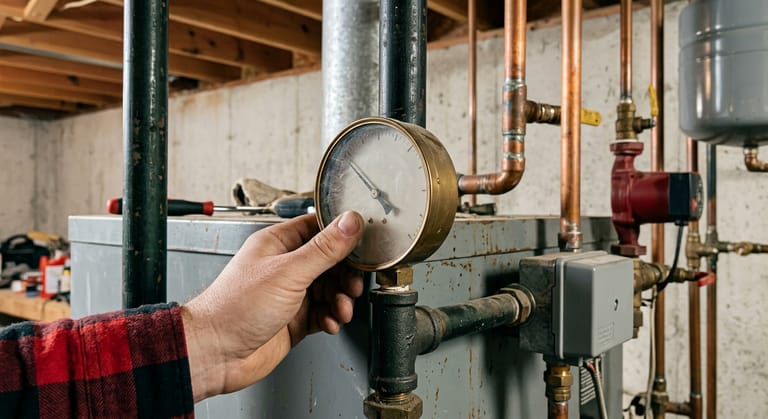
Two free readings narrow a boiler making noise before any part is touched. The first is pressure: Weil-McLain pairs that 12 psi figure with a caution that correct pressure varies by application. The ceiling is firmer: its user manual stops a water boiler at 24 psig on the dial, and puts anything higher on the tank or on the dial itself.
The second is when the noise lands.
- At ignition only. A bark as the burner lights, then quiet: combustion side, licensed work.
- A minute into the call. Sounds that build as water heats follow flow.
- Whenever the pump runs. Rotating hardware, not fire.
- In one room only. The loop is fine and the emitter is not.
Banging and knocking: the noise of air in the loop
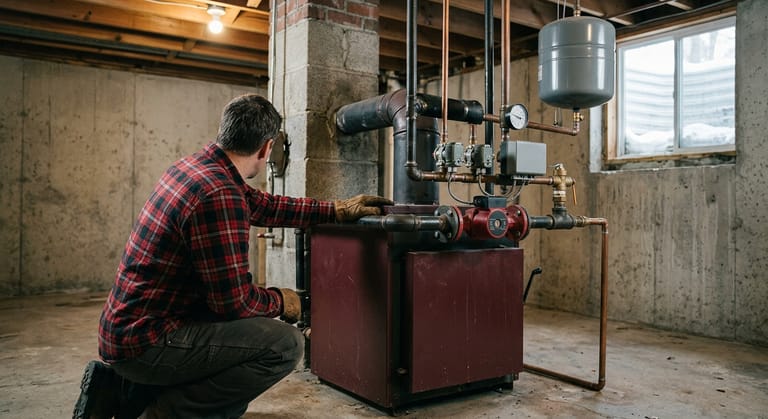
Air is the loudest cheap fault here. Caleffi's idronics 15 puts numbers on it: deaerated water at 4 feet per second or less runs at sound levels virtually undetectable by human ears, while a water and air mixture is far more acoustically active and air pockets act as amplifying chambers.
Caleffi puts manual air vents, opened with a screwdriver or a square drive key, at each emitter's high point. Order matters: how to bleed a radiator without losing pressure.
Bleeding a vent is yours. A bang from inside the cabinet, or air back within a week, is not: (800) 555-0163 is free, and it puts you through to someone who services boilers for a living.
Gurgling: the same noise on the move
Gurgling is that air on the move: it follows the circulator, wanders room to room, and fades after a real purge, alongside the cool spots Caleffi ties to trapped air.
If it is back before the next cold snap, the free call beats a second purge: the fault sits upstream of the vent you opened.
Kettling: a rumble from inside the cabinet
Kettling is the trade word for a percolating noise from the boiler itself, not the piping. Two things get checked: flow through the heat exchanger, and the limit control.
Resideo publishes ranges and no recommendation: its L8148 aquastat relay carries a standard scale range of 180 to 240 degrees F, and the L8124 family a high limit adjustable from 130 to 240 degrees F. Because heating systems differ, Resideo writes, the correct setting follows the boiler manufacturer.
Water quality is the other half: HomeGuide's July 14, 2025 page prices a system flush and descaling at $150 to $600, and what a boiler service includes covers the yearly visit. Note the noise and both gauge readings, then stop: the free line reaches a licensed heating contractor.
Talk to someone who sees these boilers every week
Call (800) 555-0163Free to dial. Whoever answers works on boilers and holds whatever license or registration your state requires.Partner contractors who work on boilers and hydronic systems- Contractors who work on boilers, not just furnaces
- Answered at 2 a.m. in January
- Dialing costs nothing and books nothing
- The price is the contractor's own, set with you
Humming: hardware noise, not fire
A hum that tracks the pump comes from rotating hardware, not the burner. Grundfos publishes three speeds for the UPS 15-58 at 115 V: 87 watts on speed 3, 80 on speed 2, 60 on speed 1. Top speed in a short loop moves more water than it needs, and velocity noise follows.
Taco rates the plain 007 circulator at 0 to 23 GPM and the 007-IFC at 0 to 17. Symptoms sit on circulator pump noise and replacement.
| The noise | Usual suspect | HomeGuide range, July 14, 2025 |
|---|---|---|
| Hum whenever the pump runs | Circulator speed or bearing | Circulating pump $300 to $1,100 |
| Buzz that dies with the heat call | Zone valve actuator | Zone valve $100 to $500 |
| Hum with a weeping relief valve | Expansion tank | Expansion tank $200 to $800 |
Resideo rates the V8043 zone valve at 24 Vac, opening or closing in 15 seconds maximum, so a buzz that follows the thermostat lives there. Reading the speed tap is yours; anything wired is not, and the free line reaches a boiler pro.
Steam bangs for a different reason
EIA's RECS 2020 counts 6.01 million Northeast homes on a steam or hot water system, a category the survey never splits. On one pipe steam the bang is water sitting where steam wants to travel. Hoffman Specialty prints minimum elevations for four of its main vent models, 6 to 10 inches above the horizontal return and 18 inches above the boiler water line, to prevent sputtering water or damage from water hammer.
Pressure settings drift. The Utica PEG-E manual puts a single family house on clean one pipe steam with cast iron radiation at a 1/2 psi cut in and a 1-1/2 psi cut off, and withholds it from larger, two pipe and convector systems, settled one at a time. Honeywell's L404F1060 pressuretrol covers 2 to 15 psi on a subtractive differential, so raising the differential dial lowers the restart pressure rather than the shutoff.
None of that is a homeowner adjustment; sight glass, cut off and pressuretrol are followed on steam boiler faults and their sounds. Count the bangs, note the room, leave the controls alone. (800) 555-0163 rings through at no cost to a pro who services steam.
The three signals that end the diagnosis
A sounding carbon monoxide alarm ends the search for a cause: CPSC sends everyone outdoors and into clean air, then to emergency services or 911, then a tally of who got out, with nobody stepping back inside until responders allow it. The suspect appliance stays cold until a technician trained for it has been in.
Nobody caps, plugs or quiets a relief valve that keeps discharging. Weil-McLain splits the meaning: on water boilers frequent weeping points at an expansion tank that has quit working, on steam boilers at a limit sitting above where it should be. Either way the manual routes it to a qualified service technician.
CDC's standing advice sits under all of it: have the heating system and every other gas, oil or coal burning appliance seen by a qualified technician annually.
What to have ready when you call
- The noise in your words. Bang, gurgle, rumble, hum or hiss, and how loud a floor away.
- When it happens. At ignition, minutes in, whenever the pump runs, or overnight.
- The gauge. Cold and hot readings, against 12 psi and that 24 psig ceiling.
- Where it lives. Whole house, one zone, or one radiator.
- What it is. Steam or hot water, gas or oil, roughly how old.
If the noise stops one night and the heat with it: what to check when the boiler quits.
A boiler making noise rarely forces a replacement decision that week; it needs someone to hear it. Call (800) 555-0163 whenever the noise starts, day or night: nothing is charged, and a licensed heating contractor takes it.
Talk to someone who sees these boilers every week
Call (800) 555-0163Free to dial. Whoever answers works on boilers and holds whatever license or registration your state requires.Partner contractors who work on boilers and hydronic systems- Contractors who work on boilers, not just furnaces
- Answered at 2 a.m. in January
- Dialing costs nothing and books nothing
- The price is the contractor's own, set with you