
Radiator Not Getting Hot? Six Checks, in Order
Straight to it
- Count the cold rooms first. One cool unit is air, a valve or a starved branch; a whole floor of them is the circulator, the pressure or the call for heat, and those are two different conversations.
- Air is the cheap answer. Caleffi's idronics 15 states that water holds nearly 3,500 times the heat an equal volume of air holds, and that cool spots on radiators usually indicate entrapped air.
- A head left at dial position 1 is doing its job. Danfoss puts the RA 2000 numbered scale of 1 to 5 at roughly 57 to 79 degrees F, and says the valve stays open when no operator is mounted at all.
- One pipe steam is a venting question. Hoffman Specialty lists steam vents for one pipe steam systems and water vents for hydronic systems, and neither of its two radiator steam vents is key operated.
- Everything cold with the burner firing points past the emitters. Taco rates the 007 circulator at 0 to 23 GPM and 0 to 10 feet of head, and a stalled one moves nothing at all.
A radiator not getting hot is usually trapped air when one unit is cold, and the pump or the boiler when every unit is cold. Six checks separate those, in this order: air, valve, balance, zone, pump, boiler. The first two cost nothing but a vent key.
Partner heating contractors work it from free to expensive, and at the boiler end the gauge leads: Weil-McLain marks 12 psi as the usual cold fill on a residential system.
| What is cold | Likely cause | Who handles it |
|---|---|---|
| Top of one unit, bottom warm | Air at the high point of the emitter | Homeowner, with a vent key |
| One unit, top to bottom | Valve head, seized pin, blocked emitter | Homeowner, then a pro |
| The last rooms on a long loop | Balance or pump speed | Contractor |
| Several rooms on one thermostat | Zone valve or its end switch | Contractor |
| Whole house, supply pipe hot | Circulator, air lock, closed valve | Contractor |
One cold radiator, or all of them
Make that count first. One cool unit with the rest of the house warm is an emitter fault: air, a valve, a starved branch. A whole floor gone cold is a supply fault: nothing moving the hot water, nothing heating it, nothing asking for it.
Walk the rooms and note which are cold, whether the burner is firing, and whether the pipe leaving the boiler is hot. Those three answers pick the half of this page that applies. EIA's RECS 2020 counted 6.01 million Northeast homes on a steam or hot water system.
Hot water (hydronic) and steam radiators are the subject. Electric baseboard has no boiler behind it and is an electrical trade.
Check 1: air at the top of the emitter
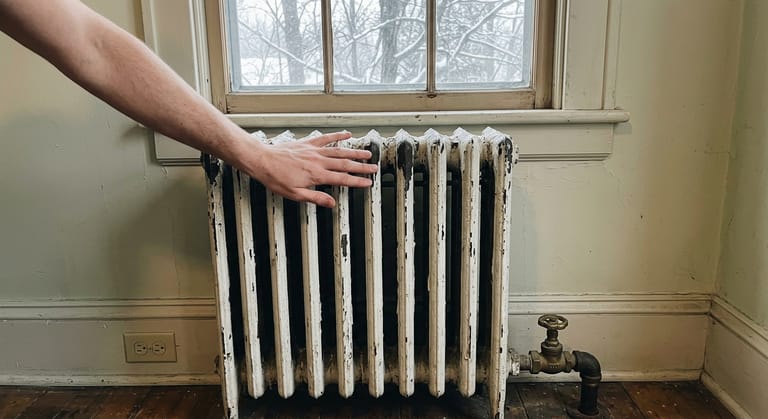
The arithmetic behind a cold radiator is lopsided. Caleffi's idronics 15 puts water at almost 3,500 times the heat absorption of the same volume of air, and warns that transfer drops sharply once air displaces water off the heat transfer surfaces. Cool spots on radiators, the same document says, usually indicate entrapped air.
Air collects at the high point, which is why Caleffi describes manual air vents, small valves that open under a screwdriver tip or a square drive, as commonly installed at the top of each heat emitter. A radiator not getting hot across the top while the bottom stays warm fits exactly.
The sequence, and the pressure check after it, sit on bleeding a radiator without losing system pressure. Vent key, rag and a gauge check are homeowner work. Air that returns month after month is not: something is feeding a closed loop, and calling (800) 555-0163 costs nothing at all.
Check 2: the valve on the radiator itself
Danfoss builds the RA 2000 to meter what reaches an emitter, hot water in one system and low pressure steam in another, across free standing radiators, baseboards and convectors alike, hot water or two pipe steam. Inside the head a gas charged bellows expands as the room warms and closes the valve, and Danfoss puts the reaction at 10 minutes for that gas mixture to respond to a temperature change.
Three datasheet lines explain most single cold rooms. The numbered dial of 1 to 5 corresponds to approximately 57 to 79 degrees F, so a head wound down to 1 holds that room cool by design. The valves remain normally open with no operator mounted, which is why a unit with a missing head runs hot while its neighbor with a seized pin stays cold. And a snap action mechanism means the operator comes off without tools: the pin either moves under a fingertip or it does not.
Seized pins, and the steam valves that behave nothing like one, are on thermostatic heads and steam radiator valves. Pulling a head is yours; replacing a valve body means draining part of the system, which is what the free line is for.
Check 3: balance, or the last rooms on the loop
A room that was never warm is a different case. Flow is shared along a loop, and the last branch takes what the earlier ones leave. Taco sells its TacoSetter balancing valves for adjusting flow rates through closed loop hydronic heating systems, and states a measuring accuracy of 10 percent of the indicated value on the GPM reading.
What arrives at the emitter is only half the question. The other half hangs on the wall: Governale rates a 4 by 25 inch Gov-Free cast iron section at 340 BTU at 180 degrees F water, so an old parlor with an addition may have outgrown its emitter, a question for what a cast iron radiator still delivers.
Looking costs nothing. Setting flow to a number takes a meter and a wrench, and that call is free.
Check 4: a zone that never opens
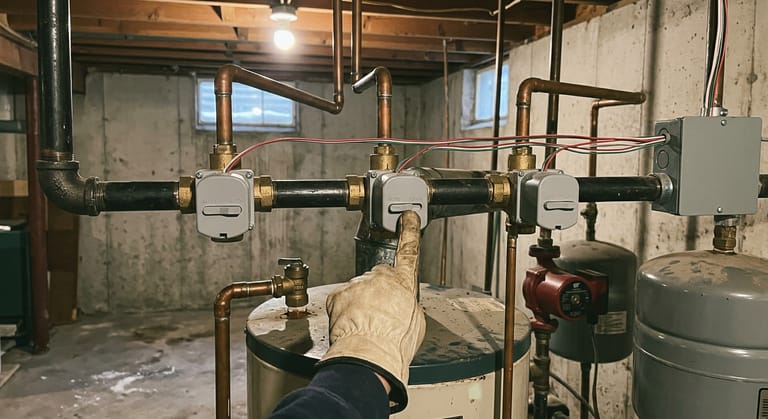
Several rooms cold on one thermostat, and the emitters are innocent. Resideo's V8043 submittal describes a two position valve, normally closed when de-energized, on 24 Vac at 7.2 VA, opening or closing in 15 seconds maximum, so a cold zone is never waiting on valve travel.
Two things show without tools. Resideo says the manual opener allows opening the valve in case of power failure and returns it to automatic once power is restored, so a lever pushed over in a January outage can leave one wing running for weeks. The other is the end switch, fitted on the V8043E and V8043F but not the leadwire-only V8043A: it passes the call onward, so a zone valve can sit open while hot water is never asked for.
Stuck stems and buzzing heads are on zone valves that stick or fail to open. Finding a lever is homeowner work; low voltage wiring is not, and there is no charge for asking.
Talk to someone who sees these boilers every week
Call (800) 555-0163Free to dial. Whoever answers works on boilers and holds whatever license or registration your state requires.Partner contractors who work on boilers and hydronic systems- Contractors who work on boilers, not just furnaces
- Answered at 2 a.m. in January
- Dialing costs nothing and books nothing
- The price is the contractor's own, set with you
Check 5: the circulator that stopped moving water
- Touch the supply pipe at the boiler briefly with the back of your hand, then the return; supply piping can run at 180 degrees F or more, so a quick touch is all this takes.
- Hot out and cold back means heat is made and not carried.
- Count the cold zones: one is a valve, all of them is the pump.
The Taco 007 cartridge circulator is rated 0 to 23 GPM and 0 to 10 feet of head; the 007-IFC, with its integral flow check, 0 to 17 GPM and 0 to 8.5 feet. Grundfos publishes three speeds for its UPS 15-58 at 115 volts, drawing 87, 80 and 60 watts, and speed 1 moves the least water, which the far end of a long loop notices first.
Stalls, a leaking flange and bearing noise belong to the circulator pump and its symptoms. Feeling two pipes is free; judging whether a pump is dead, airbound or set wrong is a contractor's call, and (800) 555-0163 finds one at any hour.
No heat from radiators anywhere in the house
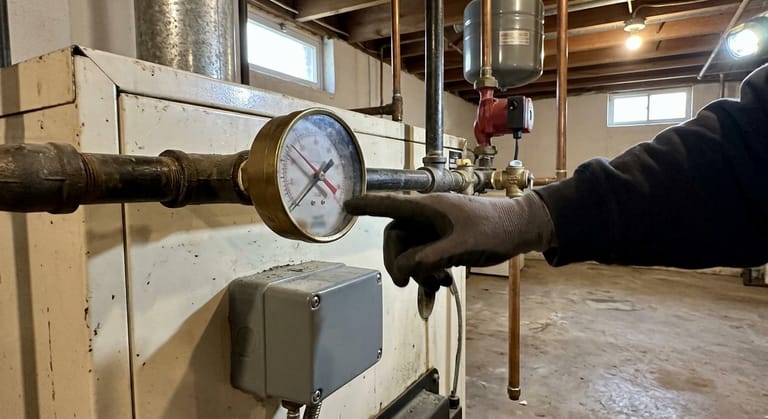
With no heat from radiators in any room, the emitters stop being the subject: two dials on the boiler answer faster.
Start with pressure. Weil-McLain's user manual tells owners the gauge on a water boiler should never read above 24 psig, and that a higher reading may point to a fault in the expansion tank or in the gauge itself; on a steam boiler it caps the reading at 15 psig. Against the 12 psi typical cold fill, a needle far below or far above tells two stories, neither fixed at a radiator.
Then the limit control. Resideo publishes an L8148 scale range of 180 to 240 degrees F with a nonadjustable differential, and instructs that the boiler manufacturer's recommendation governs the setting, so no page can name yours. The control is set out on the aquastat and how it starts the burner; the checks for a dead system are on a boiler that will not start.
Both readings cost nothing. Gas valves, oil burners and boiler wiring are licensed work, and reading the number into (800) 555-0163 often shortens the visit.
A steam radiator answers to a vent, not a key
On one pipe steam the diagnosis shifts. Hoffman Specialty splits its catalog by system: steam vents serve one pipe steam heating systems, water vents serve hydronic systems. Under its heading for radiator steam vents it lists two models, the 1A and the 40, both float type and neither key operated the way Caleffi's hydronic vent is. A steam radiator not getting hot is a venting question first.
Pressure decides whether that vent works at all. Hoffman states that the rated operating pressure of the vent must be higher than the maximum operating pressure in the steam system, and that once system pressure exceeds the vent rating the vent cannot open and air remains in the system. Its catalog puts the Model 1A at a maximum operating pressure of 1-1/2 psig and the Model 40 at 6 psig, so a boiler carried above that leaves the far rooms cold.
Utica's PEG-E manual gives the common setting: in a single family residence on a clean one pipe layout with cast iron radiation, cut-in at the minimum 1/2 psi with a 1 psi differential, giving a 1-1/2 psi cut-off. Larger and two pipe systems are settled one at a time. Hissing, banging and sections that never fill are on steam radiator faults and what each one means, and a pressure setting on a fired appliance is never homeowner work.
What is never yours to touch
Three situations end it.
A discharging relief valve is the third, and it is never plugged or capped. Weil-McLain's user manual reads a frequently weeping valve two ways, an expansion tank no longer doing its job on a water boiler, or a limit set too high on a steam boiler, and tells the owner to get a qualified service technician in.
Where the free half ends
The rest divides cleanly. Counting cold rooms, feeling two pipes, lifting a baseboard cover, pulling a head and venting an emitter open nothing fired or wired, and most cases of a radiator not getting hot end inside that free half. Gas trains, oil burners, wiring, pump swaps and pressure settings sit on the far side. That is what (800) 555-0163 is for: nothing to pay, and a licensed heating contractor takes it.
Talk to someone who sees these boilers every week
Call (800) 555-0163Free to dial. Whoever answers works on boilers and holds whatever license or registration your state requires.Partner contractors who work on boilers and hydronic systems- Contractors who work on boilers, not just furnaces
- Answered at 2 a.m. in January
- Dialing costs nothing and books nothing
- The price is the contractor's own, set with you