
The Aquastat: the Control That Decides When Your Boiler Fires
Straight to it
- One case, two duties. Resideo builds the L8148 to sit in the water, hold the high limit, and switch line voltage to burner and circulator.
- Resideo, the maker of the L8148 and L7224, publishes no recommended number: it prints ranges only and sends the installer to the boiler manufacturer, so a page naming a universal 180 degrees F is not quoting the controls maker.
- The published spans are wide: 130 to 240 degrees F on one high limit, 110 to 220 degrees F on a low limit, and a standard 180 to 240 degrees F scale on another family.
- Retailer pages printing a fixed differential in degrees are not quoting the maker. Resideo's specification line for the L8148 reads Differential: Nonadjustable, with no number beside it.
- The relay switches 120 Vac at 7.4 A full load, so testing one means metering a live circuit. Reading the gauge, the thermostat and the model number does not.
An aquastat is the immersion control that reads boiler water temperature and switches both the burner and the circulator. Resideo's L8148 relays carry a standard scale range of 180 to 240 degrees F, and Resideo, its maker, publishes no recommended setting: that number belongs to your boiler's manual.
Two duties in one steel case, three shapes of failure: a burner that never gets the call, a burner the limit fails to stop, a pump running alone.
What an aquastat does on a boiler
Resideo puts it in one line. The L8148 family, it writes, mounts in the water, carries the high limit, and switches burner and circulator motor from one case. The limit caps water temperature, the relay hands line voltage to burner and pump. A thermostat asks for heat; the aquastat decides whether the boiler may make any.
The same word appears on indirect water heater tank controls, which are domestic hot water and a different job; everything here is the boiler control.
Code calls it a listed part. The 2021 IRC states at M2002.1: "Electrical and mechanical operating and safety controls for boilers shall be listed and labeled." M2001.1.1, identical in the 2021 and 2024 editions, provides in part that controls and safety devices for boilers rated 12,500,000 Btu/hr or less shall meet ASME CSD-1. Your state's adopted edition governs.
Where it sits, and what an aquastat looks like
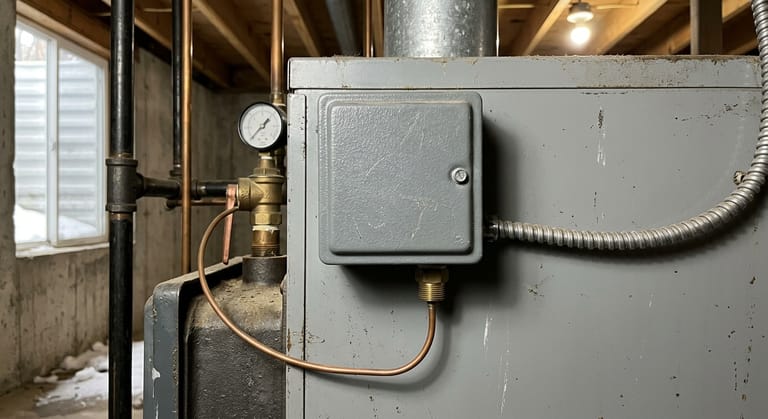
Follow the wiring back from the burner, not the thermostat. In a Northeast basement it is the boxy gray control on the front panel or jacket top, a capillary tube running into a well in the block.
Resideo's numbers set the scale: an immersion well rated to 255 psi maximum, a 3-3/8 inch insertion length, and a bulb ceiling 40 degrees F above the setpoint, up to 265 degrees F. Not all models include wells; a clamp on sensor strapped to a pipe does the same job.
Brand names vary more than the device: a Hydrolevel aquastat, a Ranco or a Penn turns up in searches beside Honeywell Home. What a contractor wants is the model number. Resideo's listing reads: "The L7224A,C and L7248A,C,L replace the L8124A, L8124C, L7124A,C, L7148A and L8148A Controllers."
High limit, low limit and the differential
One dial or two: the second is a low limit, which is what a dual or triple aquastat means.
| Resideo family | High limit or scale | Low limit | Differential and timing |
|---|---|---|---|
| L8124 relays | 130 to 240 degrees F, adjustable | 110 to 220 degrees F, adjustable | High limit 10 degrees F fixed; low limit 10 to 25 adjustable |
| L8148A,E,J relays | Standard scale 180 to 240 degrees F, optional 140 to 240 | Not on that sheet | "Nonadjustable" |
| L7224 and L7248 | 130 to 240 degrees F | 110 to 220 degrees F | Anti short-cycle OFF to five minutes |
Those are published spans, not recommended settings, and some models ship with a narrower high limit range printed on the label.
The last column is where the internet goes wrong. Resideo's differential line for the L8148 is one word, "Nonadjustable", no figure beside it, and the 8 and 15 degrees F on retail listings were not confirmed against any Resideo document read for this page. For an aquastat diagram, use the sheet for that exact model: Resideo posts product data for the L8148 and installation instructions for the L7224.
What the setting should be, and who decides
The 180 degrees F repeated all over the web is the conventional design supply temperature for fin tube baseboard, which is how Caleffi's idronics 25 uses it, not a controls maker specification. Resideo states the mechanism and declines the question. Water climbing past whatever the high limit is set to trips that switch, and the burner stops. Because heating systems differ, it continues, the installer is sent to the boiler manufacturer's recommendation.
The number lives in your manual. One Weil-McLain start-up checklist caps its limit at 220 degrees F on water and 10 PSI on steam.
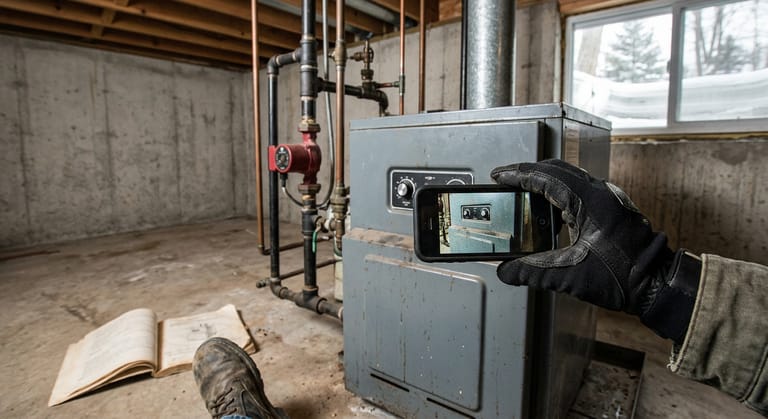
Yours to do: photograph the dial positions and the model number, then find the setting page in the manual. Not yours: the dials. (800) 555-0163 costs nothing to call, and it lands you with a licensed heating contractor who will ask what the manual says.
Talk to someone who sees these boilers every week
Call (800) 555-0163Free to dial. Whoever answers works on boilers and holds whatever license or registration your state requires.Partner contractors who work on boilers and hydronic systems- Contractors who work on boilers, not just furnaces
- Answered at 2 a.m. in January
- Dialing costs nothing and books nothing
- The price is the contractor's own, set with you
Signs of a bad aquastat on a boiler
No home test separates a bad control from the cheaper faults that imitate one. Describe the pattern instead: each duty fails in its own shape.
- Thermostat calls, nothing happens. No burner, no pump, no click. The relay is a candidate, after the service switch and breaker.
- The burner runs and will not stop. Weil-McLain gives owners a ceiling: a water boiler's gauge should not exceed 24 psig, and over 15 psig on steam points at the gauge or the limit control.
- The circulator runs with no call for heat, or never runs. The same relay switches the pump, so its behavior is evidence.
- Short bursts, minutes apart. On an L7224 that may be the anti short-cycle timer, adjustable from OFF to five minutes, working rather than failing.
Rule out the ordinary first: the order is in what to check when the boiler quits; pump behavior belongs with circulator faults and replacement.
Testing and replacing an aquastat
Testing one means metering a live burner circuit, where the DIY line falls. Resideo rates the L8148 at 120 Vac, 60 Hz, its circulator circuit drawing 7.4 A full load and 44.4 A locked rotor.
On oil there is a second reason to leave it alone. Resideo's L7224 and L7248 instructions say a separate electromechanical high limit is not required where this control is used to meet UL 726 for oil-fired boiler assemblies, so the control itself is doing listed safety duty. A part that satisfies a listing is not a parts counter errand.
Replacement is wiring work on a listed and labeled control. Note what you see, leave the cover on, and call (800) 555-0163: no charge on the line, and a licensed heating contractor picks up.
What an aquastat replacement costs
No cost publisher read for this site prices an aquastat by name: HomeGuide, Fixr and HomeAdvisor print boiler parts tables and it appears in none, so a firm figure online is a quote, not a market range.
Fixr's January 26, 2026 page puts boiler repair at $150 to $750, average $450. What a yearly visit covers sits on what a boiler service includes.
Where it fits, and what to do next
How a boiler moves heat around a house shows why a pump and a burner stop together. An aquastat gives no warning of its own: it shows up as a boiler that will not fire, will not stop, or cycles for no reason the weather explains. Note the pattern and the model number, then dial (800) 555-0163: the contractor who answers sees these controls weekly all season.
Talk to someone who sees these boilers every week
Call (800) 555-0163Free to dial. Whoever answers works on boilers and holds whatever license or registration your state requires.Partner contractors who work on boilers and hydronic systems- Contractors who work on boilers, not just furnaces
- Answered at 2 a.m. in January
- Dialing costs nothing and books nothing
- The price is the contractor's own, set with you