
What the Boiler Pressure Relief Valve Is Telling You
Straight to it
- Set point on a residential hot water unit is 30 psi: Weil-McLain lists an ASME 30 PSIG part as factory trim on its CGa line, and Watts gives its 174A series the same standard setting.
- Watts prints the rule that governs the rest: the device relieves an emergency and is not to be leaned on as a control. Nothing about it is a field adjustment, and nothing cappable belongs on its outlet.
- 12 psi is a typical cold fill figure per the CGa manual, and its companion user manual draws the owner's line at 24 psig and no further. Nothing in between is published.
- On a water boiler, repeat weeping usually points at the expansion tank. Weil-McLain's manual and Amtrol's tank instructions reach that diagnosis independently.
- PRV means two opposite things in one basement: the reducing or fill valve lets water in at a set fill figure, the safety device lets it out at 30 psi.
A boiler pressure relief valve on a residential hot water system is normally set at 30 psi, the ASME figure Weil-McLain ships as factory trim on its CGa line. Watts prints the limit on its own product: emergency relief only, never a working control. Water at the discharge pipe is information, never a drip to cap.
Where it sits and why the number is 30
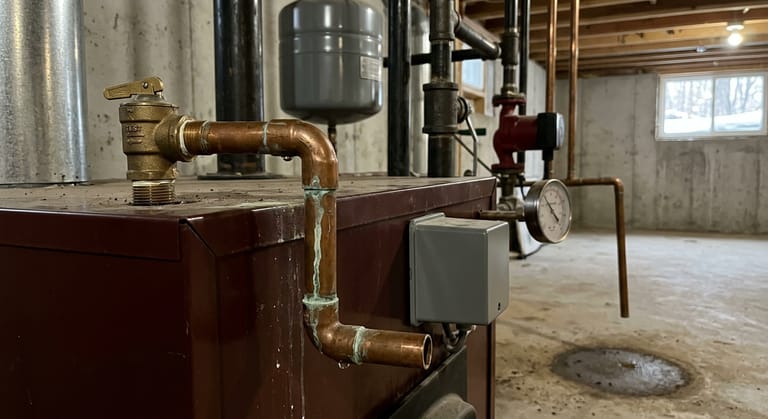
Weil-McLain's CGa Series 3 manual lists the factory trim as an ASME part at "30 PSIG, 3/4 inch male inlet." Factory trim tells you where to look: it threads into the appliance, not out in the system piping, with a metal discharge line dropping from its outlet. Watts, which builds the part not the appliance, gives its 174A series the same 30 psi standard setting.
Thirty sits under what that vessel is rated for: Weil-McLain rates its CGa boilers, one model line and not the whole class, for 50 psig ASME working pressure. Watts describes the rest: if the controls let temperature run away, water in the vessel can flash to steam, and the valve has to pass it as fast as the boiler makes it.
Capacity follows fired input: Watts rates a 3/4 by 3/4 inch body at 650,000 BTU/hr at that setting, and M2002.4 of the 2021 and 2024 IRC ties the capacity required to the equipment each valve protects.
The psi readings that are published
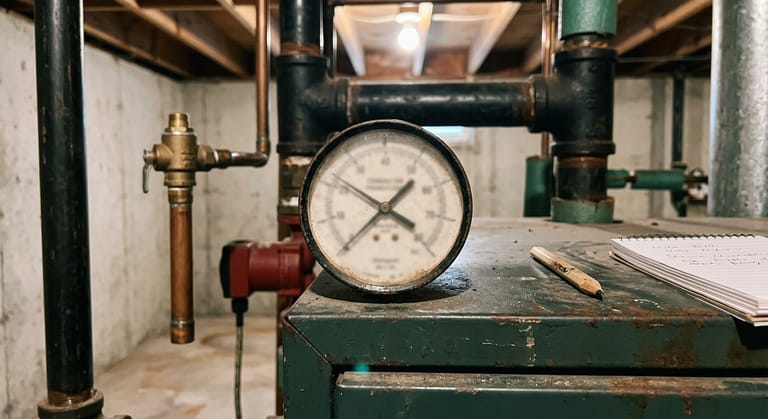
Four figures get quoted in basements. Three are documented.
| Reading | Figure | Source |
|---|---|---|
| Cold fill, water | 12 psi, called typical | Weil-McLain CGa manual |
| Running, water | No published band | No manufacturer manual read here |
| Owner ceiling, water | Not above 24 psig | Weil-McLain user manual, daily |
| Trip point, water | 30 psi | Weil-McLain CGa trim; Watts 174A |
| Owner ceiling, steam | Not above 15 psig | Weil-McLain user manual |
| Federal class definition, water | At or below 160 psig, 250 degrees F | 10 CFR 430.2 |
The last row is not a gauge reading; it is how 10 CFR 430.2 defines the equipment class. Popular advice fills the blank row with an 18 to 20 psi band and a 3 to 5 psi rise on heat up. No manufacturer document supports either.
Boiler pressure too low, and what the gauge means
Low means under the fill figure the system was designed around, usually 12 psi. Two Weil-McLain manuals say so: the CGa manual calls 12 psi typical, and the EG and PEG manual says such systems "are often designed for 12 PSIG of cold fill pressure." Neither calls it a rule. Taller buildings need more, and Amtrol publishes the arithmetic: height in feet above the tank times 0.433, plus what stops water boiling, 5 psig at 210 degrees F on its table.
A gauge that keeps sinking back matters more than the number: water that leaves goes somewhere, a circulator flange, a pinhole in a return, a seam between sections. Where water shows up under a boiler walks the puddle back.
Do this much yourself: read it cold, read it again once the burner has run, look for damp concrete. Then stop, because topping up a system that keeps losing water hides the fault. (800) 555-0163 rings through to a licensed heating contractor.
Boiler pressure too high and what pushes it up
High is a needle walking toward 30 as the burner cycles, and the expansion tank is the usual reason. Amtrol states its job in one line: "It is the function of the expansion tank to prevent an increase in pressure to a level where safety relief valves may operate." Heated water expands and cannot compress, so the rise needs a cushion.
Two failure modes remove it. A diaphragm tank that lost its charge or tore its membrane cushions nothing: the CGa manual has the technician check the charge pressure, which in a house normally sits at 12 psig, and replace the tank if it will not hold pressure. Amtrol is just as firm about the reading: shut the tank off from the system and drain it first, or the gauge lies.
The second failure is a piping mistake on old steel tanks. The same manual bars automatic air vents wherever a closed-type tank is fitted: that air belongs back up in the tank, and a vent lets it leave instead, until the tank fills with water and cushions nothing.
A fill valve that never closes pushes the needle up the same way, feeding a system that is already full.
When the relief valve keeps discharging
A boiler pressure relief valve that lifts once after an overheat and reseats has done its job. Repeat discharge is a fault somewhere else, and the manuals split the suspects by boiler type. Weil-McLain's user manual, in a monthly maintenance item, says that if it often weeps the expansion tank may have failed on a water boiler, while on steam the limit control may be set too high. Both branches end the same way for the homeowner, with a qualified service technician called out.
Amtrol arrives from the tank side: if the relief valve drips, the tank is either charged wrong or too small for the system. The boiler maker and the tank maker land on the same diagnosis. On steam, the EG and PEG manual adds that a limit "should never be set with a pressure above 10 PSIG," because higher operation can damage the valve. Debris is the fourth candidate, named by the manuals themselves: the monthly test flushes the seat "free of sediment and debris."
Free to check: a bead after every cycle, where the needle sits, who added water last. Stop at the valve, the feed, the burner and the wiring; (800) 555-0163 reaches a contractor licensed to open those.
Talk to someone who sees these boilers every week
Call (800) 555-0163Free to dial. Whoever answers works on boilers and holds whatever license or registration your state requires.Partner contractors who work on boilers and hydronic systems- Contractors who work on boilers, not just furnaces
- Answered at 2 a.m. in January
- Dialing costs nothing and books nothing
- The price is the contractor's own, set with you
PRV on a boiler: one abbreviation, two opposite parts
The abbreviation collides: one basement holds two, with opposite jobs.
- Lets city water in, at a fill setting
- Adjustable, set at commissioning
- Amtrol: charge the tank "with air to match boiler fill valve setting"
- Its Fill-Trol ships with "a factory precharge of 12 PSIG which automatically sets the minimum fill pressure"
- Lets water out, at 30 psi on a residential system
- Not adjustable in service, and not a control
- Watts lists the 174A as NBBI certified to ASME BPVC Section XIII
- Required by M2002.4 of the 2021 and 2024 IRC
Two looser terms land on the same part: pressure release valve is a common way of saying it, and boiler pressure valve is vaguest of all, since a hydronic system also carries the shutoffs that M2001.3 of the 2021 and 2024 IRC requires on supply and return piping. Those isolate; open or closed is never a question for the safety device.
Raising the fill setting raises where the system lands hot, which is why partner heating contractors set it on site.
Testing the lever, and who does the rest
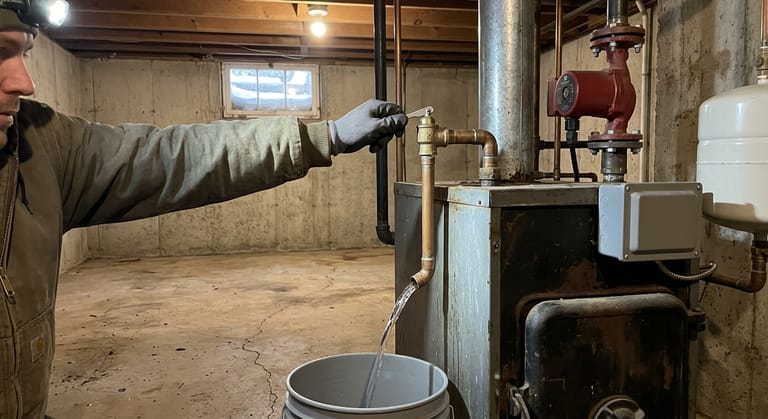
Two documents give the owner one job, at different intervals. Weil-McLain's EG and PEG manual asks for a test every month through the heating season, proving that the valve and the pipe below it both still pass water. Watts puts it annually, in capitals: once each year the owner works that lever, proving the waterways stayed clear.
- Confirm the discharge line is there, sized to the outlet and pitched down to a safe place for disposal, as Watts requires.
- Stand clear of the outlet, children and pets out of the room.
- With the system at its normal running pressure, hold the lever wide open, five full seconds by the Weil-McLain figure, so the flow scours the seat.
- Release it, let the valve snap shut, and watch that flow stops.
- If nothing comes out, the valve is dead. Watts answers that case in capitals too: shut the boiler down, then get a plumber on the phone.
That is the whole owner list. Past it the manual hands the work over: three years is the outside interval before a reinspection, and it belongs to a licensed plumbing contractor or an authorized inspection agency. That is a manufacturer minimum, not a code schedule.
HomeGuide's July 14, 2025 page prices a yearly gas service at $200 to $500; what a yearly boiler service includes breaks down the checklist.
The discharge pipe the code cares about
The 2021 IRC, in M2002.4, wants that discharge carried to a drain by gravity, terminating either at an open receptor or no higher than 18 inches (457 mm) off the floor. Eighteen inches is a maximum at the termination, not a minimum, and the edition that governs is whichever one the state has adopted.
Watts adds size and slope: match the pipe to the valve outlet, and run it downhill the whole way to somewhere a discharge does no harm. ICC's Building Safety Journal, writing about relief valve discharge on the plumbing side, gives the reasoning: such a line "cannot terminate with a threaded connection," because a thread invites a cap, and it belongs "at a point where readily visible to the building occupants." A drop leg behind the appliance means nobody sees the first bead.
What this part is worth in a budget
No national cost publisher read for this page prices a boiler pressure relief valve by name, so no figure is invented here. Published figures cover the work around it: HomeGuide's July 14, 2025 page lists call-out minimums of $75 to $200, and Fixr's January 26, 2026 page puts a national boiler repair average at $450, in a $150 to $750 range.
Where this fits in the system
The safety device is last in a chain that starts at the thermostat. The 2021 IRC requires a gauge on every hot water boiler in M2002.2 and a low water cutoff in M2002.5, and pulls in ASME construction through M2001.1.1. Resideo warns that its aquastat is intended only for systems fitted with a relief valve. How a boiler moves heat around a house puts the loop in order. Most of this hardware is old: EIA's RECS 2020 counts 4.02 million US homes on steam or hot water heat built before 1950.
If the burner will not fire and the needle sits at the bottom of the scale, start with the order to check things when a boiler stops working. If the valve is discharging and will not stop, (800) 555-0163 costs nothing and brings a licensed heating contractor to the phone.
Talk to someone who sees these boilers every week
Call (800) 555-0163Free to dial. Whoever answers works on boilers and holds whatever license or registration your state requires.Partner contractors who work on boilers and hydronic systems- Contractors who work on boilers, not just furnaces
- Answered at 2 a.m. in January
- Dialing costs nothing and books nothing
- The price is the contractor's own, set with you