
Boiler vs Furnace: 8 Differences, and the One That Decides
Straight to it
- One machine heats water and moves it through pipe, the other heats air and moves it through duct. Everything else follows from that single split.
- EIA RECS 2020 counted 9.29 million US homes on steam or hot water, 8 percent of the stock, 6.01 million of them in the Northeast.
- AFUE covers both: under 10 CFR 430.2 it is the one efficiency figure describing furnace and boiler alike. It says nothing about what fuel will cost this winter.
- The water side carries hardware the air side never needs: relief valve, low water cutoff, expansion tank and gauges, all required by IRC Chapter 20 in whichever edition your state has adopted.
- A heat pump on existing fin-tube is a water temperature problem. Slant/Fin rates the Fine/Line 30 at 580 BTU/hr per foot at 180 degrees F and 1 GPM, against 320 on the 140 degree row, which Slant/Fin derives rather than measures.
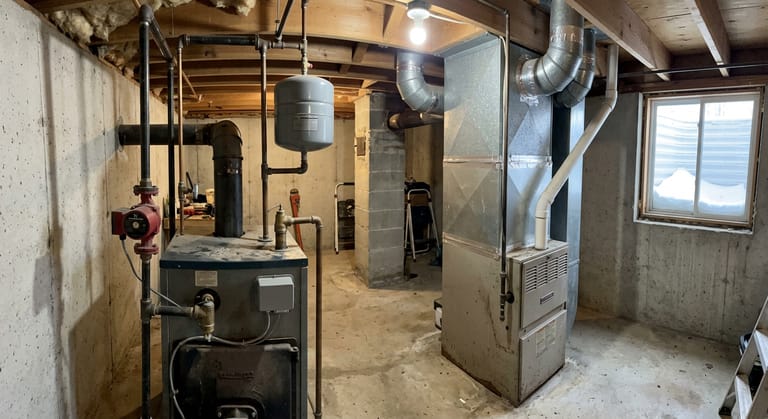
Boiler vs furnace is decided by what the house already holds: pipe and radiators, or duct and registers. One warms water and moves it; the other warms air and blows it. EIA RECS 2020 counted 9.29 million US homes on steam or hot water, 8 percent of the stock.
Search it the other way around, as furnace vs boiler, and the answer does not move: water against air, with existing pipe or duct casting the vote.
Boiler vs furnace on eight measures
| Measure | Boiler, hot water | Furnace, ducted air |
|---|---|---|
| What gets heated | Water in a closed loop | Air across a heat exchanger |
| What carries it (the decider) | Pipe to radiators, baseboard, floor tubing | Supply and return duct |
| Heat the carrier holds | Caleffi: a volume of water absorbs almost 3,500 times the heat of the same volume of air | Air |
| Pressure vessel | ASME BPVC Section IV, 2025 edition | No pressurized water to certify |
| Code hardware | Relief valve, low water cutoff, expansion tank, gauges | None |
| Shutoff valves | Required in supply and return piping | Not a hydronic requirement |
| Air moved indoors | None, so no filter, no register noise | Continuous during a call for heat |
| If the heat quits in a cold snap | Water in pipe; Weil-McLain warns of frozen plumbing | No water in the duct |
One boundary, stated plainly: the federal AFUE floor quoted here is the boiler row of 10 CFR 430.32(e)(2), and furnaces have their own row at 430.32(e)(1), outside this site's subject.
What each system costs to put in
Aggregators price the water side far better than the air side, and each measures its own scope, so they stay separate. HomeGuide's boiler page of December 31, 2025 reports installation at $3,200 to $9,000, national average $6,100. HomeAdvisor's install-a-boiler page, updated June 20, 2026, reports a $5,911 average, normal range $3,605 to $8,445. The nearest like-for-like line is HomeGuide's oil-to-gas breakdown of December 30, 2025, pricing "new gas furnace or boiler installation" at $3,500 to $12,000.
Numbers by fuel and efficiency class sit on what replacing a boiler costs. Age, fuel and nameplate rating you read off the jacket. Sizing, venting and anything behind the gas valve is licensed work. Nothing is billed for (800) 555-0163, and a licensed heating contractor takes it.
Efficiency: one descriptor, two machines
10 CFR 430.2 defines annual fuel utilization efficiency as the efficiency descriptor for furnaces and boilers, so both labels read the same way. DOE's FEMP office puts it plainly: AFUE measures how much of the fuel's energy a boiler turns into heat across a year.
Minimums on the water side apply to equipment leaving the factory from January 15, 2021: 84 percent AFUE gas hot water, 82 gas steam, 86 oil hot water, 85 oil steam. That is a manufacture date rule, not an installation one. ENERGY STAR sits above that, at 90 percent for gas and 87 for oil, under Boilers eligibility criteria Version 3.0, effective October 1, 2014 and revised effective January 2024.
Running cost moves faster than any rating. EIA's US average residential heating oil hit $5.535 a gallon the week of March 30, 2026 after Brent crude ran from $61 to $118 a barrel in one quarter; the mid-season figure was $3.693 in December 2025 and January 2026.
Comfort, and what the rooms feel like
Nothing blows. Heat leaves metal by radiation and convection instead of moving air, so no filter to change and no register whistling at 3 a.m. Slant/Fin rates its Fine/Line 30 element at 580 BTU/hr per linear foot at 180 degrees F average water and 1 GPM, with 65 degrees F entering air, on active finned length, including a 15 percent heating effect factor.
Governale rates a 4 by 25 inch Gov-Free cast iron section at 340 BTU at 180 degrees F water. Emitters like these hold heat after the burner stops, which reads steady rather than quick. More ratings sit on hot water baseboard.
Talk to someone who sees these boilers every week
Call (800) 555-0163Free to dial. Whoever answers works on boilers and holds whatever license or registration your state requires.Partner contractors who work on boilers and hydronic systems- Contractors who work on boilers, not just furnaces
- Answered at 2 a.m. in January
- Dialing costs nothing and books nothing
- The price is the contractor's own, set with you
What the house already has decides most of it
RECS 2020 puts 6.01 million of the Northeast's 21.92 million homes and 1.97 million of the Midwest's 27.04 million on steam or hot water. Of the national 9.29 million, 4.02 million stand in houses built before 1950.
ACS 2024 measures fuel, never equipment: 12,561,899 of the Northeast's 22,938,571 occupied units burn utility gas, 54.8 percent, any of which may run either machine. NOAA's 1991-2020 normals at base 65 degrees F give Boston Logan 5,545.4 annual heating degree days and Minneapolis 7,399.0, which is why the pipe went in.
Boiler vs heat pump, the third machine
A heat pump moves heat rather than making it, so AFUE does not describe one: 10 CFR 430.2 attaches that figure to furnaces and boilers, and stops there.
Water temperature decides the retrofit. Caleffi states the common existing-system case: fin-tube baseboard "requires a supply water temperature of 180 degrees F at design load conditions." The Fine/Line 30 chart at 1 GPM reads 580 BTU/hr per foot at 180 degrees F and 320 at 140, and Slant/Fin derives that 140 degree row and below by factor from the 150 degree rating rather than measuring it. The same baseboard loses about 45 percent of its rated output on cooler water.
- Measure finned length in every room, not enclosure length.
- Ask what supply temperature the proposed source holds on a design day.
- Have emitter output recalculated at that temperature, then price the extra surface.
Radiant floor is the emitter that likes low temperature: Uponor's Table 9-1 lists 80 to 165 degrees F supply for residential heating, typical data on a table captioned "(not for System Design)." Federal rules point the same way: gas, oil and electric hot water boilers leaving the factory on or after January 15, 2021 must have an automatic means for adjusting water temperature, except units with a tankless domestic coil.
Hot water and steam are the systems compared here; electric baseboard goes to an electrician. Resistance heat inside a loop sits on electric boilers. Where published numbers stop, a load calculation starts, and that is a licensed heating contractor's work. The call is free and books nothing.
Safety hardware: the list is longer on the water side
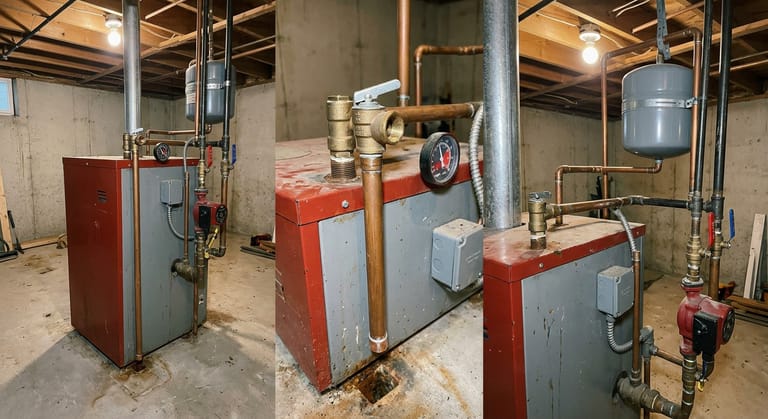
IRC Chapter 20 governs the water side, numbered the same in the 2021 and 2024 editions, and the governing text is whichever your state adopted. In the 2021 IRC: M2001.1.1 puts the vessel under ASME Section I or Section IV; M2001.3 puts a shutoff in supply and return; M2002.4 sets a relief valve at the appliance's maximum rating; M2002.5 adds a low water cutoff; M2003.1 an expansion tank; M2002.2 gauges for pressure and temperature. A furnace owns none of it, holding no water under pressure. Combustion is where the two converge.
Losing heat also costs more on the water side: Weil-McLain's user manual warns that outages or component failures in cold weather can leave frozen plumbing and water damage "in a matter of hours," the manufacturer's phrasing.
Which machine for which house
Keep the boiler when
- Radiators or baseboard already reach every room
- The house predates duct chases, as 4.02 million pre-1950 homes on this side do
- Quiet, even heat matters more than fast recovery
A furnace makes more sense when
- Duct already runs everywhere and is in usable shape
- Central cooling is going in at the same time and can share it
- The building is new enough to be designed around airflow
Boiler vs furnace has no winner in the abstract: the machine already tied into your walls starts thousands ahead, and age, fuel at the curb and emitter coverage settle the rest.
Read the nameplate, count the emitters, note the fuel, check whether a gauge is present. Past that, sizing, venting, gas trains and burner work are licensed jobs. (800) 555-0163 is free, lands a licensed heating contractor, and gets a straight answer before anything is ordered.
Talk to someone who sees these boilers every week
Call (800) 555-0163Free to dial. Whoever answers works on boilers and holds whatever license or registration your state requires.Partner contractors who work on boilers and hydronic systems- Contractors who work on boilers, not just furnaces
- Answered at 2 a.m. in January
- Dialing costs nothing and books nothing
- The price is the contractor's own, set with you