
Electric Boiler Ratings, Prices and Where It Belongs
Straight to it
- Price: $1,800 to $8,000 installed on HomeGuide's page dated December 31, 2025, with the unit alone at $1,000 to $6,000. Fixr's January 28, 2026 fuel table is tighter, at $2,500 to $6,000.
- Efficiency: for units whose build date falls on or after January 15, 2021 the federal table at 10 CFR 430.32(e)(2)(iii)(A) prints None in both electric rows, while the FTC range of comparability at 87 FR 61475 reads 100 low to 100 high.
- That 100 grades the appliance, not the utility bill. AFUE says nothing about what a delivered kilowatt hour costs in your service territory.
- Everything wet still applies: relief valve, gauges and low-water cutoff under the 2021 IRC where a state has adopted it, plus a circulator and an expansion tank, which HomeAdvisor's June 20, 2026 page puts at $300 to $1,000 and $200 to $550.
- Service is not cheaper than gas. HomeGuide's July 14, 2025 page puts electric at $150 to $450 against $100 to $400 for gas.
An electric boiler heats a hydronic loop without a flame, and the federal efficiency table sets no AFUE standard for it. HomeGuide, on a page dated December 31, 2025, prices a replacement at $1,800 to $8,000.
The label on this class reads 100; the utility statement reads something else.
What the machine is, and the line this page will not cross
Federal law files electricity beside the other two fuels: Under 10 CFR 430.2, a low pressure steam or hot water boiler can be fired by electricity as readily as by gas or oil, so long as what it delivers into the rooms is low pressure steam or hot water.
The same section caps federal residential coverage for electric boilers below 300,000 Btu per hour of input. ASME BPVC Section IV, 2025 edition, reaches every heating boiler fired direct, whether the energy arrives as oil, gas, electricity, coal or another solid or liquid fuel. Searches split the spelling between electric boiler and electrical boiler; both name this appliance, as does electric resistance boiler.
Hot water (hydronic) systems are the subject. Electric baseboard heaters and floor mats hold no water and drive no loop; that work is an electrician's job.
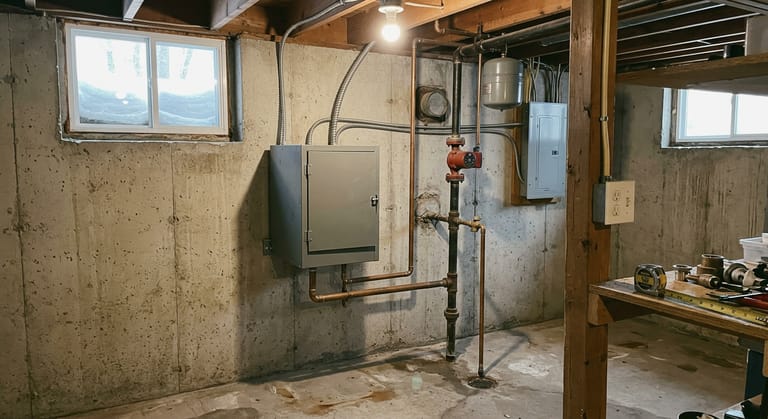
Electric boiler efficiency, and what the label leaves out
Design rules from that table do apply: electric hot water units built on or after that date need an automatic means for adjusting water temperature, unless a tankless coil is installed, held to no more than 140 degrees F when no heat load is inferred. The next table, at (B), caps standby and off mode draw at 8 W.
ENERGY STAR skips the class: its Boilers Eligibility Criteria Version 3.0, in effect since October 1, 2014 and revised January 2024, sets thresholds for gas and oil only and carries no electric row.
The rating measures the appliance, not the meter: ENERGY STAR defines AFUE as "the ratio of annual output energy to annual input energy," so a perfect score settles nothing about the bill.
What one costs to buy and install
| Publisher and date | What it covers | As printed |
|---|---|---|
| HomeGuide, December 31, 2025 | Replacement, installed | $1,800 to $8,000 |
| HomeGuide, December 31, 2025 | Unit alone | $1,000 to $6,000 |
| Fixr, January 28, 2026 | Cost by fuel type | $2,500 to $6,000 |
| HomeAdvisor, June 20, 2026 | Unit and installation | $1,800 to $8,000 |
Two of the four match to the dollar. All are national ranges, not a quote for one house.
Two line items a fuel swap carries never appear here: a chimney liner at $1,500 to $4,000 and a high-efficiency condensate drain at $200 to $600, both on HomeGuide's December 31, 2025 page. Neither belongs to equipment with no flue gas, which leaves an electric condensing boiler nothing to condense. Permits stay; the rest of the arithmetic is on the full boiler replacement cost breakdown.
Trade-offs, listed both ways
What it wins on
- Lowest entry price of any fuel in HomeAdvisor's June 20, 2026 table: $1,800, against $4,800 for oil.
- No flue and no combustion air, so those two lines drop out of the estimate.
- Nothing burns inside it, so it adds no carbon monoxide source of its own; the 2021 IRC R315.2.1 still requires an alarm where another fuel-fired appliance or an attached garage is present.
What it gives up
- No federal standard and no ENERGY STAR tier: no ladder to shop and no certified mark to point to.
- Every delivered BTU is billed at your own electric rate, not at a national series.
- Service costs more than on gas: $150 to $450 against $100 to $400, HomeGuide, July 14, 2025.
- The wet side is unchanged: relief valve, gauges, low-water cutoff, circulator and expansion tank all stay, priced the same.
Talk to someone who sees these boilers every week
Call (800) 555-0163Free to dial. Whoever answers works on boilers and holds whatever license or registration your state requires.Partner contractors who work on boilers and hydronic systems- Contractors who work on boilers, not just furnaces
- Answered at 2 a.m. in January
- Dialing costs nothing and books nothing
- The price is the contractor's own, set with you
Running cost is a rate question, not a rating question
EIA publishes delivered prices for the burning fuels: residential natural gas ran to a national average of $15.34 for each thousand cubic feet across 2025, Massachusetts $25.06 against Wisconsin $10.74 in the same annual series.
No national figure stands in for your electric rate. What decides this purchase is cost per delivered BTU at the price on your own statement, set against what gas equipment costs to run and repair. The wider argument sits on boiler against furnace.
Yours to gather before anyone quotes: the rate off your last bill, the square footage, the emitter type, and whether a gas main reaches the street. Stop before the panel and the wiring, licensed work under any fuel; (800) 555-0163 bills nothing and answers with a boiler contractor on it.
Who heats this way, and where it fits best
ACS 2024, Table B25040, counted electricity as the heating fuel in 41.8 percent of occupied US units, but in only 19.2 percent of the Northeast and 23.9 percent of the Midwest. Those homes may run a furnace, so read it as a ceiling.
Service, controls and the parts that still fail
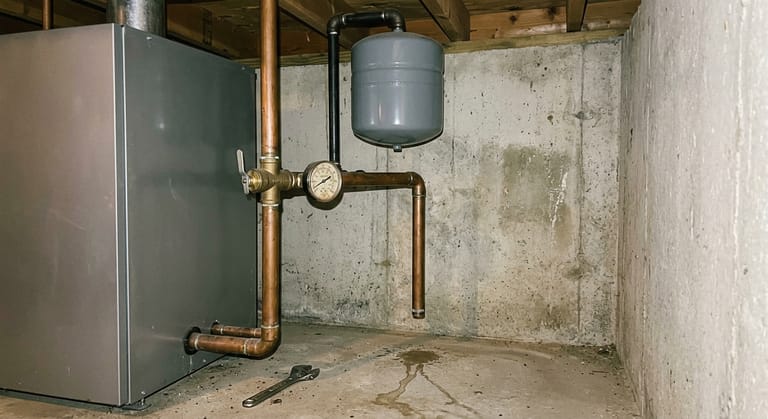
Losing the flame does not thin the safety kit. Under the 2021 IRC, where a state has adopted it, M2002.4 still requires a pressure relief valve set at the maximum rating of the boiler, the discharge run to a drain under gravity and stopped within 18 inches of floor level, or taken to an open receptor; M2002.2 still requires pressure and temperature gauges; M2002.5 still requires a low-water cutoff. M2002.1 lands here too: every operating and safety control on the appliance, electrical or mechanical, has to be listed and carry its label.
- Expansion tank, $200 to $550 for the electric variant, HomeAdvisor, June 20, 2026.
- Circulating pump, $300 to $1,000 on that table.
- Zone valve, $200 to $500 there, $100 to $500 on HomeGuide's July 14, 2025 page.
- Aquastat and relief valve: no aggregator prices either, so any firm figure is invented.
Read the gauge, confirm the thermostat is calling, look for water underneath, check the service switch and breaker, which ESFI says not to touch with wet hands or on a wet surface. Stop there: everything behind the jacket here is electrical, and a discharging relief valve is never plugged or capped. (800) 555-0163 answers free, and whoever picks up works on boilers and holds whatever license or registration your state requires.
Water, current and the relief valve. ESFI's rule on flooded gear is absolute: submerged electrical equipment is not to be handled at all, since it may still be live, and after a flood the power stays off until an electrician has inspected the system. Weil-McLain goes further for the models its manual covers: wiring or an electrical part that met water, or might have, ends with a new appliance rather than a dried-out one.
On the relief valve, Watts instructs the owner to operate the lever at least once a year, only with a discharge line connected and nobody near its outlet because hot water comes out, and if no water flows, the valve is inoperative: shut the boiler off and call a plumber immediately. Where another fuel-burning appliance shares the house and a carbon monoxide alarm sounds, CPSC sends the household straight into open air, with the fire department or 911 called from the driveway, tallies everyone outdoors and keeps the door shut until responders say otherwise.
The best electric boiler question, answered without a ranking
No model is named here: a page that crowns one best electric boiler is usually selling it. Three things settle it: the heat loss, which HomeGuide's December 31, 2025 page prices as a $200 to $500 Manual J calculation; what the electrical service can carry, an electrician's calculation; and whether parts and a technician for this class stay within reach.
Under 16 CFR 305 a retailer must show the EnergyGuide label before you agree to buy. On this class the tag reads 100, which says the rules were followed and nothing about your bill.
The conversation at (800) 555-0163 is free, with a licensed heating contractor on the other end; the quote follows a site visit and is theirs, agreed before anything is ordered.
Talk to someone who sees these boilers every week
Call (800) 555-0163Free to dial. Whoever answers works on boilers and holds whatever license or registration your state requires.Partner contractors who work on boilers and hydronic systems- Contractors who work on boilers, not just furnaces
- Answered at 2 a.m. in January
- Dialing costs nothing and books nothing
- The price is the contractor's own, set with you