
Gas Boiler Prices, Parts, Repairs and Efficiency Rules
Straight to it
- Installed price: $4,000 to $9,000 on HomeGuide's page dated December 31, 2025, of which $1,400 to $5,600 is the unit itself. HomeAdvisor's own gas page, updated June 17, 2026, averages $5,883.
- Efficiency floor: 84 percent AFUE for gas-fired hot water and 82 for gas-fired steam, on equipment produced on or after January 15, 2021, under 10 CFR 430.32(e)(2)(iii)(A).
- The same federal table bans a constant-burning pilot on that equipment, which is why a modern burner lights on a spark or a hot surface igniter.
- Valve failures are ordinary: HomeGuide's July 14, 2025 table prices that part at $200 to $900 and Fixr's January 26, 2026 table at $200 to $1,100, with an igniter at $100 to $400 on both.
- Yearly service is $200 to $500 for a tune-up, cleaning and repairs on HomeGuide's July 14, 2025 page. CDC asks for a qualified technician annually on any fuel-burning heating equipment.
A gas boiler replacement runs $4,000 to $9,000 installed, HomeGuide's figure dated December 31, 2025. The other number is set in Washington: 10 CFR 430.32(e)(2)(iii)(A) holds hot water models built on or after January 15, 2021 to 84 percent AFUE.
What the appliance is, and where its job ends
10 CFR 430.2 draws the line by pressure. A low pressure steam or hot water boiler, on that definition, burns gas or oil or runs on electricity, and raises low pressure steam or hot water to heat a building, steam at or below 15 psig and water at or below 160 psig and 250 degrees F, with residential coverage stopping below 300,000 Btu per hour of input.
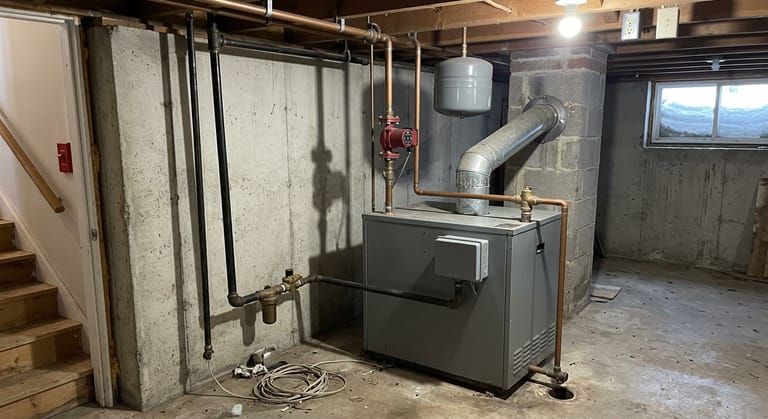
Under that wording sits a familiar basement machine: a burner tray fed by a gas valve, a cast iron or stainless heat exchanger, a circulator, an expansion tank and a relief valve, laid out in how a boiler works. This page stays with that equipment, its fuel train, ignition and controls; the gas piping feeding it is another trade and another subject.
Natural gas or propane: one machine, two supply stories
Propane turns up wherever the utility main does not: ACS 2024 counted 6,183,787 homes on bottled, tank or LP gas. The appliance itself barely moves between the two: HomeGuide's December 31, 2025 page prices a natural gas to propane conversion kit at $150 to $500 and a propane replacement at $2,800 to $7,500, against $4,000 to $9,000 for the natural gas version.
Fuel is where the two part. EIA put the 2025 annual residential natural gas price at $15.34 per thousand cubic feet nationally, and the spread inside that average is wide: Massachusetts $25.06, Wisconsin $10.74.
The gas valve, the igniter and the sounds they make
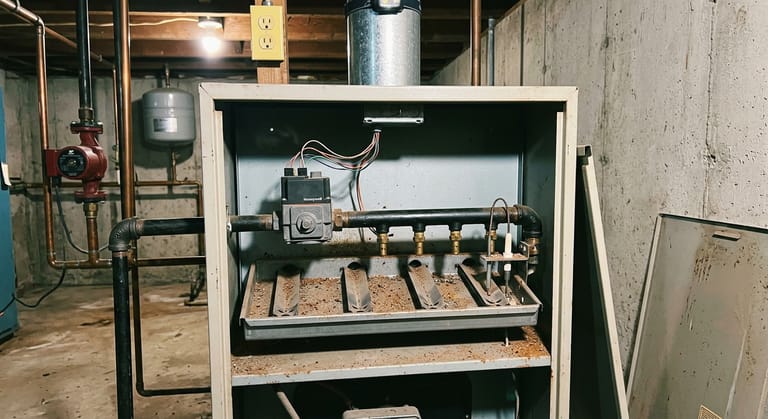
The gas valve admits fuel to the burner when the control calls for heat, and it fails often enough to have its own price line: $200 to $900 at HomeGuide, July 14, 2025, and $300 to $1,100 all in at HomeAdvisor, June 20, 2026. An igniter is cheaper, $100 to $400 on the HomeGuide and Fixr tables.
Ignition changed by rule: the design column of 10 CFR 430.32(e)(2)(iii)(A) bars a constant-burning pilot on gas-fired hot water and steam equipment produced on or after January 15, 2021. A standing flame belongs to older stock; newer burners light on a spark or a hot surface.
A soft click and a low hum as the burner lights is the valve doing its job. Kettling, banging and knocking usually sit on the water side instead: the first item on Caleffi's list of what trapped air does to a hydronic system is noise in the piping and emitters, with scale and poor circulation behind the rest, each traced in the noises a boiler makes. Steady noise from the valve itself is a service call.
A smell of gas ends the diagnosis. PHMSA describes the cue as "the distinctive rotten egg smell of odorized natural gas." Start no engine, strike no match, use no telephone indoors, and touch no wall switch and no garage door remote: those can ignite airborne gases. Leave the area without starting a vehicle, phone 911 once you are at a neighbor's door, and warn others away if it is safe. Weil-McLain's user manual adds a call to the gas utility from that same phone, or the fire department where nobody answers.
What a new gas boiler costs, source by source
Three national pricing sites cover this work, each with its own scope and date.
| Publisher and date | Scope | Figure as printed |
|---|---|---|
| HomeGuide, December 31, 2025 | Natural gas, installed | $4,000 to $9,000 |
| Fixr, January 28, 2026 | Natural gas, by fuel type | $4,000 to $10,000 |
| HomeAdvisor's own page, June 17, 2026 | Replacement, all in | $5,883 average, most $3,306 to $8,464 |
Labor is quoted separately: $1,200 to $3,200 at HomeGuide on that same page, $1,000 to $3,500 at Fixr on January 28, 2026, which also puts permits at $50 to $300, a charge from the jurisdiction rather than part of the fee. The breakdown sits on what a boiler replacement costs, the other fuels on oil-fired systems and electric boilers, which carry no AFUE standard.
High efficiency gas boiler, measured against the 84 percent floor
ENERGY STAR sets a higher threshold, 90 percent AFUE for a certified unit. Its Boilers Eligibility Criteria Version 3.0 took effect October 1, 2014 and was revised in January 2024, and a model certifies against the version in force when it was built. EPA describes those models as running roughly 6 percent better than the federal floor asks, which is a six point gap in AFUE and not a claim about a fuel bill.
The EnergyGuide label shows where a model sits. As published at 87 FR 61475 on October 12, 2022, the range of comparability for gas boilers other than steam runs from 84 low to 96.4 high, revised ranges due in 2027. Its low end is the federal floor, not the worst equipment sold.
HomeGuide, December 31, 2025, prices the classes apart: 80 to 89 percent at $2,200 to $7,000 to replace, 90 percent and up at $4,000 to $10,000. What condensing gear asks in return is on condensing and high efficiency systems.
Talk to someone who sees these boilers every week
Call (800) 555-0163Free to dial. Whoever answers works on boilers and holds whatever license or registration your state requires.Partner contractors who work on boilers and hydronic systems- Contractors who work on boilers, not just furnaces
- Answered at 2 a.m. in January
- Dialing costs nothing and books nothing
- The price is the contractor's own, set with you
Gas boiler repair: what fails, and what the fix costs
Fixr, January 26, 2026, gives $150 to $750 nationally, average $450. HomeGuide, July 14, 2025, lands at $150 to $700 with call-out minimums of $75 to $200. Parts that come up most, from the HomeGuide and Fixr tables:
- Gas valve, $200 to $900 at HomeGuide and $200 to $1,100 at Fixr
- Circulator pump, $300 to $1,100 at both
- Expansion tank, $200 to $800 at both
- Zone valve, $100 to $500 at HomeGuide, $175 to $500 at Fixr
Neither table names a price for the aquastat or the relief valve, so a firm figure is somebody's own.
Confirm three things first: that the thermostat is calling, that the service switch and breaker are on, and what the gauge reads. Stop there. The fuel train, the ignition circuit and anything electrical inside the jacket belong to a trained technician. Searching gas boiler repair near me on a January night finds this line: (800) 555-0163 goes straight to a licensed heating contractor, and asking costs the caller nothing. The order of checks: no heat, where to start.
What a yearly service visit is for
CDC is direct about the interval. Every year, a qualified technician looks over the heating plant, the water heater, and whatever else in the house burns gas, oil or coal.
- Burner and combustion cleaning, priced by HomeGuide at $150 to $350 on its July 14, 2025 page.
- Inspection alone, $70 to $125 on the same page.
- A full annual tune-up with minor repairs, $200 to $500.
- Parts and labor on a gas unit, $100 to $400.
A carbon monoxide alarm outranks the appliance. CPSC's instruction skips the search: clear the building for open air, get emergency services or a fire crew on the line, count the household outdoors, and leave the place to the responders until they hand it back, because going back in can cost consciousness and life. Where the source proves to be a malfunctioning appliance, CPSC will not have it running again before a service technician with the right training has been in.
CDC lists the symptoms as dizziness, headache, weakness, an upset stomach, vomiting, chest pain, confusion, and counts more than 400 unintentional CO deaths a year in the United States outside fires. CPSC puts alarms on every level and outside sleeping areas, not in an attic or basement unless that level has a sleeping area.
What a paid visit covers is on annual service.
Pressure, the aquastat and the gauges worth reading
The 2021 IRC, at M2002.2, wants both readings available, on two instruments or one combined dial, scaled so the needle sits inside the normal running range. The edition with force behind it is the state's. Weil-McLain's CGa Series 3 manual gives a residential system a typical cold fill pressure of 12 psi, while noting that correct pressure varies by application. Its user manual gives owners a ceiling, not a band: the needle stops at 24 psig, and higher may point at the tank or at the instrument. On steam that ceiling is 15 psig.
Temperature belongs to the aquastat, whose maker declines to name a setting. Resideo writes only that the right setting varies by system and belongs to the boiler manufacturer, then publishes ranges instead, such as a high limit adjustable from 130 to 240 degrees F. A universal 180 degrees F is folklore; more is on the aquastat.
Reading a gauge is yours. Moving a limit setting, opening the fuel train or repeatedly resetting a lockout is not, and a discharging relief valve is never plugged or capped. Dial (800) 555-0163 instead: a licensed heating pro answers and bills nothing for it.
Who heats this way in the Northeast and Midwest
Fuel share is not equipment share, and the census table reports only fuel. ACS 2024 puts utility gas at 65.1 percent of the 28.5 million occupied homes in the Midwest and 54.8 percent of the 22.9 million in the Northeast. Any of those may run a furnace, so treat it as an upper bound.
For equipment, EIA's RECS 2020 counted 9.29 million homes, 8 percent of the US total, on a steam or hot water system as main heating equipment.
Choosing a new one without guessing
There is no single best gas boiler, and a page ranking one is selling something. Three narrower things decide it: sizing to the house's real heat loss, a venting route the building accepts, and parts and service available locally. Specifications of the major American brands, without ratings or reviews, sit on boiler brands.
Under 16 CFR 305.22(b)(2) retailers must show the EnergyGuide label and let a customer read it before that customer agrees to purchase, so ask for it. Bring the fuel, the emitter type and the age of the house; a load calculation and a venting check turn those into a model. That conversation is unbilled at (800) 555-0163, and the price that follows is the contractor's, settled before any equipment is ordered.
Talk to someone who sees these boilers every week
Call (800) 555-0163Free to dial. Whoever answers works on boilers and holds whatever license or registration your state requires.Partner contractors who work on boilers and hydronic systems- Contractors who work on boilers, not just furnaces
- Answered at 2 a.m. in January
- Dialing costs nothing and books nothing
- The price is the contractor's own, set with you