
High Efficiency Boilers, Condensing Hardware and the 90 Percent Line
Straight to it
- The badge is 90 percent AFUE for gas and 87 for oil, set by ENERGY STAR Boilers Eligibility Criteria Version 3.0, revised January 2024. The federal floor under it is 84 percent for gas hot water equipment built on and after January 15, 2021.
- EPA calls certified gas models "approximately 6% more efficient than the federal standard." That is a gap of six points in a rating, 90 against 84, and not a promise about a fuel bill.
- Price by class, HomeGuide, December 31, 2025: the 80 to 89 percent band replaced at $2,200 to $7,000, the 90 to 95 percent band at $4,000 to $10,000.
- Condensing gear brings two line items an older unit never had: a drain for the condensate, priced by HomeGuide on December 31, 2025 at $200 to $600, and a vent route the chimney no longer provides.
- Return water temperature, not the label, decides whether the efficiency rating shows up. Caleffi's figure needs 31 feet of baseboard at 180 degrees F and 111 feet at 120 degrees F to move the same 20,000 Btu/hr.
A high efficiency boiler is a condensing unit rated at 90 percent AFUE or better, against the 84 percent federal floor for gas hot water models. That floor binds equipment built on and after January 15, 2021; the 90 percent line is ENERGY STAR's, from Boilers Eligibility Criteria Version 3.0, revised January 2024, with 87 percent for oil. The efficiency rating brings hardware with it: flue gas cooled until it gives up its water, a sealed vent, a drain the old boiler never needed.
What condensing does that a plain cast iron section cannot
AFUE, annual fuel utilization efficiency, scores a whole heating season and not the burner's best minute. DOE's Federal Energy Management Program describes the rating as "how efficiently a boiler converts the energy in its fuel to heat over a typical year." A non-condensing burner sends its combustion products up the flue still hot and carrying water vapor. Condensing gear keeps pulling heat from them until that vapor turns back to liquid, and the extra efficiency points come from there.
Federal test rules score the two differently: AFUE is measured under 10 CFR Part 430, Subpart B, Appendix EE and calculated per ASHRAE 103-2017, whose section 11.2.12 covers non-condensing systems and 11.3.12 condensing ones.
The rating leaves something out. ENERGY STAR's boiler specification builds AFUE from a year of output over a year of input. A pilot burning through the summer counts against it; on gas and oil equipment, electricity does not count at all. Circulators, the combustion fan and the controls all run outside that ratio.
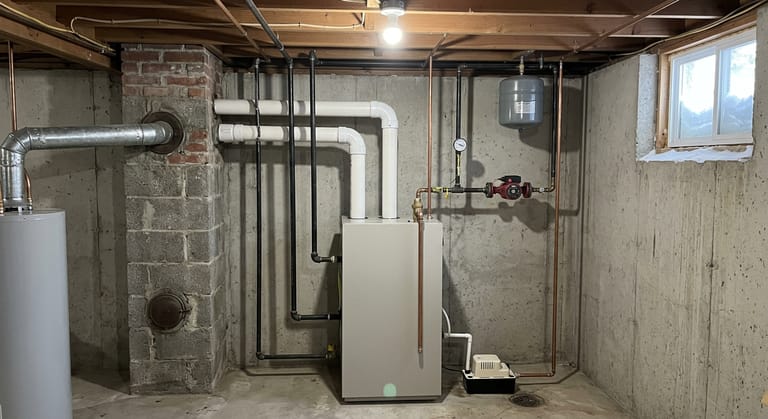
The 84 percent floor binds the factory, not the fitter
The same table carries design rules that shaped what is on sale. A constant-burning pilot is not permitted on gas-fired equipment built under it, and an automatic means for adjusting water temperature is required on gas, oil and electric hot water models, except those with a tankless domestic coil. Standby and off mode draw are capped at 9 watts each on gas-fired hot water boilers.
Dating a boiler in the basement runs back through the same section. Equipment made between September 1, 2012 and January 15, 2021 answered to 82 percent gas hot water and 80 gas steam; anything older to 80, or 75 for gas steam. A plate reading 80 percent is not a defect, only an earlier tier.
Where the 90 percent badge sits, and what EPA's six points are not
Version 3.0 of that specification took effect October 1, 2014 and carries a January 2024 revision. Its Section 3.B.c rounds what reaches the ENERGY STAR website to whole percentage points, so the 90 beside a model name need not be what the test produced.
The EnergyGuide tag places a model on that scale. The FTC's gas range of comparability, steam excluded, was published October 12, 2022 at 87 FR 61475, low 84 and high 96.4, with revised ranges due in 2027. That low end is the federal floor itself, not the worst appliance sold. Under 16 CFR 305.20(f)(12) a unit that can be set up as either steam or hot water is labeled with the AFUE from the hot water test, so a convertible tag can flatter steam performance. Electric boilers sit outside all of it: no federal AFUE standard, and an FTC scale that runs 100 low to 100 high.
Condensing against conventional, line by line
Set a high efficiency boiler beside a conventional one and three things separate them: efficiency band, invoice, and the connections at the back.
| What differs | Standard efficiency | High efficiency |
|---|---|---|
| Efficiency band, HomeGuide, December 31, 2025 | 80 to 89 percent AFUE | 90 to 95 percent AFUE and up |
| Replacement all in, HomeGuide, December 31, 2025 | $2,200 to $7,000 | $4,000 to $10,000 |
| Oil-fired by type, Fixr, January 26, 2026 | Non-condensing $4,000 to $8,000 | Condensing $6,000 to $11,500 |
| Drain, HomeGuide, December 31, 2025 | None | Condensate line $200 to $600 |
HomeAdvisor, June 20, 2026, splits it differently: standard at $2,200 to $7,000 against high-efficiency at $6,000 to $11,000. Labor, permits and removal sit on what a replacement costs; a boiler that also makes domestic hot water is priced apart on combination units.
Talk to someone who sees these boilers every week
Call (800) 555-0163Free to dial. Whoever answers works on boilers and holds whatever license or registration your state requires.Partner contractors who work on boilers and hydronic systems- Contractors who work on boilers, not just furnaces
- Answered at 2 a.m. in January
- Dialing costs nothing and books nothing
- The price is the contractor's own, set with you
Venting and the condensate drain
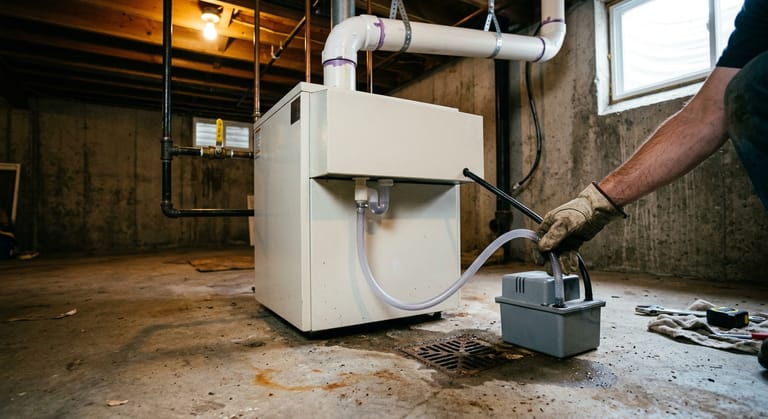
Cool wet exhaust does not climb a masonry chimney the way a hot dry plume does. High-efficiency equipment vents through a sealed pipe to the outdoors on the path its manufacturer's instructions allow, under whichever code edition the state has adopted.
That reroute matters in an older basement. Take the boiler off the chimney and whatever else vented into it, a water heater for instance, is left on that flue alone. Water heaters are a subject of their own; the chimney is this page's, and HomeGuide's December 31, 2025 page lists a liner at $1,500 to $4,000 among its costs of changing boiler type.
The water has to go somewhere too, which is why the same HomeGuide estimate carries its own row for a condensation drain on high-efficiency models, $200 to $600. Where it runs and how its discharge terminates come from the manufacturer's installation instructions.
A homeowner's part stops there. The vent path, the combustion air and the appliance left on the chimney belong to a licensed heating contractor in the basement; dialing (800) 555-0163 to reach one costs nothing.
Why a boiler this efficient can miss its rating when return water runs high
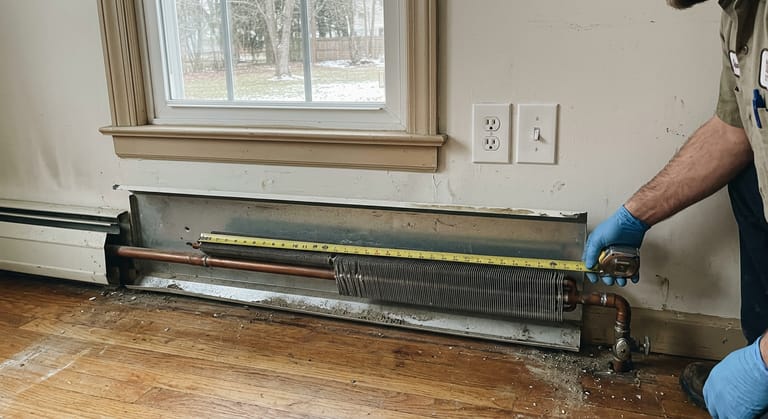
A high efficiency boiler earns its label on the return side, where water coming back from the emitters has to be cool enough for the flue gas to give up its moisture. Where the baseboard was sized for 180 degrees F water, that return runs hot all winter and the more efficient machine on paper becomes the less efficient one in service.
Caleffi states the principle directly: "The greater the total surface exchange area of the heat emitters, the lower the required supply water temperature for a given rate of heat transfer," and illustrates it with 31 feet of baseboard at 180 degrees F against 111 feet at 120 degrees F, each moving 20,000 Btu/hr. Those labels come from one figure with its own assumptions: the shape of the problem, not a sizing rule.
Manufacturer ratings agree. Slant/Fin rates its Fine/Line 30 element, No. 30-75, at 580 BTU/hr per linear foot at 180 degrees F average water, 1 GPM and 65 degrees F entering air, including a 15 percent heating effect factor, and 320 BTU/hr at 140 degrees F. That lower figure, its footnote says, is derived by factor from the 150 degrees F rating, not measured.
Federal design rules push the same way: 10 CFR 430.32(e)(2)(iv)(C) holds the required automatic temperature control to 140 degrees F when there is no inferred heat load. That is a no-load ceiling inside a design requirement, not an aquastat setting under load; anyone quoting it as a running temperature has misread it.
So payback depends on the building, and no savings percentage belongs here. Gather two things first: emitter length and type by room, and last winter's fuel bills. Turning those into an answer takes a survey on site, and that call costs nothing.
What high efficiency boiler repair looks like
Sealed combustion, a fan, a condensate path and a control board make a different service call than a burner tray and an aquastat.
| Part | HomeGuide, July 14, 2025 | HomeAdvisor, June 20, 2026 |
|---|---|---|
| Fan | $200 to $500 | $200 to $500 |
| Flue | $300 to $700 | $300 to $700 |
| Gas valve | $200 to $900 | $300 to $1,100 |
Three checks belong to the owner: is the thermostat calling for heat, is the service switch on with its breaker, and what does the pressure gauge read against the manual's figure. Stop at the jacket. The fuel train, the ignition circuit, the flue and anything electrical inside are licensed work, and a boiler that keeps locking out is a call to make, not a button to keep pressing. (800) 555-0163 is free to dial, and the person answering works on boilers and holds whatever license or registration your state requires.
Sealed combustion does not retire the carbon monoxide alarm. In the 2021 IRC, R315.2.1 requires alarms in new dwelling units that contain a fuel-fired appliance, and R315.3 fixes the position: just outside every sleeping area, close enough to the bedroom doors to wake the people behind them. Which edition governs is whichever the state has adopted.
CPSC asks for a test button pressed every month, and fresh batteries once a year. The symptoms CDC counts as most common in carbon monoxide poisoning are the ones a household writes off as flu: dizziness and confusion, weakness, chest pain, headache, an upset stomach and vomiting.
On a sounding alarm CPSC says to skip the hunt for a source and go: outside into fresh air first, then a call out to the fire department or to 911, a head count once everyone is out, and no reentry until responders allow it, since going back inside can end in unconsciousness and death. If the culprit proves to be a faulty appliance, CPSC leaves it switched off until a qualified technician has been through the appliance.
Before signing: sizing, the permit and the label
- Ask for a heat loss calculation, not a copy of the old nameplate. HomeGuide prices a Manual J at $200 to $500, December 31, 2025.
- Ask which permit the job takes. Fixr, updated August 29, 2025, is the one publisher pricing a mechanical permit separately, $60 to $600.
- Ask to see the EnergyGuide label. Under 16 CFR 305.22(b)(2) a retailer must show it and let a customer read it before agreeing to purchase.
- Ask in writing what happens to the chimney and anything else vented into it.
Sequence, permits and inspection sit on how an installation runs, fuel-side detail on gas-fired systems, and specifications on the major American brands. Whether a utility or state program keys its incentive to the certified tier varies, and no amount is quoted here.
Equipment badly matched to a house is an expensive disappointment: the question is never which model topped a table but whether this building, these emitters and this vent route suit a high efficiency boiler. That answer comes from someone in the basement with a tape measure, and the phone call that starts it is free.
Talk to someone who sees these boilers every week
Call (800) 555-0163Free to dial. Whoever answers works on boilers and holds whatever license or registration your state requires.Partner contractors who work on boilers and hydronic systems- Contractors who work on boilers, not just furnaces
- Answered at 2 a.m. in January
- Dialing costs nothing and books nothing
- The price is the contractor's own, set with you