
Boiler Installation, Step by Step and Line by Line
Straight to it
- Nine steps, in order: load calculation, permit, removal, setting the unit, near-boiler piping, venting, controls, fill and purge with a pressure test, then first fire and inspection.
- HomeGuide, December 2025, puts the finished job between $3,200 and $9,000, averaging $6,100 nationally. Fixr, January 2026, gives $3,000 to $8,500. HomeAdvisor, June 2026, averages $5,911.
- Sizing belongs to a Manual J load calculation, priced by HomeGuide at $200 to $500, not to the nameplate on the unit being hauled out.
- The 2021 IRC hangs four things on the finished job: shutoff valves in supply and return, a pressure and temperature gauge or a combination gauge, a low-water cutoff, and an expansion tank on hot water systems. Which edition applies is your state's decision.
- A relief valve that weeps in the first season points at the expansion tank on a water boiler, which Weil-McLain's manual calls waterlogged or undersized, and at the limit setting on a steam one.
A boiler installation runs in nine steps, not one: sizing, permit, removal, setting the unit, near-boiler piping, venting, controls, fill and purge, inspection. HomeGuide's page dated December 31, 2025 puts the finished job at $3,200 to $9,000. What sits in the middle of that list is what moves the figure.
What boiler installation cost actually buys
Three national publishers price this job and their ranges do not line up; each row is one publisher's dated market range.
| Where it comes from | What is priced | The figure |
|---|---|---|
| HomeGuide, December 31, 2025 | New unit installed, all fuels | $3,200 to $9,000, $6,100 average nationally |
| Fixr, January 28, 2026 | National replacement | $3,000 to $8,500, $6,100 average |
| HomeAdvisor, June 20, 2026 | Replacing a boiler | Average $5,911, normal range $3,605 to $8,445 |
Labor splits them. That HomeGuide page has plumbers at $45 to $150 an hour, fitting and labor $1,200 to $3,200, equipment $1,400 to $6,500. HomeAdvisor plans on $100 to $250 for the first visit, then $100 to $250 an hour. Averaging them invents a number nobody printed.
HomeGuide's estimate table adds line items: removal and disposal $200 to $500, permits $50 to $250, a condensate drain $200 to $600 on condensing models. Repair against replacement sits on what a boiler replacement costs.
Reading ranges is homework; matching one to your basement is not, because piping, vent route and load decide it. (800) 555-0163 costs nothing at all, and the pickup is a licensed heating contractor who prices this work every week.
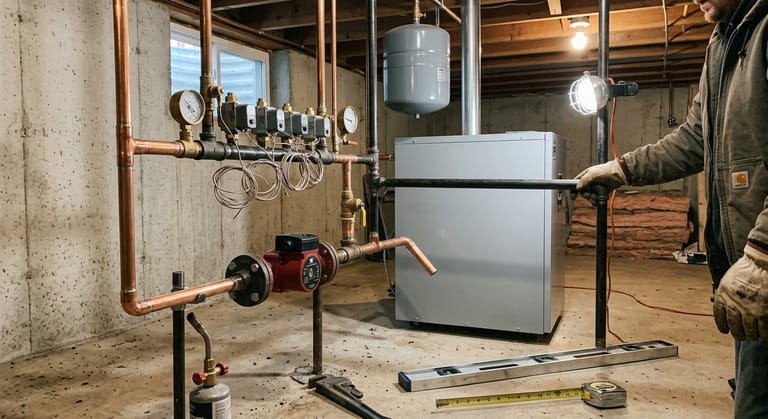
The nine steps of a boiler install, in order
A boiler installation follows that order, and the middle steps are the ones that get shortened.
- Load calculation. A Manual J runs $200 to $500 (HomeGuide, December 2025).
- Permit. Pulled before anything is cut, usually mechanical.
- Removal. The old appliance comes down: drained, cut loose, carried out, with disposal billed on its own line.
- Setting. The replacement is positioned, leveled, given its manual's clearances.
- Near-boiler piping. Supply and return made up, each with the shutoff valve the 2021 IRC wants.
- Venting and combustion air. Chimney, sidewall or plastic vent by category.
- Controls. Relief valve, gauge, low-water cutoff, expansion tank, circulator, thermostat wiring.
- Fill, purge and test. Air out, water in, then the code's hydrostatic test.
- First fire and inspection. Combustion checked, controls proved, permit signed off.
Steps four through seven are where identical bids stop matching: one crew reuses forty-year-old near-boiler piping, another replaces it. Both are installing a boiler; only one starts clean.
Ask what is being reused, then stop at the gas train, the burner and the wiring. Calling (800) 555-0163 is free of charge, and a licensed heating contractor can name the corner being cut.
Sizing is the step people skip
Sizing happens before installation day, and the old nameplate is the worst available spec: insulation and windows get replaced, so a number stamped in 1988 describes a house that is gone.
Emitters matter as much as the box. Caleffi shows 111 feet of baseboard at 120 degrees F and 31 feet at 180 degrees F both delivering 20,000 Btu per hour: more emitter surface means a lower supply temperature for the same output, which decides whether a condensing unit ever condenses. Loop, circulator and emitters are laid out on how a hydronic heating system works; specifications by manufacturer sit on what separates the major boiler brands.
Permits, inspection and who may pull them
Permit pricing is thin: treat it as a planning figure. Fixr, updated August 29, 2025, is the only source here pricing a mechanical permit alone, at $60 to $600. That fee is what the jurisdiction charges the holder, not part of a repair price.
Who may hold an installation permit changes at every state line.
City rules stack on top, and both halves count: Philadelphia's permit page sends boiler installations to the Pennsylvania Department of Labor and Industry, whose boiler law then exempts the single family house. In New York City plumbing work is restricted to licensed master plumbers and their employees.
Checking a credential in your state's lookup is free, but it will not tell you whether the quote in hand is sized right. No fee attaches to (800) 555-0163, where the pickup works on boilers and holds whatever license or registration your state requires.
Talk to someone who sees these boilers every week
Call (800) 555-0163Free to dial. Whoever answers works on boilers and holds whatever license or registration your state requires.Partner contractors who work on boilers and hydronic systems- Contractors who work on boilers, not just furnaces
- Answered at 2 a.m. in January
- Dialing costs nothing and books nothing
- The price is the contractor's own, set with you
Gas boiler installation, and what the fuel changes
All three publishers price gas boiler installation on its own. HomeGuide's December 2025 page puts a gas replacement at $4,000 to $9,000 installed, the unit alone $1,400 to $5,600. Fixr's January 2026 by-fuel table gives natural gas $4,000 to $10,000. HomeAdvisor's gas page, June 17, 2026, averages $5,883, most jobs $3,306 to $8,464. On that HomeGuide page propane runs lower, $2,800 to $7,500.
Two rules shape the equipment. IRC M2001.1.1, worded the same in the 2021 and 2024 editions, sends the vessel to Section I or IV of the ASME code for certification, and puts the controls and safety devices on anything up to 12,500,000 Btu/hr input under ASME CSD-1. Which edition governs any code cited here depends on what your state adopted. Federal design rules at 10 CFR 430.32 forbid a constant-burning pilot on gas-fired steam and hot water units built on or after January 15, 2021, which is why a new one lights electronically.
Nothing about a burner, a gas valve or the wiring is a homeowner project, whatever a state exemption says about the permit. Fuel by fuel is on choosing a gas boiler.
Condensing or standard, and what each one adds
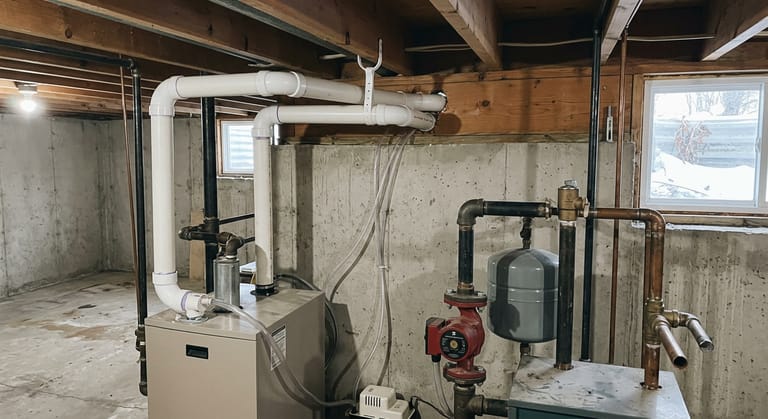
Efficiency class changes the vent, the drain and the installation price. Prices below are HomeGuide's, December 2025, materials only.
Standard efficiency, 80 to 89 percent AFUE
- Non-condensing units $1,200 to $5,000
- Federal floor: 84 percent AFUE gas-fired hot water, 86 oil-fired hot water, on equipment built on or after January 15, 2021
Condensing, 90 percent AFUE and up
- Condensing units $1,900 to $7,000
- ENERGY STAR starts at 90 percent AFUE for gas, 87 for oil (Version 3.0, effective October 2014, revised January 2024)
- Installation adds a condensate drain, $200 to $600
EPA's comparison gets restated as a fuel bill saving it never claimed, so quote it exactly: certified gas units at 90 percent AFUE are "approximately 6% more efficient than the federal standard", certified oil units at 87 percent "approximately 1% more efficient". Those are percentage-point gaps in AFUE, not money. Whether emitters run cool enough to earn the premium sits on what a high efficiency boiler actually delivers.
Electricity is the outlier: the federal AFUE table sets no standard for electric steam or hot water units, and the same HomeGuide page puts an electric replacement at $1,800 to $8,000, covered on electric boilers in a hydronic system. Hot water and steam systems are what follow; electric baseboard heaters are a different appliance and an electrician's job.
The pressure tests that close the job
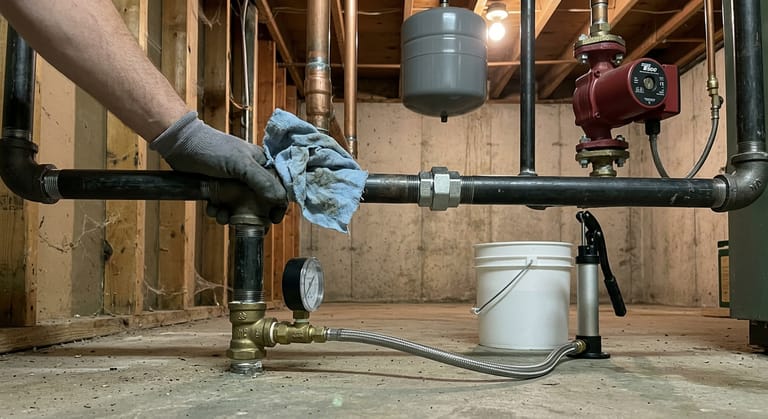
Installation is not finished until new piping is proved, and the 2021 IRC sets two tests. Under M2101.10 hydronic piping is tested hydrostatically at half again the design pressure the system is built for, 100 psi at the very least, for a quarter hour. M2103.4 holds embedded piping longer, 100 psi for 30 minutes while joints are inspected for leaks.
Neither is an operating pressure or a diagnostic for a running system: both are acceptance tests for new or altered work. Slab and staple-up loops have their own sequence on installing a radiant floor heating system.
What a bad boiler installation shows a year later
Most tell-tales are code items the installation crew skipped, surfacing in the first season.
The loudest is a relief valve that keeps weeping. Weil-McLain's manual is direct: frequent weeping usually traces back to a tank that has waterlogged or was too small to begin with, so the technician clears the system before blaming the part. Its user manual splits that by type: the tank on a water boiler, the limit setting on a steam one. The 2021 IRC at M2003.1 requires hot water boilers to be provided with expansion tanks.
M2001.3 wants a shutoff on the supply and on the return, excepting a single low-pressure steam boiler. M2002.2 wants a pressure and temperature gauge, or a combination gauge, reading within the system's normal range. M2002.5 requires a low-water cutoff, and its exception reaches only coil-type and water-tube boilers on forced circulation with a flow-sensing control, so ordinary cast iron in a Northeast basement stays covered.
Look for the valves, read the gauge, confirm the alarm outside the bedrooms. Stop before the relief valve, whose discharge M2002.4 sends down under gravity to a termination no more than 18 inches off the floor, and never into a capped fitting, and before the burner. (800) 555-0163 costs nothing, and a licensed contractor who works on boilers will say whether a bad boiler installation is what you have.
What to ask before signing
Seven questions separate a clean boiler installation from a cheap one.
- What load calculation is this size based on, and may I see it?
- Whose name goes on the permit, and what day does the inspector show up?
- What near-boiler piping is replaced rather than reused?
- What is the AFUE, and may I see the EnergyGuide label?
- How is it vented, and where does the condensate go?
- Who removes the old unit, and is disposal included?
- Who returns for the first annual service, at what price?
Under 16 CFR 305.22 retailers must show the EnergyGuide label and let a customer read it before purchase. It sets the model's AFUE against a range of comparability, adopted at 87 FR 61475 in October 2022 and due for revision in 2027: 84 to 96.4 for gas boilers other than steam, 82 to 83.4 for gas steam, 85 to 88.2 for oil. Each low end is a federal minimum, so a number near the bottom is the floor.
Asking all seven costs nothing, and the answers belong in a written boiler installation quote before any deposit. Judging them is where a second opinion pays: (800) 555-0163 gets you a licensed heating contractor for free, and books nothing.
Talk to someone who sees these boilers every week
Call (800) 555-0163Free to dial. Whoever answers works on boilers and holds whatever license or registration your state requires.Partner contractors who work on boilers and hydronic systems- Contractors who work on boilers, not just furnaces
- Answered at 2 a.m. in January
- Dialing costs nothing and books nothing
- The price is the contractor's own, set with you