
What a Combi Boiler Is, What It Costs, and Who Should Skip One
Straight to it
- Installed price: $6,000 to $10,000 on HomeGuide's page dated December 31, 2025, with the appliance alone at $1,700 to $3,500 on the same page. Fixr, January 28, 2026, spreads the same type from $2,600 to $10,000.
- EPA's ENERGY STAR specification, Version 3.0 revised January 2024, is where the category is defined: a unit that heats the house and also makes hot water for domestic use is a combination space-heating and water heating appliance.
- Federal rules single these out. The design column at 10 CFR 430.32(e)(2)(iii)(A) drops its automatic temperature-reset requirement for units with tankless domestic water heating coils.
- Yes, it needs power. A gas-fired hot water boiler built on or after January 15, 2021 is capped at 9 W standby and 9 W off by the federal table at 10 CFR 430.32(e)(2)(iii)(B).
- Descaling is a scheduled item, not a repair. HomeGuide's July 14, 2025 page prices a system flush and descaling at $150 to $600.
A combi boiler is one appliance that heats the house and makes domestic hot water, and HomeGuide's December 31, 2025 page puts the installation at $6,000 to $10,000. The unit alone is $1,700 to $3,500 there. Whether yours is a candidate turns on what the basement already holds.
What a combi boiler actually is
EPA's ENERGY STAR Boilers specification, Version 3.0 revised January 2024, covers self-contained fuel burning appliances rated under 300,000 Btu per hour of input, running at or below 160 psig and 250 degrees F, that put out low pressure steam, or hot water, to heat rooms. Then comes the sentence that names this machine. Any unit answering that description which also sends hot water to the faucets counts, under the agreement, as a combination space-heating and water heating appliance.
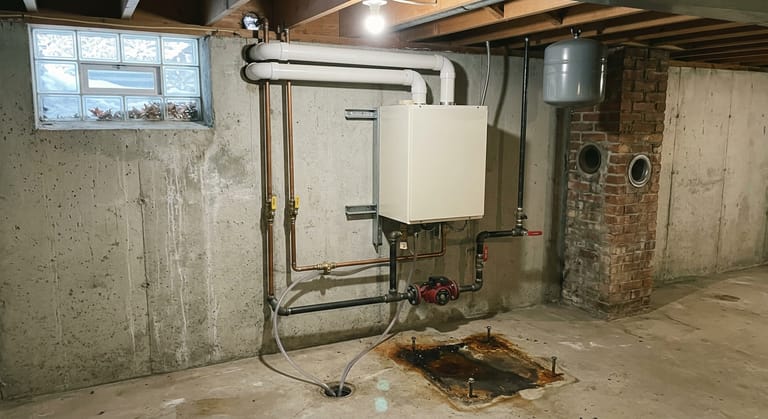
The trade sells the same appliance under several labels: combination boiler, on demand model, or the wall mounted box hung where a floor-standing sectional stood. The loop it feeds is unchanged, and how a boiler heats that circuit applies either way.
This page stays on the heating half of that definition. Gallons a minute at the shower, tank comparisons and slow faucets belong to a plumbing site.
Why combi boiler cost ranges disagree
| Source and its date | Scope of the number | Printed range |
|---|---|---|
| HomeGuide, December 31, 2025 | Installation, all in | $6,000 to $10,000 |
| HomeGuide, December 31, 2025 | Appliance alone | $1,700 to $3,500 |
| Fixr, January 28, 2026 | Combination type, installed | $2,600 to $10,000 |
| HomeAdvisor, June 20, 2026 | Combination type, installed | $2,600 to $7,000 |
| Fixr oil page, January 26, 2026 | Oil-fired combination, installed | $8,000 to $12,000 |
On the same Fixr table a conventional unit is $2,200 to $7,000 and a condensing one $4,000 to $11,000, so a combination overlaps both rows rather than topping the list. HomeAdvisor discloses that automation drafts its cost pages and staff edit them. The full arithmetic is on what a boiler replacement costs.
Combi boiler installation, line by line
Line items are published separately, and that is where quotes diverge.
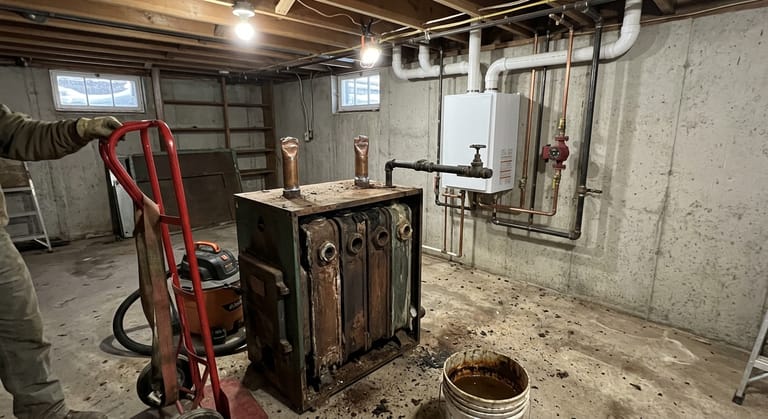
- Old appliance out of the basement and hauled away: $200 to $500, HomeGuide, December 31, 2025.
- Labor and fitting: HomeGuide $1,200 to $3,200; Fixr, January 28, 2026, $1,000 to $3,500.
- Permits: $50 to $250 at HomeGuide, $50 to $300 at Fixr.
- A chimney liner where the flue must change: $1,500 to $4,000 or more, HomeGuide's conversion page dated December 30, 2025.
The flue line decides whether a bid is honest. A condensing unit earns its efficiency by cooling flue gas until it condenses, which leaves liquid to drain and a vent question the old masonry chimney may not answer, which is why high-efficiency condensing boilers and what they demand is worth reading first. Ask installers to itemize removal, permit, venting and condensate on the combi quote, then compare bids line by line. The sequence is on how a boiler installation runs from shutoff to startup. The call to (800) 555-0163 carries no fee, and the scope gets priced by a licensed heating contractor.
Combi boiler sizes, and what actually sets them
Nothing in a catalog sets the number. A load calculation does. HomeGuide's December 31, 2025 page puts a Manual J at $200 to $500. The outer edge is federal: ENERGY STAR excludes anything rated at 300,000 Btu per hour or higher, the threshold that also ends residential coverage in 10 CFR 430.2.
Fixr's January 28, 2026 page ladders price by floor area, from $4,000 to $6,500 at 1,000 square feet to $6,000 to $10,000 at 3,000 square feet. That is a price ladder, not a sizing method: floor area says nothing about insulation, glazing or how much radiation hangs on the walls. The smallest model that covers the calculated heat loss is the right one, so hunting for the smallest unit sold is the wrong question.
Measuring rooms and counting radiators is yours; the load calculation needs software and a site visit.
Does a combi boiler use electricity?
Yes, and even the idle draw is regulated. Under 10 CFR 430.32(e)(2)(iii)(B), a gas-fired hot water boiler manufactured on or after January 15, 2021 is limited to 9 W in standby mode and 9 W in off mode. The design column of the AFUE table just above it, at (iii)(A), forbids a constant-burning pilot, so ignition has to be lit on demand, which takes current, as does the circulator.
The rules do carve out a genuinely electricity-free machine. Under 10 CFR 430.32(e)(2)(v), a boiler manufactured to operate without any need for electricity, electric connection, gauges, pumps, wires or devices is not held to those AFUE and design requirements. A combi is not that machine, so an outage takes the heat and the hot water with it.
Searches mixing electric and combination usually mean an electric boiler, a real hydronic appliance covered on electric boilers and the AFUE line they lack. Electric baseboard is another trade, an electrician's job rather than a hot water system.
Talk to someone who sees these boilers every week
Call (800) 555-0163Free to dial. Whoever answers works on boilers and holds whatever license or registration your state requires.Partner contractors who work on boilers and hydronic systems- Contractors who work on boilers, not just furnaces
- Answered at 2 a.m. in January
- Dialing costs nothing and books nothing
- The price is the contractor's own, set with you
Combi boiler efficiency and the tankless coil exception
What repays reading in that table is the exception printed next to the percentage. Hot water boilers carry an automatic way of adjusting water temperature, and the rule lifts that duty from any unit with a tankless coil for domestic hot water. Where the same vessel feeds the faucets, the requirement steps back. On a boiler that does carry that automatic means, 10 CFR 430.32(e)(2)(iv)(C) holds the water to no more than 140 degrees F when there is no inferred heat load, and a vessel that also serves the faucets has a second job.
Above the floor sits certification: ENERGY STAR asks 90 percent AFUE for a certified gas model and 87 percent for oil, under Eligibility Criteria Version 3.0 revised January 2024. Fuel-side detail is on gas boilers and propane fuel detail.
Descaling a combi, and the yearly service visit
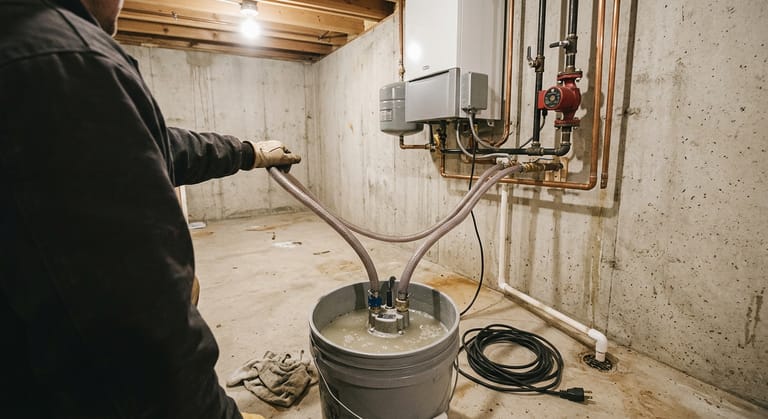
Scale is what separates this appliance from a cast iron sectional. The closed loop holds the same water for years; the domestic side takes fresh supply water every time a faucet opens, so the manufacturer's manual sets the cleaning interval, not a web page.
On HomeGuide's July 14, 2025 page a flush with descaling runs $150 to $600, an annual gas boiler service $200 to $500, an inspection alone $70 to $125, and the call-out minimum $75 to $200. CDC puts the interval plainly: once every year, a qualified technician goes over the heating plant, the water heater and anything else in the house burning gas, oil or coal.
Carbon monoxide outranks everything on this page. CPSC wants a unit on every floor and one outside the bedrooms, and rules out attics and basements unless somebody sleeps on that level. If one sounds, CPSC's instruction skips diagnosis: everyone into open air, a call to 911 or the fire department from outside, a head count on the sidewalk, and no re-entry until responders give permission. If the source proves to be the appliance, CPSC says it stays cold until trained hands have been over it.
Note the model number, the last service date and any code on the display before calling. Descaling, the fuel train and the burner are service work. Calling (800) 555-0163 costs nothing, and the contractor who answers works on boilers and holds whatever license or registration your state requires.
Navien combi boiler, and the rest of the shortlist
Navien is the name that turns up most often beside this category, and the search box fills with the rest of the American shelf: Weil-McLain, Burnham and US Boiler, Lochinvar, Buderus, Dunkirk, A.O. Smith, Westinghouse, plus model names like ProLine XE and AquaBalance.
You will not find a ranking here. No output, efficiency or reliability figure runs on this site unless it was read on the maker's own document, which rules out a "best" list built from retailer copy. Specifications brand by brand are on boiler brands and their published specifications.
The practical answer to the best combi boiler question is not a brand. It is whichever line the contractors within an hour of you stock parts for, because a proprietary control board on a Sunday in January is what costs real money.
When a combi is the wrong choice
The Northeast housing stock argues against it more often than the marketing suggests. EIA's RECS 2020 counted 9.29 million US homes, 8 percent of the total, on a steam or hot water system as main heating equipment: 6.01 million of the Northeast's 21.92 million homes, and 4.02 million of that national figure in homes predating 1950.
Where it fits
- A smaller house with no room for a tank beside the boiler
- An existing hot water system already running at condensing temperatures
- A gas or propane supply and a vent route the code official accepts
Where it does not
- One-pipe steam, which the pricing sites keep on a separate line
- Large simultaneous draws, which are a plumber's question
- Houses far from anyone trained on that specific control platform
No heat from the combi: what to check first
Start where the partner contractors start. Check that the thermostat calls for heat, that the basement service switch and the breaker are both on, then read the display: a fault code is the fastest thing to hand whoever answers the phone. Then the gauge. The Weil-McLain user manual gives owners a ceiling rather than a band: 24 psig and no higher on a water boiler, with a bigger number pointing at the tank or at the instrument.
A smell of gas ends every other check. PHMSA's indoor list is short: start no engine, strike no match or flame, use no telephone inside, and leave every wall switch, garage door control and other electrical switch untouched. Leave the area, then place the 911 call from a neighbor's kitchen.
One reset is diagnosis. Repeated resets only clear a lockout that is there for a reason, and the fuel train, the ignition side and the wiring inside the jacket are a licensed trade. A relief valve that keeps weeping is the Weil-McLain user manual's cue to call a qualified service technician, never a fitting to cap or plug. Everything past the thermostat, switch, breaker and gauge is a contractor's job, and reaching one on (800) 555-0163 costs nothing whether or not a visit follows.
Talk to someone who sees these boilers every week
Call (800) 555-0163Free to dial. Whoever answers works on boilers and holds whatever license or registration your state requires.Partner contractors who work on boilers and hydronic systems- Contractors who work on boilers, not just furnaces
- Answered at 2 a.m. in January
- Dialing costs nothing and books nothing
- The price is the contractor's own, set with you