
Cast Iron Radiators: Keep, Restore or Replace
Straight to it
- Repair is the cheaper branch on the published numbers. HomeAdvisor's June 2026 page lists $200 to $600 to repair one unit and $250 to $2,500 to replace it.
- Output is a table row, not a fact about iron. Governale rates a 4 by 25 inch Gov-Free section at 340 BTU with 180 degrees F water, and at 150 degrees F the same section is rated 220 BTU.
- Reuse has published conditions. Caleffi ties it to a minimum 30 psi pressure test, a way to vent air from the upper part of the unit, and an honest look at internal corrosion if it once carried steam.
- The literature read here prints water content, not shipping weight: 0.61 gallon per Victoria section. Any pounds-per-section figure is unsourced on this page.
- Never size from a price table. HomeGuide's BTU bands are a retail size label with no water temperature, flow rate or rating standard behind them.
Repairing a cast iron radiator costs less than replacing it at both ends of HomeAdvisor's June 2026 figures: $200 to $600 a unit against $250 to $2,500. Age settles nothing here. Cast iron sections do not wear out the way a burner does, and what fails is a valve, a vent, a joint, or the pipe feeding them.
Partner heating contractors treat these as fittings problems until proven otherwise. Every output figure below carries the water temperature it assumes: a BTU number without one means nothing.
- Repair runs $200 to $600 a unit on HomeAdvisor's June 2026 radiator repair page.
- Rated output tracks section size and water temperature, not the year it was cast.
- Nothing leaves the wall, so the piping stays put.
- A cracked section or a weeping joint is not a field repair.
- Internal corrosion after years on steam ends the argument.
- Removal and disposal is billed separately.
What one section puts out, and at what water temperature
Governale rates a 4 by 25 inch Gov-Free free standing cast iron section at 340 BTU with 180 degrees F water, the 4 by 19 inch section at 272 BTU and the 6 by 25 inch at 510. These are ratings per section, so a room total is the section count times the row matching your supply temperature.
| Water temperature | BTU per section |
|---|---|
| 150 degrees F | 220 |
| 170 degrees F | 300 |
| 180 degrees F | 340 |
| 200 degrees F | 420 |
| 215 degrees F | 480 |
| 220 degrees F | 500 |
Each line is a separate published row, and the 150 to 220 degrees F span is the reach of one table, not an operating range anyone recommends. The recessed Gov-Ray is rated separately, 382 BTU per section at 180 degrees F, and the Victoria page lists 3.05 square feet EDR per section with its outputs based on a 70 degrees F room.
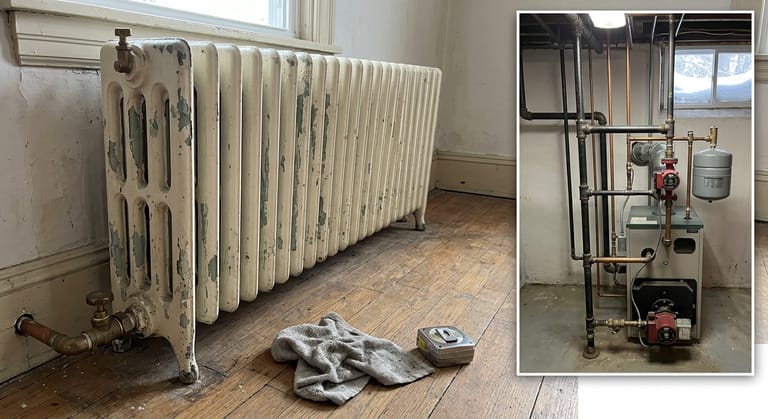
Steam ratings sit in a different column
On steam the same iron carries separate numbers. Governale lists 384 BTU per section for the 4 by 19 inch Gov-Free, 480 for the 4 by 25 inch and 720 for the 6 by 25 inch, matching the 215 degrees F rows of its water table. Caleffi describes steam emitters as typically cast iron radiation sized for low pressure steam at 215 to 220 degrees F.
Pressure differs too. Utica's PEG-E manual, on a single family residence whose one pipe system is clean and whose radiation is cast iron, sets the pressuretrol cut-in at the minimum 1/2 psi with a 1 psi differential for a 1-1/2 psi cut-off; larger systems, two pipe systems, convectors and fan coils it settles one at a time. Banging, hissing and a unit that never fills sit on steam radiator faults and what each sound means.
How heavy is a cast iron radiator
Manufacturer literature read for this page publishes water content, not shipping weight. Governale lists 0.61 gallon per section for the Victoria, so a ten section unit holds a little over six gallons of water before anyone lifts it.
No document behind this page states pounds per section, so none appears here. The practical answer holds anyway: it is drained before it moves, the route out is measured first, and a long one is a two person carry.
Restoring the one already in the room
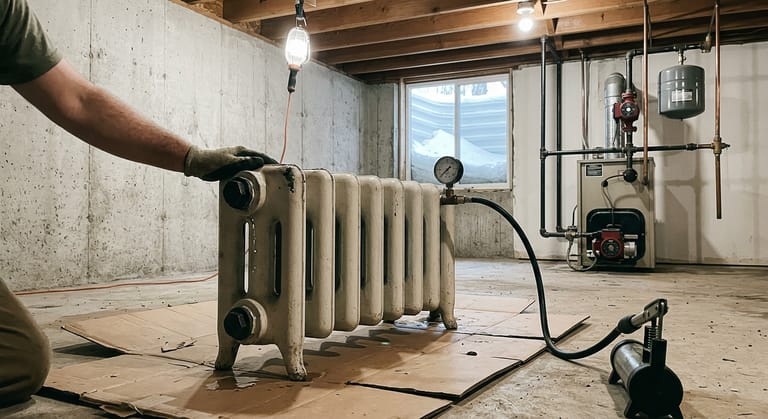
Caleffi sets out what reuse of two pipe cast iron in a low temperature system depends on: the radiator withstanding a minimum 30 psi pressure test, a means of venting air from its upper portion, and an evaluation of internal corrosion, especially where it once served steam. That is a technical journal's guidance, not code, and a contractor runs it in this order.
- Isolation and draining, then the union and valve body before the casting takes blame.
- A pressure test at the 30 psi Caleffi names, joints watched throughout.
- A confirmed tapping at the upper header where an air vent can go.
- A lance valve where only one lower connection exists: Caleffi describes a tube carrying hot water to the far lower end so it rises by convection.
- Valve refitted, system refilled, and the boiler gauge read rather than the room.
Small parts are priced. HomeGuide, bylined September 1, 2023 under a 2026 title, lists $100 to $350 to replace a radiator valve, $100 to $320 for an air vent and $100 to $300 to balance one.
Looking, counting and photographing is yours. Draining a system, cracking a joint or working at the boiler is not, and (800) 555-0163 is free, a licensed heating contractor taking it from there.
Talk to someone who sees these boilers every week
Call (800) 555-0163Free to dial. Whoever answers works on boilers and holds whatever license or registration your state requires.Partner contractors who work on boilers and hydronic systems- Contractors who work on boilers, not just furnaces
- Answered at 2 a.m. in January
- Dialing costs nothing and books nothing
- The price is the contractor's own, set with you
Paint, and what it does not tell you
HomeGuide prices painting at $200 to $900, on that same 2023 byline. No document read for this page states what paint does to the output of cast iron, so nothing here claims a percentage.
The nearest published clue is another product: Slant/Fin rates its Fine/Line 30 on aluminum fins spaced 55 per linear foot, unpainted. That is a fin tube basis, not a finding about iron.
Buying a new cast iron radiator
New cast iron sections are still sold. Governale's line covers the free standing Gov-Free, the recessed Gov-Ray and the Victoria, all rated for a maximum working pressure of 15 psi steam and 30 psi water.
Two publishers, kept separate. Fixr, updated January 31, 2025, puts a plumbed cast iron unit at $200 to $700 alone and plumbed radiator labor at $600 to $800, being 3 to 4 hours at roughly $200 an hour. HomeGuide, on its 2023 byline, gives $150 to $1,000 each plus $200 to $800 for labor.
Valves and vents that belong on a cast iron radiator
Danfoss states that its RA 2000 thermostatic valves regulate hot water or low pressure steam through free standing radiators, baseboards and convectors, on hot water and two pipe steam alike, rated to 250 degrees F and 145 psi maximum static pressure on the water side. One datasheet line explains a room that will not cool down: the valves stay open with no operator mounted.
One pipe steam runs on vents instead. Hoffman Specialty lists two radiator steam vents, the Model 1A with six adjustable port settings and a maximum operating pressure of 1-1/2 psig, and the single port Model 40 at 6 psig, both float type. On hot water, Caleffi puts a manual air vent, turned by screwdriver or by square key, on top of every emitter.
Which head fits which body is on radiator valves, thermostatic heads and steam air valves, and the order for opening a vent is on bleeding a radiator without losing system pressure. Anything drained, unthreaded or rewired is licensed work, and asking about it costs nothing.
Taking one out, and what the code calls altered work
Removal is quoted on its own. HomeGuide adds $75 to $400 for old radiator removal and disposal inside a replacement estimate; Fixr states $250 to $400. Two publishers, one question, not averaged.
Where the plan is fin tube baseboard on that wall instead, that side sits on how hot water baseboard is put together.
What a search for a cast iron radiator near me is really asking
Three errands hide behind that phrase: a salvage yard holding reclaimed cast iron, a supplier of new sections, and a contractor able to hang, pipe and vent one. Only the third keeps a schedule.
The trade sits where the housing is. EIA's RECS 2020 Table HC6.7 counted 6.01 million homes in the Northeast on a steam or hot water system out of 21.92 million, and its Table HC6.3 counts 4.02 million US homes with such a system built before 1950.
One line of scope. Hot water (hydronic) and steam radiation are what follow; electric radiators and electric baseboard are an electrician's job. When several rooms went cold at once, start with six checks for a radiator that will not heat.
Counting sections, reading a nameplate and photographing the boiler gauge are yours. Testing a casting and anything at the burner belong to someone licensed for it, and dialing (800) 555-0163 costs nothing.
Talk to someone who sees these boilers every week
Call (800) 555-0163Free to dial. Whoever answers works on boilers and holds whatever license or registration your state requires.Partner contractors who work on boilers and hydronic systems- Contractors who work on boilers, not just furnaces
- Answered at 2 a.m. in January
- Dialing costs nothing and books nothing
- The price is the contractor's own, set with you