
The Honeywell Zone Valve, Read in Five Minutes
Straight to it
- Normally closed is the resting state: Resideo's V8043 submittal lists that de-energized position, so a zone valve with no 24 volt call keeps its loop sealed.
- Timing is the test, but only of the valve: Resideo rates travel at 15 seconds maximum, so the valve is open or it is not, while the pipe behind it warms only once the circulator runs.
- The manual lever is the cheapest evidence in the basement. Resideo says it opens the valve during an outage and reverts to automatic once power returns.
- Wiring differs by suffix: V8043A leadwires, V8043E leadwires and an end switch, V8043F a terminal board and an end switch.
- Three publishers price the swap: $100 to $500 (HomeGuide, July 14, 2025), $175 to $500 (Fixr, January 26, 2026), $200 to $500 all in (HomeAdvisor, June 20, 2026).
A Honeywell zone valve opens or closes in 15 seconds or less on 24 volts, so one cold zone usually means that valve, its thermostat, or the 24 volt supply. Resideo, publisher of the submittal sheet for the Honeywell Home V8043 QuickFit, prints that timing as a ceiling: "Open or close in 15 seconds max." A part that either travels in a quarter of a minute or not at all can be tested by hand.
What a Honeywell zone valve does in a hydronic system
Resideo's submittal fills four lines for the V8043. A hydronic control, two positions rather than a modulating range, a straight-through body with two ports, and shut whenever no power reaches it.
Two position means fully open or fully shut, never partly. Two-way straight-through is the plumbing shape, the body that overseas catalogs list as a 2 port. Normally closed is the line that matters at 6 a.m.: with no power at the head, that zone is sealed.
The head is a geared motor, not a magnet. Resideo rates it at 24 Vac, 60 Hz, 7.2 VA, drawing 0.30 A and 5 W, with a fluid temperature range of 50 to 200 degrees F, static pressure 300 psi and maximum ambient 125 degrees F.
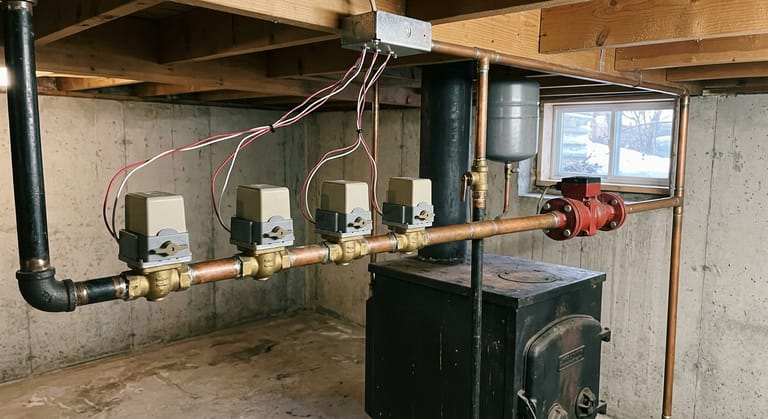
Zoned by valves or zoned by pumps
Northeast basements do this two ways: one circulator pushes the system and a small brass valve guards each zone, or every loop gets its own pump and the valves disappear. Actuators in a row means the first, pumps in a row the second.
Pump symptoms, from a seized rotor to a weeping flange, belong with circulator faults, Taco and Grundfos ratings and replacement. If every room is cold rather than one, the order of checks sits on what to do when the boiler quits.
Five checks when one zone stays cold
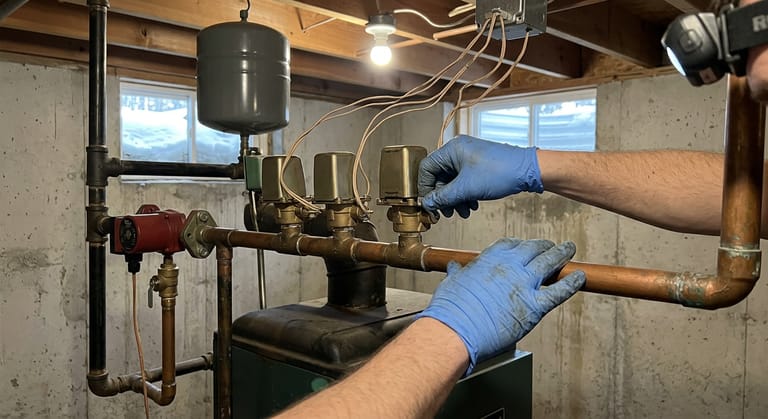
- Confirm the call. Push that thermostat several degrees above the room. No call, no travel, nothing downstream matters.
- Check the pipe. Resideo's 15 seconds is valve travel, not warm-up: if no other zone was running, give the boiler and circulator a few minutes, then touch the pipe leaving that valve briefly with the back of your hand, because supply piping runs hot enough to burn. Warm pipe means the zone opened and the trouble is out in the rooms.
- Try the manual opener. Resideo puts the lever there for outages: it forces the port open with the power out, and hands control back once the circuit is live. If the loop warms on the lever, the body is free and the fault is electrical.
- Check the neighbors. Other zones warming while this one sulks is the single-zone picture; all of them cold moves the search back to the boiler.
- Read the gauge. Weil-McLain calls 12 psi a normal cold fill in a house and puts the owner's daily ceiling on a running boiler at 24 psig. A system short of water will not fill an upper zone whatever the valve does.
Those five belong to a homeowner: a thermostat dial, a quick touch on a pipe, a lever, a gauge face. It stops at the cover. Metering 24 volts or pulling a head off a live circuit is licensed work, and (800) 555-0163 brings in a licensed heating contractor without a charge for asking.
Honeywell zone valve stuck closed, stuck open, or humming
Four patterns cover most zone valve problems, and each points somewhere different.
| What you observe | Usually means | Where it ends |
|---|---|---|
| Zone cold, valve silent, others fine | No 24 volt call arriving: thermostat, wiring or transformer | Wiring, so licensed work |
| Head hums, zone still cold | Actuator drawing current without driving the ball | Head replacement |
| Room roasts whenever the pump runs | Ball held open, lever latched, or an end switch stuck made | Inspection at the boiler |
| Every room cold at once | Boiler, circulator or pressure, not this valve | Start at the gauge |
A zone that passes a trickle has a published explanation. Resideo's close-off table lists two product groups, 20 psi at Cv 3.5 and 8 psi at Cv 8: two ratings, not a range, and the higher-capacity group seals against less pressure. None of that isolates pipe for service. That falls to a separate fitting under section M2001.3, which reads the same in the 2021 and the 2024 IRC: a boiler, modular units included, "shall have a shutoff valve in the supply and return piping." Which of those two editions governs depends on what your state adopted.
Talk to someone who sees these boilers every week
Call (800) 555-0163Free to dial. Whoever answers works on boilers and holds whatever license or registration your state requires.Partner contractors who work on boilers and hydronic systems- Contractors who work on boilers, not just furnaces
- Answered at 2 a.m. in January
- Dialing costs nothing and books nothing
- The price is the contractor's own, set with you
Zone valve parts: the body and the head Honeywell lists
Resideo splits the assembly into a body and an actuator and prints what each is made of. The body is brass, with a stainless steel stem, a brass seat, an EPDM rubber O-ring for packing and a Buna-N rubber ball plug. The actuator case is brass, its cover stainless steel, its sector gears brass.
That list argues for swapping heads instead of plumbing: nothing in the body wears like a geared motor, and leaving the brass in the pipe skips draining the system.
What a Honeywell zone valve diagram leaves out
Generic drawings assume a model, and Resideo's sheet does not. It rates that end switch at 120 V and 4.4 A running, 26.4 A inrush at 60 Hz, or pilot duty 50 VA at 24 V, and fits only the E and F versions. Wire an A to a drawing meant for an F and the boiler never learns the zone is open.
Transformers are the other thing a diagram hides. Each valve draws 7.2 VA, so a bank of them loads one transformer, and a transformer that cannot hold the load drags every zone on it rather than one. HomeGuide's July 14, 2025 table prices a boiler transformer at $150 to $500, roughly what the valve itself costs.
Code files a zone valve head with the rest of the boiler's controls. Section M2002.1 of the 2021 IRC reaches operating and safety controls of both kinds, electrical and mechanical, and each of them "shall be listed and labeled." Adoption is a state matter, so the edition your inspector works from may be a later one. Reading a model number is yours; the other side of the cover is a licensed pro's, and that conversation is free.
What replacement costs
For scale, HomeGuide's July 14, 2025 table puts a circulator pump at $300 to $1,100 and a boiler expansion tank at $200 to $800. Against those, this is a cheap failure.
When the zone still will not warm
Rule out the emitter before condemning the valve. Air at the top of a radiator, a closed hand valve or an unbalanced loop makes the same cold room, a sequence laid out in why one radiator stays cold while the rest heat. Where the layout is unfamiliar, how a hydronic system moves heat from boiler to room shows where each control sits.
Note what you saw: which room, whether the thermostat called, whether the pipe behind it warmed at all, what the lever did, the letters on the case. Then dial (800) 555-0163: no charge, no obligation, and a licensed heating pro at the other end.
Talk to someone who sees these boilers every week
Call (800) 555-0163Free to dial. Whoever answers works on boilers and holds whatever license or registration your state requires.Partner contractors who work on boilers and hydronic systems- Contractors who work on boilers, not just furnaces
- Answered at 2 a.m. in January
- Dialing costs nothing and books nothing
- The price is the contractor's own, set with you