
Baseboard Heating Repair, Five Faults Cheapest First
Straight to it
- Three of the five faults cost nothing to check. Slant/Fin's Fine/Line 30 ratings are based on aluminum fins spaced 55 to the linear foot, so a crushed stretch behind a sofa stops convecting long before any part has failed.
- One cold run belongs to the run, every cold run belongs to the boiler. Weil-McLain's manuals call 12 psi the typical cold fill for a residential system and tell owners that 24 psig is as high as a water boiler gauge should ever read.
- Cooler water is not a fault. The Fine/Line 30 chart at 1 GPM and 65 degrees F entering air falls from 580 BTU/hr per foot at 180 degrees F to 380 at 150, and Slant/Fin derives the rows at 140 and below rather than measuring them.
- No aggregator publishes an installed cost per foot for hydronic baseboard. What is published is HomeGuide's $430 to $1,200 for a hydronic baseboard heater installed, dated July 7, 2025.
Baseboard heating repair usually starts with three free checks: crushed fins, a damper still shut from the last paint job, and air trapped at the high point of the loop. None costs money. Paid work begins after them, and HomeGuide's boiler service page, dated July 14, 2025, puts minimum call-out charges for boiler repairs at $75 to $200.
What follows is about hot water (hydronic) baseboard, the kind with a boiler behind it. Electric baseboard has no boiler and no water in it, so that is an electrician's trade.
Partner heating contractors open the enclosure before the toolbox: a run that stopped warming a room is more often blocked than broken.
| What the run is doing | Usual cause | Whose job |
|---|---|---|
| Warm pipe, cool room | Crushed fins, shut damper, furniture on the outlet | Homeowner |
| Hot at the start, cold at the end | Air, or a throttled branch | Homeowner with a vent key |
| Ticking on every burner cycle | Copper growing against its cradles | Homeowner, if the cover is pinched |
| Damp floor under an end cap | Fitting, valve packing, pinholed element | Heating contractor |
| Every run cold, burner firing | Circulator, air lock, a valve left shut | Heating contractor |
Fault one: what the cover hides
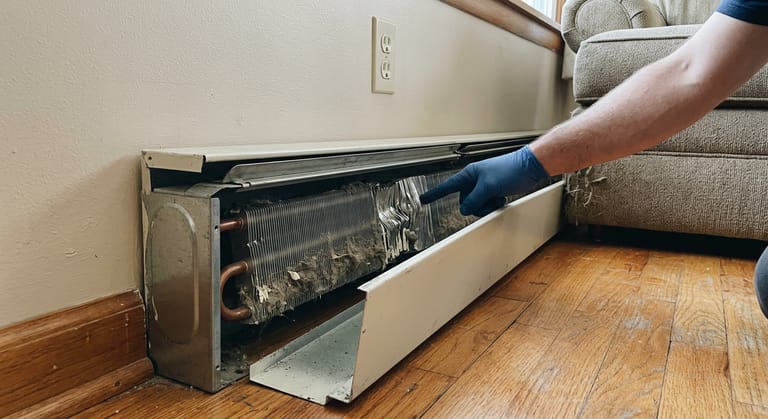
Slant/Fin bases its Fine/Line 30 ratings on 3/4 inch nominal copper tubing carrying unpainted aluminum fins spaced 55 to the linear foot, moving room air by convection alone.
A vacuum cleaner, a tight cover or a bookcase against the outlet takes output away without breaking anything. Slant/Fin rates that element at 580 BTU/hr per linear foot at 180 degrees F average water, 1 GPM and 65 degrees F entering air, on active finned length 5 to 6 inches shorter than the enclosure and including a 15 percent heating effect factor. Crushed fins are not in that measurement.
Looking and straightening are yours. Whether a corroded element has fin left to give is judged on site, and (800) 555-0163 answers that for nothing.
Fault two: how to fix baseboard heating that dies halfway along the wall
Hot at the start, cold two thirds of the way down, is a flow story, not a failed part. Work it in this order.
- Air first. Caleffi describes manual air vents as small valves threaded into 1/8 inch or 1/4 inch FPT tappings, opened with the tip of a screwdriver or a square key, and commonly installed at every emitter's high point. On a baseboard loop that high point is often a riser, not the enclosure.
- Flow second. A footnote on Slant/Fin's Fine/Line 30 chart settles which output column a run may use. The 4 GPM figures are off limits unless flow in that branch is known to be that high, and everything short of it reads off the 1 GPM column. A half closed balancing valve can leave a branch below the column its output was picked from.
- Water temperature third. On that chart at 1 GPM, output reads 580 BTU/hr per foot at 180 degrees F, 380 at 150 and 320 at 140, with the 140 degree row derived by factor rather than measured. Cooler water gives a warm run, not a hot one.
Venting order and the gauge reading afterward sit on bleeding a hydronic loop without dropping system pressure. A vent key is homeowner work; air back every few weeks is not, and nothing is charged for asking.
Fault three: ticking, gurgling, and noise that is not baseboard at all
Ticking that starts a minute after the burner and fades once the loop warms is copper growing against the cradles inside the enclosure. Not damage. It gets loud where a cover has been screwed onto the element or a hanger has lost its glide.
Gurgling is another animal: water and air arriving together. Caleffi lists what air does to a hydronic heating system, beginning with noises in the piping and heat emitters that annoy occupants, then inadequate circulator flow, poor heat transfer where surfaces are not wetted, and complete loss of flow behind a large air pocket.
Banging or a kettle sound from the basement is a boiler noise in a baseboard costume, sorted out on what a given boiler noise means.
Fault four: a wet floor under the end cap
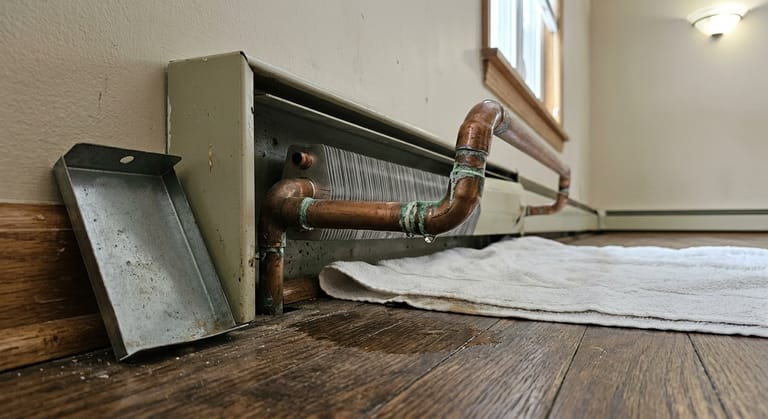
Baseboard leaks show up in three places: the fitting under an end cap where the element meets the loop, the stem of a valve on a run with its own shutoff, and the element itself, thin drawn copper that can pinhole.
Table M2101.1 of the 2021 IRC lists copper and copper alloy tubing in Types K, L and M among approved hydronic piping materials, and the governing edition is whichever the state has adopted. Where a length is repiped, M2101.10 requires a hydrostatic test at half again the design pressure the system is rated for, with 100 psi as the floor, held a quarter hour: an acceptance test for new or altered work, not a diagnostic.
Shutting a valve and putting a towel down is yours. Opening a soldered joint beside a finished floor is not, and a licensed heating contractor answers (800) 555-0163 on a January night.
Talk to someone who sees these boilers every week
Call (800) 555-0163Free to dial. Whoever answers works on boilers and holds whatever license or registration your state requires.Partner contractors who work on boilers and hydronic systems- Contractors who work on boilers, not just furnaces
- Answered at 2 a.m. in January
- Dialing costs nothing and books nothing
- The price is the contractor's own, set with you
Fault five: baseboard heater repair that is really a boiler fault
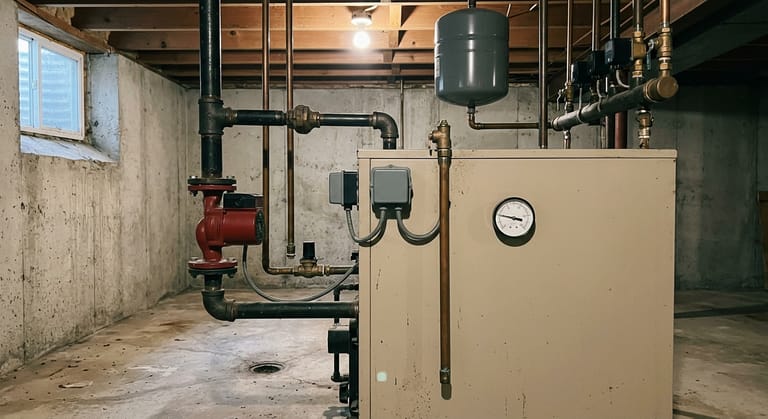
When every run is cool, stop opening covers and read two instruments.
The gauge first. Weil-McLain's CGa Series 3 manual puts the typical cold water fill for a residential system at 12 psi, correct pressure varying with the application, while its own user manual sets the owner's limit at 24 psig on a water boiler, reading anything past it as a tank or instrument problem.
Then the pump. Taco rates its 007 cartridge circulator at 0 to 23 GPM and 0 to 10 feet of head, and its 007-IFC, with the flow check built in, lower on both. A stalled one moves nothing, and every foot of finned copper goes quiet with it. HomeGuide's boiler service page, dated July 14, 2025, prices a boiler circulating pump replacement at $300 to $1,100.
Stalls, weeping flanges and bearing whine sit on what a failing circulator does; a system that will not fire at all is on a boiler that will not start on a cold morning.
Reading a gauge is free. Gas trains, oil burners and boiler wiring are not owner work, and a gauge figure given over (800) 555-0163 often settles a visit before it starts.
Repair or replace the run
Baseboard heating repair stops paying once the element itself is the problem, and the question turns from how to fix a baseboard heater to whether the run comes out. No aggregator prices hydronic baseboard by the foot, so quotes come per run. What is published: HomeGuide's baseboard page, dated July 7, 2025, puts a hydronic baseboard heater at $430 to $1,200 installed, or $180 to $320 for the unit alone, with HVAC contractor labor to install baseboard heaters at $75 to $150 an hour.
Cast iron baseboard changes the arithmetic. Governale rates its Gov-Board at 480 BTUH per linear foot at 180 degrees F average water with 500 lb/hr of flow, which the same page states is 1 GPM, on active length equal to total length. Swap one for the other and the room's output moves.
How the loop works sits on hot water baseboard heating explained end to end; the replacement decision is on when a run is worth replacing instead.
Who fixes baseboard heating, and what a call covers
Both trades touch it and the rates differ. For radiator work HomeGuide, on a page bylined September 1, 2023, puts plumbers at $45 to $150 an hour and HVAC repair technicians at $75 to $150, with a call-out fee of $50 to $200 covering the first hour.
The trade labels are not decoration. Ohio's licensing board, for one, issues a hydronics license as its own class beside HVAC, plumbing and refrigeration, though those state licenses cover commercial work. Fin tube is the last few feet of a boiler loop, so the wrench belongs to whoever works the boiler feeding it. A search for baseboard heating repair near me returns both trades and a handyman or two; the one worth booking asks what the gauge reads and whether the burner is firing.
Calls placed through (800) 555-0163 reach a licensed heating contractor, through the season and after hours. Dialing is free and books nothing.
Where the checklist stops
Third comes a relief valve that has started to discharge. Watts allows the 174A series exactly one job, emergency safety relief, and rules out any use of it as an operating control. Never cap, plug or valve off a discharging relief valve. ICC's Building Safety Journal explains that a discharge line may not end in a threaded connection precisely because a thread is what a cap screws onto. Weil-McLain's user manual gives weeping two readings, one per boiler: on hot water, an expansion tank that has stopped doing its job; on steam, a limit set too high. Either reading goes to a qualified service technician immediately.
The rest divides cleanly. Lifting a cover, combing fins, opening a damper, venting a high point and reading a gauge open nothing fired or wired, and a good share of baseboard heating repair ends inside that free half. Soldered joints, circulator swaps, gas valves and control wiring sit on the other side, where (800) 555-0163 reaches a heating contractor who sees these loops weekly.
Talk to someone who sees these boilers every week
Call (800) 555-0163Free to dial. Whoever answers works on boilers and holds whatever license or registration your state requires.Partner contractors who work on boilers and hydronic systems- Contractors who work on boilers, not just furnaces
- Answered at 2 a.m. in January
- Dialing costs nothing and books nothing
- The price is the contractor's own, set with you