
Hot Water Baseboard Heater Replacement, Run by Run
Straight to it
- HomeGuide prices one hydronic baseboard heater at $430 to $1,200 with installation, or $180 to $320 for the unit alone, on a page dated July 7, 2025.
- No cost publisher prices hydronic baseboard by the linear foot. HomeGuide prices a unit and an hour of labor, so any per foot average is somebody's division.
- Length is the spec that matters. The Fine/Line 30 element carries 580 BTU/hr for every finned foot at 180 degrees F and 1 GPM, and bare pipe inside the enclosure carries none of it.
- New and altered hydronic piping gets a pressure test before it hides: the 2021 IRC asks at M2101.10 for 1.5 times the system's maximum design pressure, with a floor of 100 psi, held a quarter hour.
- Michigan is explicit about who may do the work: a mechanical contractor licensed in the hydronic heating and cooling classification, with an exemption for an owner who occupies the single family home.
Hot water baseboard heater replacement runs $430 to $1,200 per unit with installation, HomeGuide's figure for a hydronic baseboard heater on a page dated July 7, 2025. The same page puts the unit alone at $180 to $320. Wall length and access set the invoice, not the shiny cover.
One boundary first, because the search term is shared: the subject here is hot water (hydronic) heat, where the element carries boiler water. Electric baseboard is wired to a circuit and belongs to an electrician.
What the published prices actually cover
A hot water baseboard heater replacement quote is assembled from a few published numbers, and only one of them is the part itself.
| Line | Published figure | Source and date |
|---|---|---|
| Hydronic baseboard heater, with installation | $430 to $1,200 | HomeGuide, July 7, 2025 |
| Unit alone, no labor | $180 to $320 | Same HomeGuide page |
| HVAC contractor labor | $75 to $150 per hour | Same HomeGuide page |
| Permit, where one is pulled | $60 to $600 mechanical, $50 to $400 plumbing | Fixr, August 29, 2025 |
Five reasons a run gets pulled instead of patched
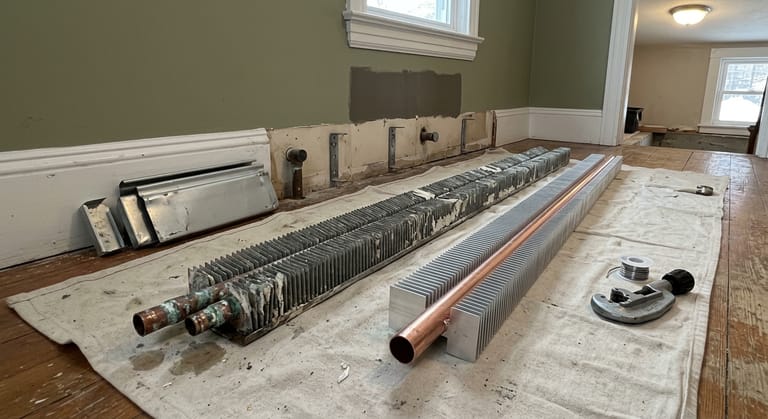
Corrosion inside the element comes first. Fins that crumble when combed, or copper weeping at a soldered joint, end the repair conversation; a bent fin or a stuck damper does not, and those live on what goes wrong with a baseboard run.
Second is a room that was never warm. Caleffi shows why with one figure: the same 20,000 BTU/hr leaves 31 feet of baseboard at 180 degrees F, or 111 feet of it at 120 degrees F. Third is a planned boiler change, since Caleffi also states that the greater the emitter surface area, the lower the supply water temperature needed for a given rate of heat transfer.
Fourth is the remodel, when flooring, a moving wall or new cabinets land where the enclosure sits. Fifth is age arriving at once: RECS 2020 counted 4.02 million homes with a steam or hot water system built before 1950, and 6.79 million Northeast homes whose main heating equipment was 20 years old or more.
Feeling both pipes at a cold run and lifting the cover are yours. Whether the element has fin left to give is judged on site, and (800) 555-0163 is free to dial, and a licensed heating contractor answers.
Deciding the length before ordering anything
Output is rated per foot, always at a stated water temperature and flow. The Fine/Line 30 element from Slant/Fin gives 580 BTU/hr for each finned foot at 180 degrees F average water, 1 GPM and air entering at 65 degrees F; the same maker's Base/Line 2000 element gives 570 in the same column. Two products, two numbers, never averaged.
Three conditions ride with those ratings. Output counts only active finned length, some 5 to 6 inches shy of the enclosure. A 15 percent heating effect factor is already inside the figure. And the chart sets its own flow rule: "Use 4 gpm ratings only when flow is known to be equal to or greater than 4 gpm; otherwise, 1 gpm ratings must be used."
Cast iron baseboard is a different number entirely. Governale publishes 480 BTUH per linear foot for its Gov-Board at 180 degrees F, at 500 lb/hr of flow, which its own page equates to 1 GPM, and it rates on active length, which it states equals total length. Sizing is worked through on how the system delivers heat by the foot.
Baseboard heating installation, step by step
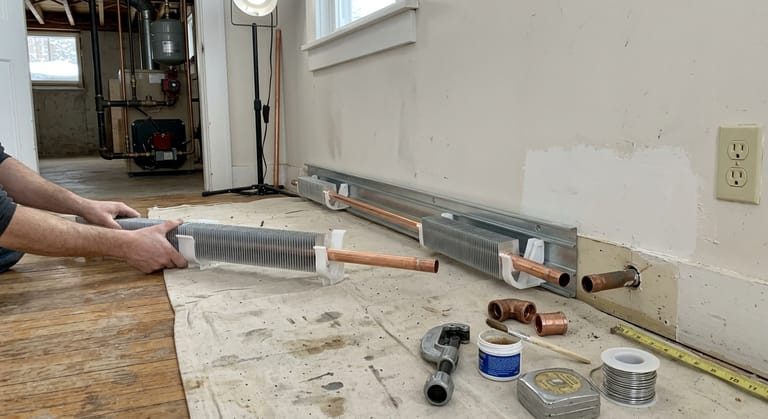
Baseboard heater installation on an existing loop is a plumbing sequence with a test at the end, whether one length or a whole zone changes.
- Settle the length from a room by room heat loss and the water temperature the boiler runs, not from the size of the old one.
- Shut the heat off and isolate the section. Isolation at the appliance is code: the 2021 and 2024 IRC both require at M2001.3 that every boiler carry a shutoff on both the supply and the return.
- Drain the section, cut out the old element, and keep the enclosure if covers and end caps are straight.
- Set the new element on its brackets with room to move, and connect in an approved material: 2021 IRC Table M2101.1 lists copper types K, L and M, PEX, PE-RT and steel among them.
- Pressure test before anything is closed up. The 2021 IRC at M2101.10 asks for a hydrostatic test at 1.5 times the system's maximum design pressure, with a floor of 100 psi, held a quarter hour, as acceptance of new or altered work. Your state's adopted edition governs.
- Refill and purge. Weil-McLain's manual calls 12 psi typical for a residential cold fill and says correct pressure varies by application; its user manual holds the owner to 24 psig at the gauge.
- Bring the zone up, vent the high points, and check that the far end heats.
Talk to someone who sees these boilers every week
Call (800) 555-0163Free to dial. Whoever answers works on boilers and holds whatever license or registration your state requires.Partner contractors who work on boilers and hydronic systems- Contractors who work on boilers, not just furnaces
- Answered at 2 a.m. in January
- Dialing costs nothing and books nothing
- The price is the contractor's own, set with you
Installing baseboard heating in a basement
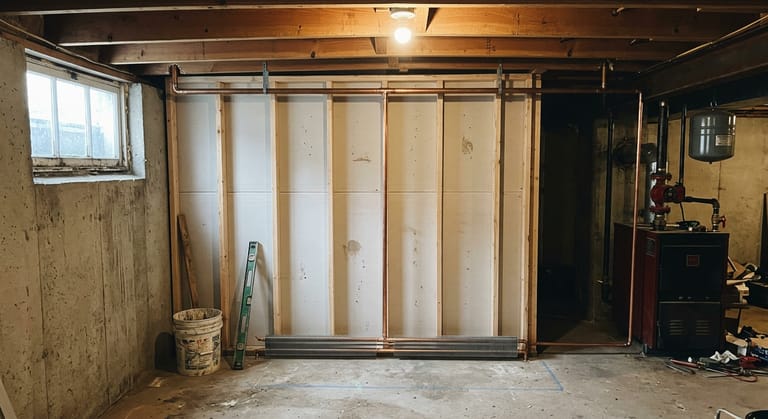
A finished basement is where a new zone usually gets added: the loop already runs overhead in the joists. Two questions decide it: whether the boiler has output left for the load, and whether the circulator and controls can carry another branch. Taco's 007 cartridge circulator is published at 0 to 23 GPM and 0 to 10 feet of head, and a Resideo V8043 zone valve swings open or shut in 15 seconds maximum.
How to install vinyl flooring under baseboard heating
The enclosure is a cover, not the heater. Front panels and end caps unclip from brackets fastened to the wall, so the floor runs beneath them while the finned element and its piping stay put.
Two rules keep the heat working afterward. Air enters low and leaves at the top, so plank ends and transition strips must not seal the intake slot along the floor. And the element stays free to expand, which rules out adhesive or underlayment wedged against it. Where the pipe itself is in the way, that is a soldered joint beside a finished floor, and cheaper to settle before the flooring goes down.
Panel radiators, cast iron and the other swaps
Keeping fin tube
- Cheapest published path, at the prices in the table above.
- Piping stays put, so wall and floor are barely disturbed.
- Output per foot is published at stated conditions.
Changing emitter type
- Hydronic radiators are priced at $350 to $1,700 per unit installed on HomeGuide's radiator page, bylined September 1, 2023.
- Fixr, on January 31, 2025, lists a plumbed cast iron radiator at $200 to $700 for the unit and a stainless one at $200 to $1,000, with 3 to 4 hours of labor at roughly $200 an hour.
- Water volume changes: on Amtrol's EXTROL PRO chart, computed for a 15 psig fill and 180 degrees F average, 50,000 BTU/hr of net output needs an EX-15PRO behind finned tube but an EX-30PRO behind cast iron.
Panel and column units buy back wall space, and what an old cast iron run is worth is weighed on what cast iron radiation delivers. Danfoss states its RA 2000 valves regulate flow through radiators, baseboards and convectors on hot water systems, rated to 250 degrees F, so room by room control suits either.
Going to the floor is another budget. HomeGuide puts hydronic floor heating at $7 to $17 per square foot without new flooring on September 24, 2025, and says a retrofit costs 50 to 80 percent more than new construction. That comparison sits on how radiant floors are built and what the square foot prices include.
Do the emitters first or the boiler first
Sequence saves money. If the appliance is near the end of its life, baseboard length and the water temperature it will run at belong in the same conversation as the new unit: by the Caleffi principle above, a shorter run needs hotter water for the same output. Pricing by fuel and efficiency class is on what a new boiler costs installed.
Where a homeowner should stop
Measuring the wall, lifting a cover, opening a damper and reading the pressure gauge cost nothing and rule things in or out. Cutting into a live loop, soldering beside a gas fired appliance, moving a circulator or touching burner and control wiring belongs to a licensed contractor, and which license that is depends on the state.
(800) 555-0163 costs you nothing, commits you to nothing, and hands the baseboard question to a licensed heating pro who can say whether it needs replacing at all.
Talk to someone who sees these boilers every week
Call (800) 555-0163Free to dial. Whoever answers works on boilers and holds whatever license or registration your state requires.Partner contractors who work on boilers and hydronic systems- Contractors who work on boilers, not just furnaces
- Answered at 2 a.m. in January
- Dialing costs nothing and books nothing
- The price is the contractor's own, set with you